
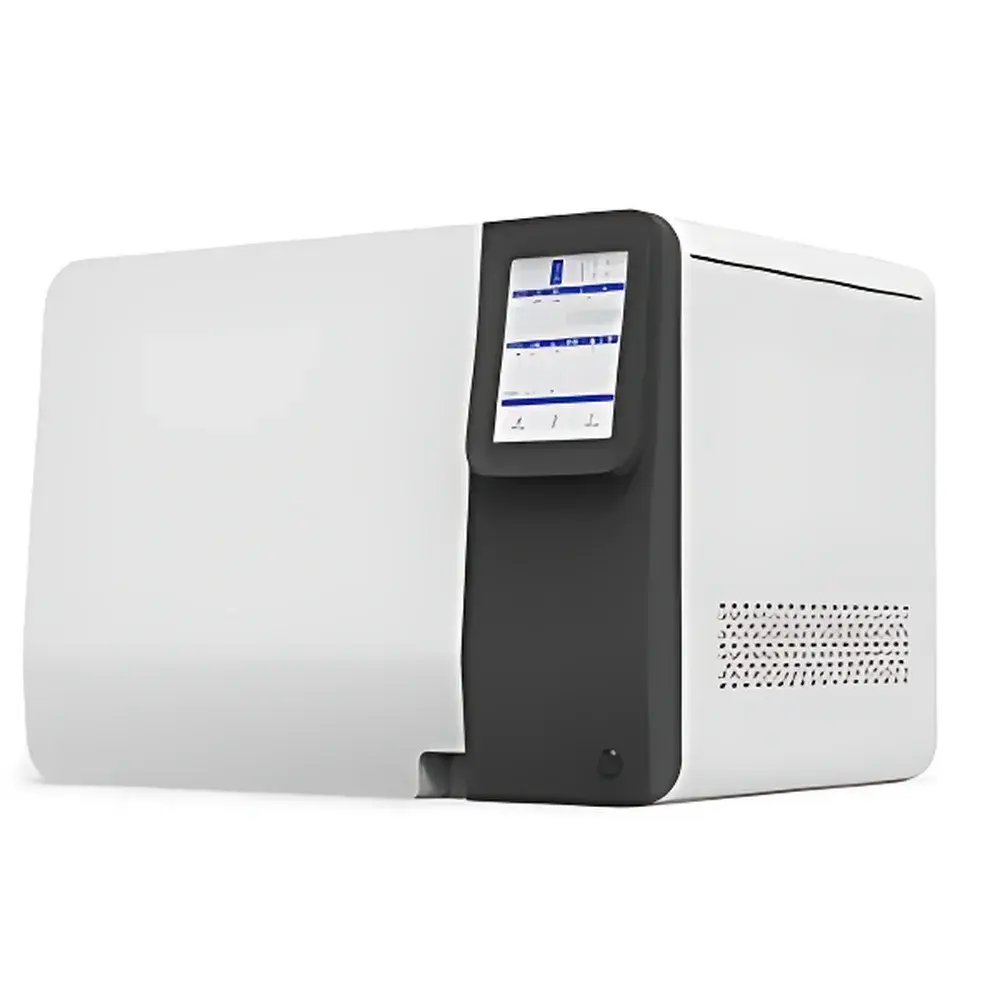
YOKE GC-7860 Networked Gas Chromatograph
| Brand | YOKE |
|---|---|
| Origin | Shanghai, China |
| Manufacturer Type | Direct Manufacturer |
| Instrument Type | Laboratory Gas Chromatograph |
| Model | GC-7860 |
| Temperature Control Range | 4 °C above ambient to 450 °C |
| Ramp Rate | 0.1–80 °C/min |
| Cooling Rate | 260 °C to 50 °C in ~6 min |
| Carrier Gas Flow Control Precision | 0.01 mL/min (sccm) |
| Carrier Gas Pressure Control Precision | 0.01 kPa |
| EPC Support | Yes (N₂, H₂, Air, He, Ar) |
| Detection Modes | FID, TCD, ECD, FPD, NPD, uTCD, HTCD, PDHID, PID, AID |
| Column Oven Programmability | 23-stage ramp, 1 °C increment, ±0.01 °C stability |
| Connectivity | Ethernet (IEEE 802.3), MODBUS TCP, DCS integration capable |
| User Interface | 8-inch capacitive touchscreen |
| External Events | 6 inputs / 2 outputs |
| Sample Introduction Options | Split/splitless, packed column, valve injection, auto-liquid sampler, headspace, thermal desorption, purge-and-trap, pyrolysis |
Overview
The YOKE GC-7860 is a network-enabled, fully digital laboratory gas chromatograph engineered for precision, reproducibility, and operational flexibility across diverse analytical environments. Based on the fundamental principle of gas-phase separation—where volatile and semi-volatile compounds are partitioned between a mobile gaseous phase (carrier gas) and a stationary liquid or polymer phase coated inside a capillary or packed column—the GC-7860 delivers high-resolution retention profiling through precise thermal and pneumatic control. Its architecture integrates advanced electronic pressure and flow control (EPC), real-time Ethernet-based remote monitoring, and modular detector compatibility to support both routine QC validation and complex multi-dimensional chromatographic workflows. Designed for compliance-critical applications, the system meets foundational requirements for GLP/GMP-aligned laboratories—including audit-trail-capable data handling, parameter locking, and traceable method versioning—when operated with validated software configurations.
Key Features
- Eight independently programmable temperature zones—including oven, up to three detectors, and dual inlet systems—with resolution of 1 °C and stability better than ±0.01 °C.
- High-speed oven ramp capability up to 80 °C/min and rapid cooling (260 °C → 50 °C in ~6 minutes), enabling efficient method development and high-throughput screening.
- Full EPC implementation supporting N₂, H₂, Air, He, and Ar; pressure range 0–0.6 MPa, flow range 0–500 sccm; control precision ±0.01 kPa / ±0.01 sccm in constant-pressure, constant-flow, or split-mode operation.
- Modular detector bay accommodating up to three simultaneous detectors (FID, TCD, ECD, FPD, NPD, etc.), with configurable signal amplification, polarity switching, and active baseline compensation.
- 8-inch industrial-grade capacitive touchscreen interface with intuitive menu navigation, real-time chromatogram overlay, and direct method editing without PC dependency.
- Network-native design compliant with IEEE 802.3 Ethernet standards; supports remote instrument control, firmware updates, and live status polling via standard TCP/IP infrastructure.
- MODBUS TCP protocol support for seamless integration into distributed control systems (DCS) and SCADA platforms—enabling automated batch reporting, component concentration trending, and alarm-triggered event logging.
Sample Compatibility & Compliance
The GC-7860 accommodates a broad spectrum of sample introduction techniques—including split/splitless injection, on-column, valve-loop, headspace (manual or autosampler-coupled), thermal desorption, purge-and-trap, and pyrolysis—ensuring compatibility with gaseous, liquid, solid, and adsorbed matrices. Its robust thermal management and inert flow path make it suitable for analysis of residual solvents (ICH Q3C), pesticide residues (AOAC 2007.01, EPA 8081B), hydrocarbon speciation (ASTM D1319, D6730), transformer oil dissolved gases (IEC 60567), ethanol in blood (CLIA-waived methods), and volatile organic compounds (VOCs) per ISO 16000-6. The system’s EPC architecture ensures retention time reproducibility <0.05% RSD (n=10), meeting ASTM E260 and ISO 17025 method validation prerequisites. When deployed with 21 CFR Part 11-compliant chromatography data systems (CDS), it supports electronic signatures, audit trails, and secure user role assignment for regulated pharmaceutical and clinical labs.
Software & Data Management
Data acquisition and processing are managed via YOKE’s GC-NetWork software suite—a Windows-based application supporting method creation, sequence definition, real-time spectral visualization, peak integration using iterative tangent-skimming algorithms, and customizable report generation (PDF, CSV, XML). Raw data files adhere to ANDI/NetCDF format for long-term archival and third-party reprocessing. The software includes built-in calibration curve tools (linear, quadratic, weighted), system suitability assessment (tailing factor, resolution, plate count), and automatic pass/fail flagging against user-defined acceptance criteria. All method parameters, sequence logs, and audit events are timestamped and digitally signed, satisfying GLP documentation requirements. Remote access is enabled through HTTPS-secured web interface, allowing authorized users to monitor run progress, adjust setpoints, and download results from any location with network connectivity.
Applications
The GC-7860 serves as a primary analytical platform in environmental testing laboratories performing EPA Method 8260D (VOCs in water/soil), 8021B (aromatics), and 624 (purgeables); in food safety labs conducting fatty acid methyl ester (FAME) profiling (AOAC 996.06), pesticide residue screening (EU MRL enforcement), and flavor compound quantitation; in petrochemical QA/QC for gasoline oxygenate analysis (ASTM D4815), hydrocarbon type distribution (D1319), and sulfur content (D5453); and in forensic toxicology for blood alcohol and drug metabolite confirmation (SWGTOX guidelines). Its dual-column/dual-oven configuration also enables heart-cutting and comprehensive two-dimensional GC (GC×GC) coupling when interfaced with appropriate modulators and cryogenic controls.
FAQ
Does the GC-7860 support 21 CFR Part 11 compliance?
Yes—when paired with validated CDS software featuring electronic signatures, audit trail logging, and role-based access control, the GC-7860 meets core technical requirements for Part 11 adherence.
Can the instrument operate unattended for extended periods?
Yes—its networked architecture, internal scheduler, and event-triggered auto-shutdown/restart functionality enable fully autonomous overnight and weekend operation.
What carrier gases are compatible with the EPC system?
Nitrogen, hydrogen, helium, argon, and synthetic air are all supported with full pressure and flow regulation.
Is method transfer possible from legacy GC platforms?
Yes—retention time indexing, linear velocity matching tools, and column dimension normalization utilities simplify migration from Agilent, Shimadzu, or Thermo systems.
How is detector maintenance documented and tracked?
The GC-NetWork software maintains a dedicated detector logbook recording filament usage hours, baseline drift history, sensitivity checks, and calibration certificate references—all exportable for internal QA review.
Related Products





