
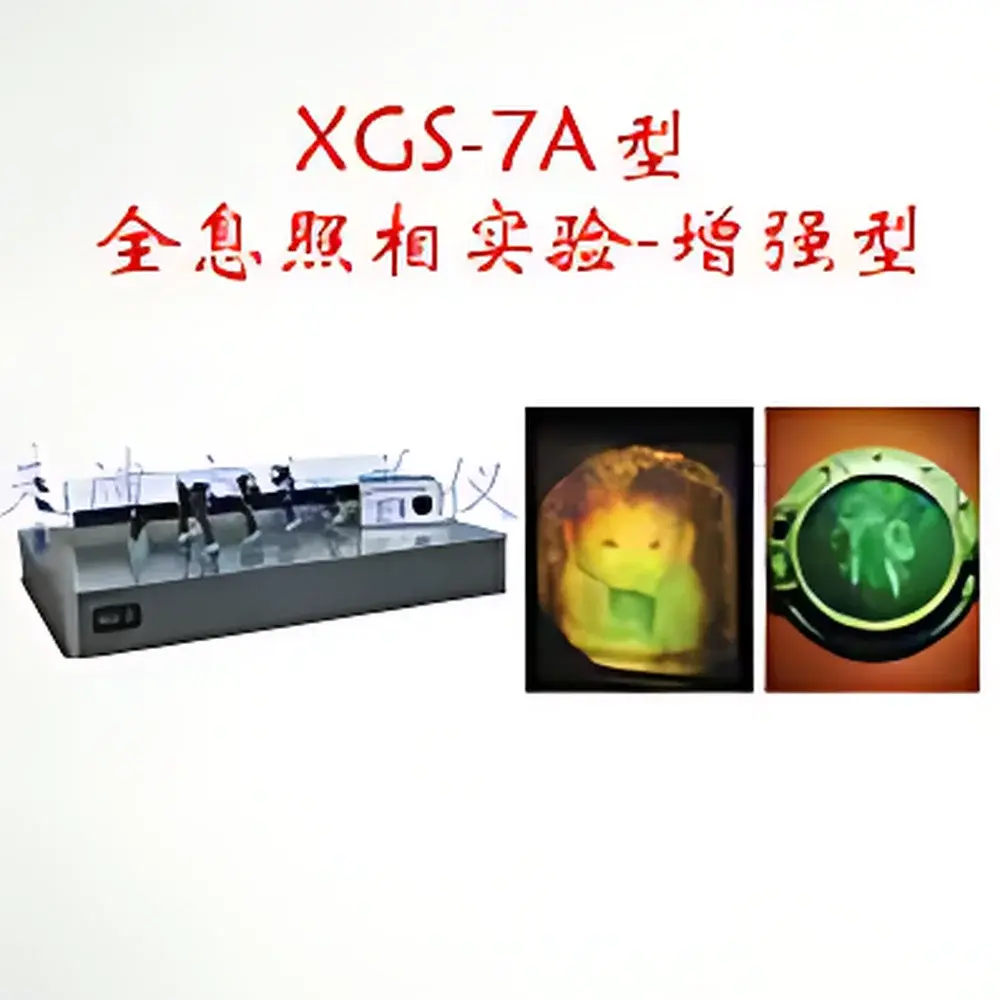
Holography Experiment System – Enhanced Edition (TP XGS-7A)
| Brand | TP |
|---|---|
| Origin | Tianjin, China |
| Manufacturer Type | Manufacturer |
| Country of Origin | Domestic (China) |
| Model | XGS-7A |
| Pricing | Upon Request |
Overview
The TP XGS-7A Enhanced Holography Experiment System is a comprehensive, education- and research-grade optical platform engineered for hands-on instruction and experimental investigation of holographic principles and applications. Built around coherent illumination and high-fidelity interference recording, the system enables precise spatial encoding of amplitude and phase information via optical interference between object and reference beams. It supports both transmission and reflection holography configurations—covering 2D and 3D volume holograms, one-step and two-step rainbow holograms, image-plane holograms, high-density holographic data storage, and holographic grating fabrication. Its dual-medium compatibility (photopolymer and silver-halide dry plates) and flexible optical layout accommodate fundamental pedagogical objectives as well as advanced explorations in wavefront reconstruction, diffraction efficiency optimization, and Bragg selectivity analysis.
Key Features
- Coherent light source: 40 mW He–Ne laser (632.8 nm), rated for ≥10,000 hours of operational lifetime, delivering stable TEM00 mode output with low beam divergence and high spatial coherence.
- Dual recording media support: Pre-sensitized photopolymer dry plates (high sensitivity, ambient-light tolerance, no wet processing) and traditional silver-halide emulsions (high resolution, archival stability, tunable spectral response).
- Controlled exposure environment: Fully functional operation in both darkroom and semi-darkened (red/yellow/green safelight) conditions—enabling safe handling of photosensitive media without compromising exposure fidelity.
- Digital electronic exposure timer: Precision-controlled exposure duration from 0.1 s to 999.9 s; selectable manual trigger or auto-timed mode with LED digital display and audible confirmation.
- Integrated illumination metrology: Compact, handheld lux meter with measurement range of 0.1–200,000 lx and ±4% accuracy (calibrated per ISO/CIE photometric standards), supporting quantitative characterization of ambient and safelight conditions.
- Modular optical bench architecture: Aluminum optical rail (standard 12 mm groove spacing) with kinematic mounts, adjustable beam splitters, mirrors, lenses, and spatial filters—facilitating user-defined optical path design and alignment repeatability.
Sample Compatibility & Compliance
The XGS-7A accommodates standard 10 × 13 cm and 7 × 10 cm holographic dry plates across both photopolymer and silver-halide formats. Plate holders include anti-vibration damping and fine angular adjustment (±5°, 1 arcmin resolution) to ensure optimal fringe contrast during recording. All optical components comply with ISO 10110 surface quality specifications (scratch-dig 60–40), and laser safety interlocks meet Class IIIb requirements per IEC 60825-1:2014. The system supports GLP-aligned documentation workflows when used with optional lab notebook templates and exposure log export functions.
Software & Data Management
While the XGS-7A operates as a hardware-centric analog-optical platform, it integrates seamlessly with third-party imaging and analysis tools. Exposure logs (timestamp, duration, plate type, ambient lux) can be manually recorded or exported via optional USB-connected data logger (TP-DL200). When paired with CCD/CMOS cameras and MATLAB® or Python-based diffraction simulation packages (e.g., PyHolo, HOLOTOOLBOX), users may quantitatively analyze reconstructed wavefronts, diffraction efficiency spectra, and Bragg angle shifts. All accessories—including beam expanders, spatial filters, and collimators—are supplied with traceable calibration certificates compliant with ISO/IEC 17025 guidelines.
Applications
- Undergraduate and graduate optics laboratories: Interference and diffraction fundamentals, coherence length measurement, fringe visibility analysis.
- Holographic interferometry: Quantitative deformation and vibration analysis of mechanical specimens under static/dynamic loading.
- Optical data storage research: Multiplexed angular and wavelength-domain recording schemes for high-capacity volumetric memory prototypes.
- Security and authentication: Fabrication of embossed holograms, kinematic holographic labels, and optically variable devices (OVDs).
- Education in photonics engineering: Alignment training, aberration compensation, and Fourier plane filtering techniques using 4f optical systems.
FAQ
Is the He–Ne laser pre-aligned and thermally stabilized?
Yes—the laser module features integrated temperature-compensated cavity design and factory-aligned output coupler, ensuring long-term pointing stability (< ±5 µrad/hour drift) and minimal mode hopping over extended operation.
Can the system be upgraded for pulsed-laser holography?
The optical bench and mounting infrastructure support integration of Q-switched Nd:YAG lasers (532 nm or 1064 nm) with appropriate harmonic generation and pulse synchronization modules—subject to user-provided safety enclosures and interlock compliance.
Are photopolymer plates supplied with spectral sensitivity curves?
Each batch of TP-branded photopolymer plates includes a certified spectral response chart (350–700 nm, ±2 nm resolution) and recommended development protocols aligned with ISO 6843:2021 for holographic emulsion characterization.
Does the system meet ASTM E284-22 for optical instrumentation terminology and classification?
Yes—the XGS-7A is classified under ASTM E284-22 Section 3.1.11 as a “coherent optical interference demonstration apparatus” and conforms to definitions for holographic recording medium, reference beam geometry, and reconstruction illumination geometry specified therein.



