
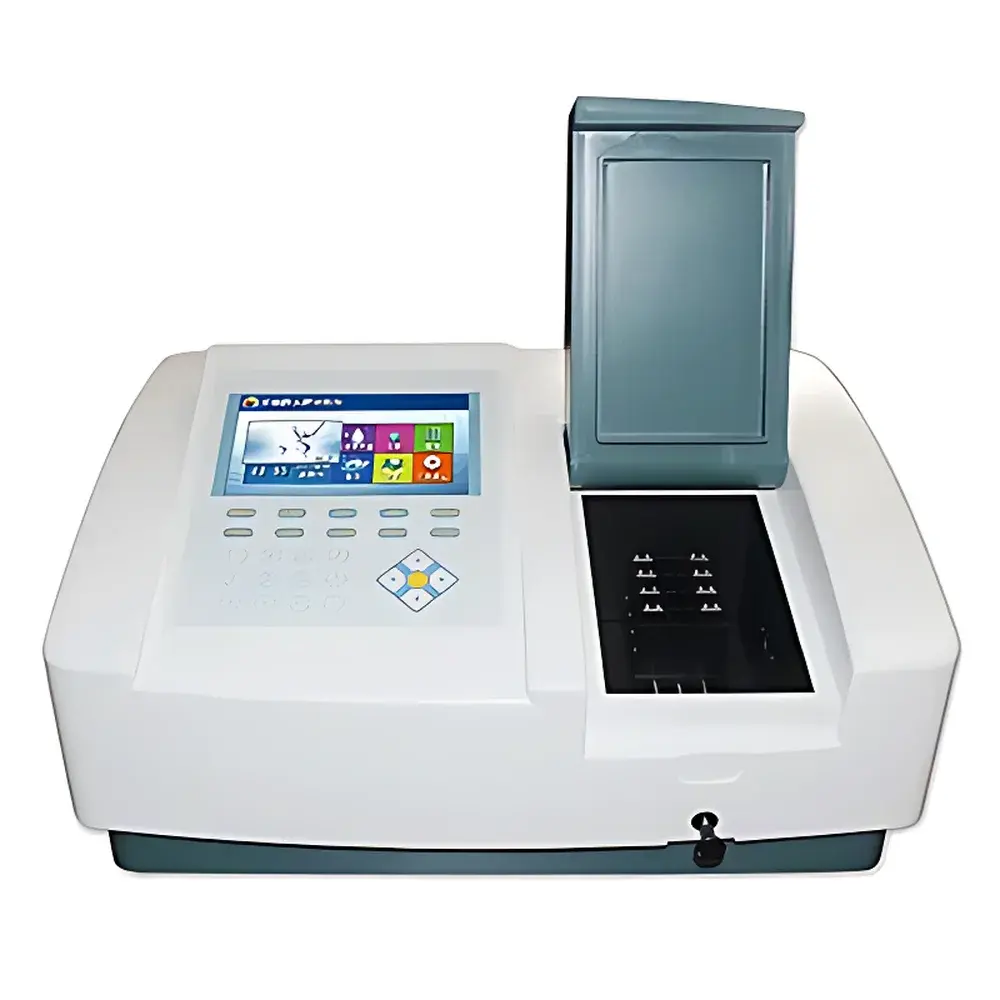
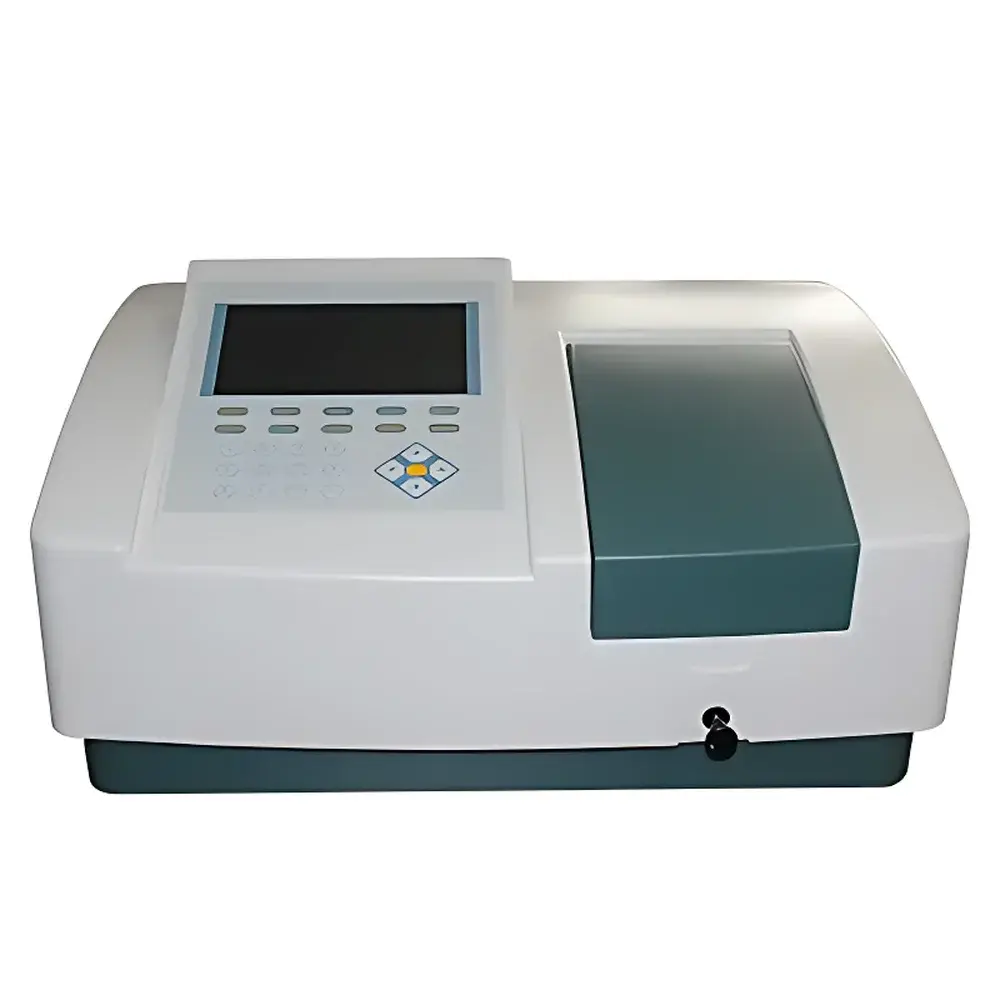
Yoke F-IN Desktop Total Nitrogen Analyzer
| Brand | Yoke |
|---|---|
| Origin | Shanghai, China |
| Manufacturer Type | Manufacturer |
| Product Category | Domestic |
| Model | F-IN |
| Price Range | USD 1,400–2,800 (est.) |
| Measured Parameter | Total Nitrogen (TN) |
| Instrument Type | Laboratory Benchtop Analyzer |
| Measurement Principle | UV-Visible Spectrophotometry (Dual-Wavelength Auto-Switching) |
| Measurement Range | 0.01–100 mg/L |
| Accuracy | ±5% |
| Detection Limit | 0.005 mg/L |
| Calibration Curves | 200 preloaded (5 factory-default + 195 expandable) |
| Data Storage Capacity | 2,000 measurement records |
| Optical Stability | ≤ ±0.002 A / 20 min |
| Batch Processing | 16 samples (standard), up to 25 (optional) |
| Display | 128 × 64 monochrome LCD |
| Interface | USB |
| Operating Voltage | AC 220 V ±10%, 50 Hz |
| Power Consumption | 80 W |
| Compliance | GB/T 11894–1989 (Chinese National Standard for TN determination by alkaline potassium persulfate digestion–UV spectrophotometry) |
Overview
The Yoke F-IN Desktop Total Nitrogen Analyzer is a dedicated laboratory instrument engineered for precise, routine quantification of total nitrogen (TN) in aqueous environmental samples—including surface water, groundwater, wastewater, and effluent streams. It implements the standardized alkaline potassium persulfate oxidation method followed by dual-wavelength ultraviolet spectrophotometric detection (GB/T 11894–1989), ensuring alignment with China’s national regulatory framework for water quality monitoring. The system employs a stable optical path design with automatic dual-wavelength switching (typically 220 nm and 275 nm) to correct for nitrate interference and organic absorbance background, thereby enhancing analytical specificity and reproducibility. Unlike generic spectrophotometers requiring manual method setup, the F-IN integrates digestion-ready sample handling, built-in curve calculation, and direct concentration readout—reducing operator dependency and minimizing procedural variability.
Key Features
- Dual-wavelength UV spectrophotometry with automated wavelength selection for robust interference correction and improved precision.
- Pre-programmed calibration architecture supporting 200 stored curves: 5 factory-verified standard curves and 195 user-expandable curves for method adaptation across diverse matrices.
- Integrated data management: stores up to 2,000 measurement records with timestamp, sample ID, and calibration reference—accessible via on-device navigation or export via USB interface.
- Self-calibration capability: accepts certified standard solutions to automatically compute and save new calibration curves without external software or manual slope/intercept entry.
- Optical stability ≤ ±0.002 A over 20 minutes, meeting performance benchmarks for low-drift quantitative analysis in regulated lab environments.
- Benchtop footprint optimized for ISO/IEC 17025-compliant laboratories; compatible with standard digestion blocks (e.g., Yoke TD-12 or equivalent) for complete TN workflow integration.
Sample Compatibility & Compliance
The F-IN is validated for use with clarified, filtered, or centrifuged liquid samples conforming to GB/T 11894–1989 specifications. It accommodates samples with turbidity ≤ 10 NTU and chloride concentrations < 1,000 mg/L (within digestion protocol limits). While not intrinsically compliant with ISO 11905-1 (Water quality — Determination of nitrogen — Part 1: Total nitrogen after acid digestion), its methodology is functionally equivalent to ISO-aligned UV-based TN protocols when paired with appropriate digestion hardware. The instrument meets CE marking requirements for electromagnetic compatibility (EMC Directive 2014/30/EU) and low-voltage safety (LVD Directive 2014/35/EU). Its firmware supports audit-ready operation under GLP conditions, including user-accessible calibration logs and measurement history with immutable timestamps.
Software & Data Management
No proprietary PC software is required for basic operation—the F-IN operates autonomously with full local control. All calibration, measurement, and data review functions are executed through the onboard 128 × 64 LCD interface with intuitive Chinese-language menus (English firmware version available upon request for international deployment). Measurement data can be exported in CSV format via USB to standard USB flash drives for integration into LIMS or Excel-based QA/QC reporting. The system maintains separate storage partitions for calibration curves and sample results, enabling traceability per ISO/IEC 17025 clause 7.7. Each stored record includes operator ID (manually entered), date/time stamp, measured absorbance values at both wavelengths, calculated concentration, and active curve identifier—supporting 21 CFR Part 11–compatible documentation practices when used within validated workflows.
Applications
- Regulatory compliance testing for municipal and industrial wastewater discharge permits (e.g., China’s “Emission Standards of Pollutants for Municipal Wastewater Treatment Plants” GB 18918–2002).
- Environmental monitoring programs conducted by provincial EPBs and third-party testing labs accredited to CNAS (China National Accreditation Service).
- Research applications in limnology, eutrophication studies, and nutrient cycling assessments where TN serves as a key indicator parameter.
- Process control in water reclamation facilities and denitrification system optimization.
- Educational laboratories requiring a cost-effective, standards-based platform for teaching advanced water chemistry principles and spectrophotometric validation techniques.
FAQ
Does the F-IN include digestion functionality?
No—the F-IN is a dedicated spectrophotometer for post-digestion analysis. Users must perform alkaline potassium persulfate digestion separately using a certified heating block or autoclave prior to measurement.
Can the instrument be calibrated with non-Yoke reagents?
Yes—provided the reagents meet GB/T 11894–1989 purity and stability requirements, the F-IN supports custom calibration using any traceable TN standard solution.
Is English-language firmware available?
Yes—international OEM configurations include English UI firmware and bilingual operation manuals (EN/CN), subject to order specification.
What maintenance is required for long-term optical stability?
Annual verification of lamp intensity and wavelength accuracy using NIST-traceable holmium oxide or didymium filters is recommended; no routine optical alignment is needed due to fixed-path monochromator design.
How does the F-IN handle high-chloride samples?
Chloride interference is mitigated during digestion (via sulfate masking) rather than optically—the instrument assumes proper sample pretreatment per GB/T 11894–1989; users exceeding 1,000 mg/L Cl⁻ should dilute or apply chloride removal protocols pre-digestion.







