
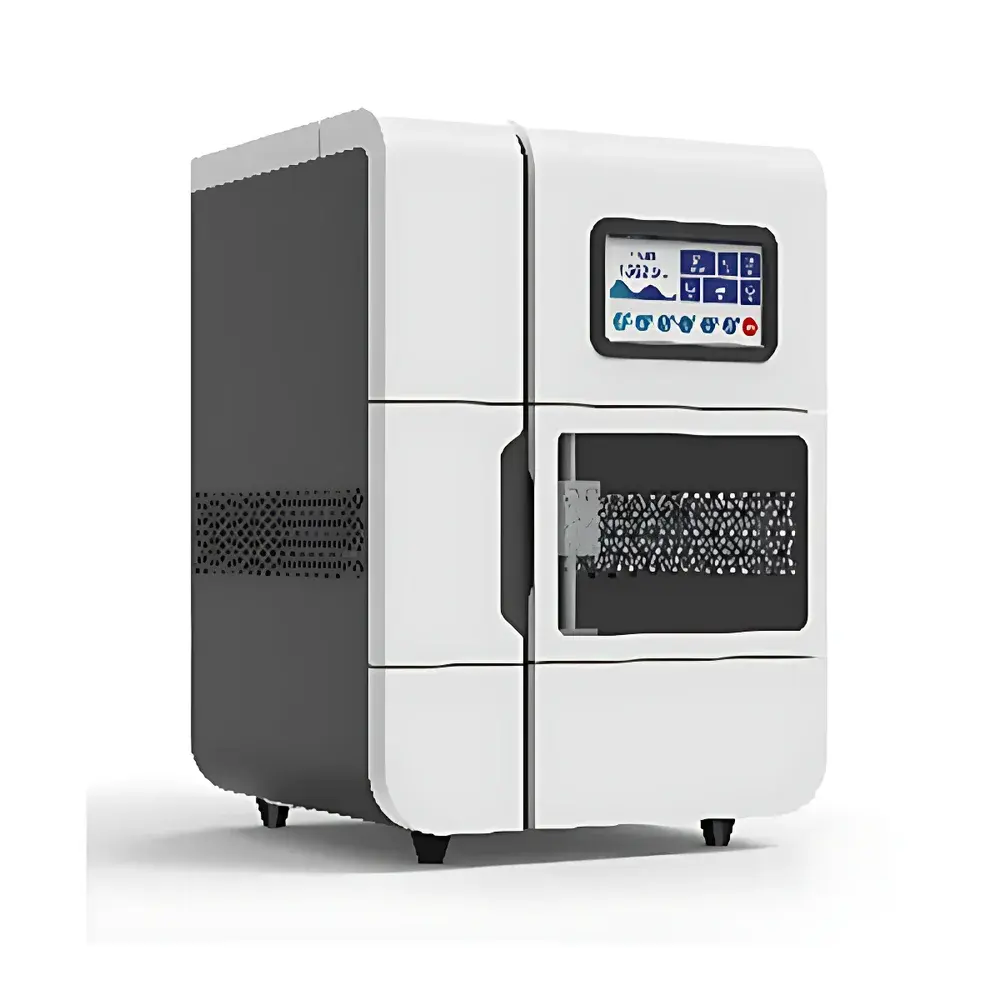
Luban Instruments LIM-4 Fully Automated Multi-Parameter Water Quality Analyzer
| Brand | Yoke (Shanghai Youke Instrument Co., Ltd.) |
|---|---|
| Origin | Shanghai, China |
| Manufacturer Type | Original Equipment Manufacturer (OEM) |
| Instrument Category | Benchtop Laboratory Water Quality Analyzer |
| Detection Parameters | COD, Total Phosphorus (TP), Total Nitrogen (TN), Ammonia-Nitrogen (NH₃-N) |
| Measurement Principle | Spectrophotometric Analysis with Integrated Auto-Digestion |
| Display | 7-inch Capacitive Touchscreen |
| COD Range | 4–10,000 mg/L (segmented) |
| NH₃-N Range | 0–100 mg/L (segmented) |
| TN Range | 0–50 mg/L (segmented) |
| TP Range | 0–20 mg/L (segmented) |
| Compliance | GB/T 11914–1989, HJ 399–2007, HJ 535–2009, HJ 636–2012, HJ 670–2013 |
Overview
The Luban Instruments LIM-4 Fully Automated Multi-Parameter Water Quality Analyzer is an integrated benchtop analytical platform engineered for high-throughput, standardized quantification of key water quality parameters in environmental monitoring laboratories. It implements spectrophotometric detection following standardized chemical digestion protocols—specifically designed to comply with Chinese national standards including GB/T 11914–1989 (COD determination via rapid digestion-spectrophotometry), HJ 399–2007 (COD by dichromate digestion), HJ 535–2009 (ammonia-nitrogen by Nessler’s reagent), HJ 636–2012 (total nitrogen by alkaline potassium persulfate UV digestion), and HJ 670–2013 (total phosphorus by ammonium molybdate spectrophotometry). The system automates sample aspiration, reagent dispensing, timed thermal digestion (up to 165 °C), cooling, colorimetric reaction, absorbance measurement at multiple wavelengths (340–1000 nm), and result calculation—all without manual intervention. Its architecture eliminates inter-operator variability inherent in manual wet-chemistry workflows and ensures method traceability through embedded process logging.
Key Features
- Fully automated sequence execution: From sample loading to final report generation, supporting unattended operation for up to 48 samples per batch.
- Modular parameter configuration: Users select only the required test modules (e.g., COD-only, or full TP/TN/NH₃-N/COD suite), minimizing reagent waste and optimizing assay turnaround time.
- Integrated high-precision digestion block: Peltier-assisted heating and active cooling enable accurate temperature ramping and hold profiles compliant with HJ 636–2012 (UV digestion at 120–124 °C for 30 min) and HJ 399–2007 (165 °C for 10 min).
- 7-inch capacitive touchscreen interface with intuitive icon-driven workflow navigation and real-time status visualization (digestion progress, photometer readiness, error alerts).
- Dual-beam optical path with stabilized tungsten-halogen and deuterium light sources, enabling baseline correction and enhanced photometric stability across extended measurement sessions.
- Onboard calibration management: Supports multi-point calibration curves (linear and quadratic), blank subtraction routines, and automatic dilution factor application for out-of-range samples.
Sample Compatibility & Compliance
The LIM-4 accepts standard 16-mm round glass or quartz digestion tubes (10–25 mL volume) and accommodates raw wastewater, surface water, drinking water pre-treated for turbidity removal, and effluent from municipal and industrial treatment plants. All digestion and detection protocols adhere to the metrological requirements outlined in JJF 1001–2011 (General Terminology and Definitions for Metrology) and are compatible with GLP-aligned laboratory practices. While not certified under ISO/IEC 17025 for accredited testing, the instrument supports audit-ready data export (CSV, PDF) with timestamps, operator ID, and method versioning—facilitating internal QA reviews and regulatory readiness for local environmental agencies.
Software & Data Management
The embedded firmware (v3.2+) provides role-based access control (administrator, analyst, viewer), electronic signature support for critical actions (e.g., calibration validation), and secure local storage of ≥10,000 test records with full audit trail (per ICH GCP and FDA 21 CFR Part 11 principles). Data export includes raw absorbance values, digestion temperature/time logs, and calculated concentrations with uncertainty estimates derived from calibration curve residuals. Optional USB-to-PC synchronization enables integration with LIMS platforms via HL7 or ASTM E1384-compliant flat-file transfer. No cloud connectivity or remote telemetry is implemented—ensuring data sovereignty and alignment with institutional IT security policies.
Applications
- Regulatory compliance monitoring for municipal wastewater treatment plants (WWTPs) reporting to MEP (now MEE) under the “Emission Standards of Pollutants for Municipal Wastewater Treatment Plants” (GB 18918–2002).
- Source water assessment in reservoirs and rivers where simultaneous TN/TP ratios inform eutrophication risk modeling.
- Industrial pretreatment verification for electroplating, food processing, and pharmaceutical manufacturing facilities subject to discharge permits.
- Educational laboratories requiring reproducible, standards-aligned demonstrations of redox chemistry (COD), ligand-complex formation (Nessler’s reagent), and heteropoly blue formation (phosphate molybdenum blue).
- Field-deployable lab support: When paired with portable filtration and pH adjustment kits, the LIM-4 serves as a central analysis node for mobile environmental testing units.
FAQ
Does the LIM-4 support EPA-approved methods such as EPA 410.4 or EPA 365.4?
No—the LIM-4 is validated exclusively against Chinese national standards (HJ and GB series). Method equivalence assessments must be conducted internally per ISO/IEC 17025 Clause 7.2.2 prior to cross-method adoption.
Can the instrument perform simultaneous digestion for all four parameters (COD, TN, TP, NH₃-N)?
No—digestion protocols differ in temperature, duration, and reagent chemistry; the system executes them sequentially within a single run to maintain method fidelity and avoid cross-contamination.
Is external calibration verification required before daily use?
Yes—users must verify photometric accuracy using NIST-traceable neutral density filters and check digestion temperature uniformity with calibrated thermocouples at least once per shift, as specified in the instrument’s SOP documentation.
What maintenance intervals are recommended for long-term reliability?
Daily: Wipe optical windows and rinse fluidic lines with deionized water. Quarterly: Replace digestion block thermal pads and recalibrate temperature sensors. Annually: Full photometer spectral validation and pump tubing replacement.
Does the LIM-4 generate reports compliant with China’s “Environmental Monitoring Technical Specifications” (HJ 168–2020)?
Yes—report templates include mandatory fields: sampling date/location, analyst ID, method reference, detection limit declaration, and QC spike recovery data (if enabled), satisfying HJ 168–2020 Section 5.3.2 requirements.
Related Products







