
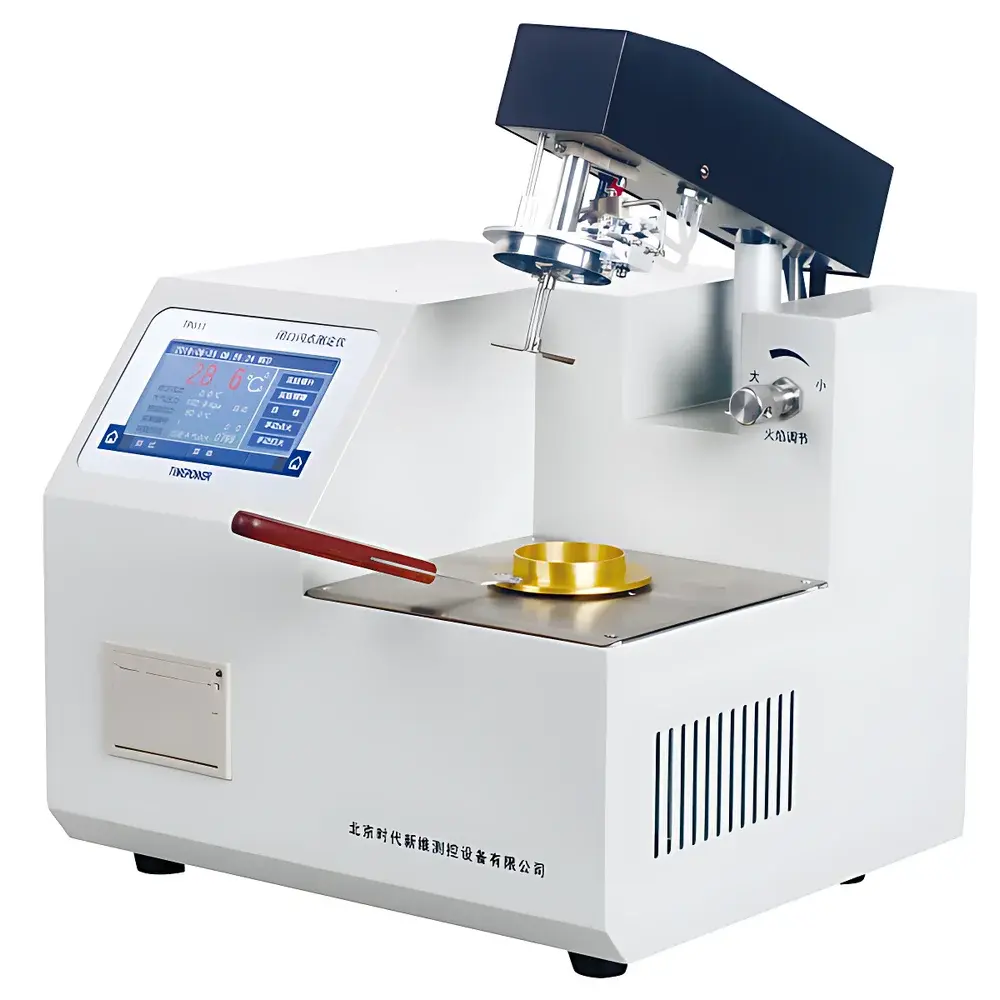
Timepower TP611 Automated Closed-Cup Flash Point Tester
| Brand | Timepower |
|---|---|
| Origin | Beijing, China |
| Manufacturer | Timepower |
| Country of Origin | China |
| Model | TP611 |
| Detection Method | Closed-Cup (ASTM D93 / GB/T 261 compliant) |
| Measurement Range | 40–370 °C |
| Accuracy | ±1 °C for flash point <110 °C |
| Repeatability | ≤2 °C |
| Resolution | 0.1 °C |
| Ambient Temperature | 5–40 °C |
| Relative Humidity | ≤85% RH |
| Display | 260k-color TFT LCD (480×272) |
| Cooling | Integrated forced-air cooling |
| Printer | Thermal, 36-character Chinese/English output |
| Power Supply | AC 220 V ±10%, 50 Hz ±10% |
| Power Consumption | ≤500 W |
| Dimensions | 350 × 310 × 300 mm |
| Weight | 13.5 kg |
Overview
The Timepower TP611 Automated Closed-Cup Flash Point Tester is a precision-engineered instrument designed for fully automated determination of the closed-cup flash point of petroleum products, lubricants, biodiesel blends, and related hydrocarbon-based liquids. It operates in strict accordance with internationally recognized test standards—including ASTM D93 (Standard Test Method for Flash Point by Pensky-Martens Closed Cup Tester) and GB/T 261 (Chinese national standard equivalent to ISO 2719)—ensuring regulatory alignment for laboratories engaged in quality control, safety assessment, and product certification across oil & gas, power generation, chemical manufacturing, and customs inspection sectors. The instrument employs the Pensky-Martens closed-cup principle: a precisely controlled heating ramp raises the sample temperature while continuous stirring ensures thermal homogeneity; at the onset of vapor ignition—detected optically or via flame-sensing circuitry—the system records the lowest temperature at which a momentary flash occurs above the liquid surface under defined atmospheric conditions. This thermodynamic endpoint serves as a critical indicator of volatility, fire hazard classification, and transport compliance (e.g., UN GHS Category 1–4, IMDG Code Class 3).
Key Features
- Fully automated operation sequence: cup positioning, temperature ramping, stirrer activation, ignition source deployment, flash detection, data logging, thermal shutdown, and arm retraction—all executed without manual intervention.
- Dual ignition mode selection: configurable switching between pressurized liquefied petroleum gas (LPG) flame scanning and solid-state electronic spark ignition—enabling method flexibility and eliminating dependency on external gas supply where infrastructure is constrained.
- Real-time atmospheric pressure compensation: integrated barometric sensor adjusts flash point calculation per ASTM D93 Annex A1, correcting for local elevation effects and ensuring traceable, standardized results.
- Intelligent thermal management: PID-controlled heating element maintains programmable ramp rates (e.g., 1–2 °C/min per ASTM D93); over-temperature cutoff (<400 °C) prevents sample degradation and enhances operator safety.
- Self-diagnostic firmware: continuous hardware status monitoring (ignition circuit integrity, stirrer motor response, temperature sensor linearity, cup position encoder feedback) reports fault codes on the 260k-color TFT display for rapid troubleshooting.
- High-resolution thermal sensing: platinum RTD sensor with 0.1 °C digital resolution and NIST-traceable calibration path supports GLP-compliant documentation requirements.
Sample Compatibility & Compliance
The TP611 accommodates standard ASTM D93/GB/T 261 test cups (typically 60–70 mL capacity) and is validated for use with mineral oils, transformer oils, turbine oils, diesel fuels, kerosene, crude oil fractions, and synthetic ester-based lubricants. It excludes highly volatile solvents (e.g., gasoline, acetone) requiring open-cup methods (ASTM D56). Instrument design conforms to IEC 61010-1 (safety requirements for electrical equipment) and meets electromagnetic compatibility (EMC) criteria per EN 61326-1. Data integrity complies with principles outlined in FDA 21 CFR Part 11 when paired with Timepower’s optional audit-trail-enabled software package—supporting electronic signatures, user access levels, and immutable result archiving.
Software & Data Management
While the TP611 operates as a standalone unit with embedded firmware, optional PC connectivity (RS-232 or USB-to-serial) enables integration with Timepower’s FlashLab™ desktop application. This platform provides real-time graphing of temperature vs. time profiles, automatic pass/fail evaluation against specification limits (e.g., ASTM D93 pass threshold ≤60 °C for Class II flammable liquids), batch report generation (PDF/CSV), and export to LIMS environments. All measurements include metadata stamps: operator ID, ambient pressure, test date/time, cup ID, and calibration certificate expiry—facilitating ISO/IEC 17025 accreditation audits.
Applications
- Power utilities: Routine flash point verification of insulating oils to detect contamination (e.g., solvent ingress, thermal cracking byproducts) per IEEE C57.106 guidelines.
- Petrochemical QC labs: Release testing of finished distillates against refinery specifications and international trade contracts (e.g., ASTM D975 for diesel fuel).
- Third-party inspection agencies: Certification of imported/exported petroleum products under China’s AQSIQ import licensing regime or EU REACH substance registration dossiers.
- Research institutions: Screening oxidative stability of biofuels under accelerated aging protocols where flash point depression signals early degradation.
- Aviation maintenance depots: Monitoring hydraulic fluid integrity in ground support equipment per SAE AS5780 requirements.
FAQ
What standards does the TP611 comply with?
It is fully compliant with ASTM D93 (Method A and B), GB/T 261, and ISO 2719. Optional firmware updates may extend support to IP 34 and DIN 51758 upon customer request.
Can the instrument operate without an LPG gas supply?
Yes—electronic spark ignition mode eliminates the need for external gas cylinders, making it suitable for laboratories with restricted gas handling permits or mobile field deployments.
Is calibration verification traceable to national standards?
Each unit ships with a factory calibration certificate referencing NIM (National Institute of Metrology, China) standards; users may perform intermediate verifications using certified reference materials (e.g., n-decane, flash point 60.5 °C ±0.5 °C).
How is ambient pressure measured and applied?
An onboard absolute pressure transducer samples local atmospheric pressure before each test cycle and applies correction per ASTM D93 Section 10.2.1, ensuring accuracy across altitudes from sea level to 3,000 m.
What maintenance is required for long-term reliability?
Daily cleaning of the test cup and ignition electrode with lint-free cloth and analytical-grade acetone; quarterly verification of stirrer speed and thermal ramp rate using calibrated reference thermometer; annual full-system calibration recommended.




