
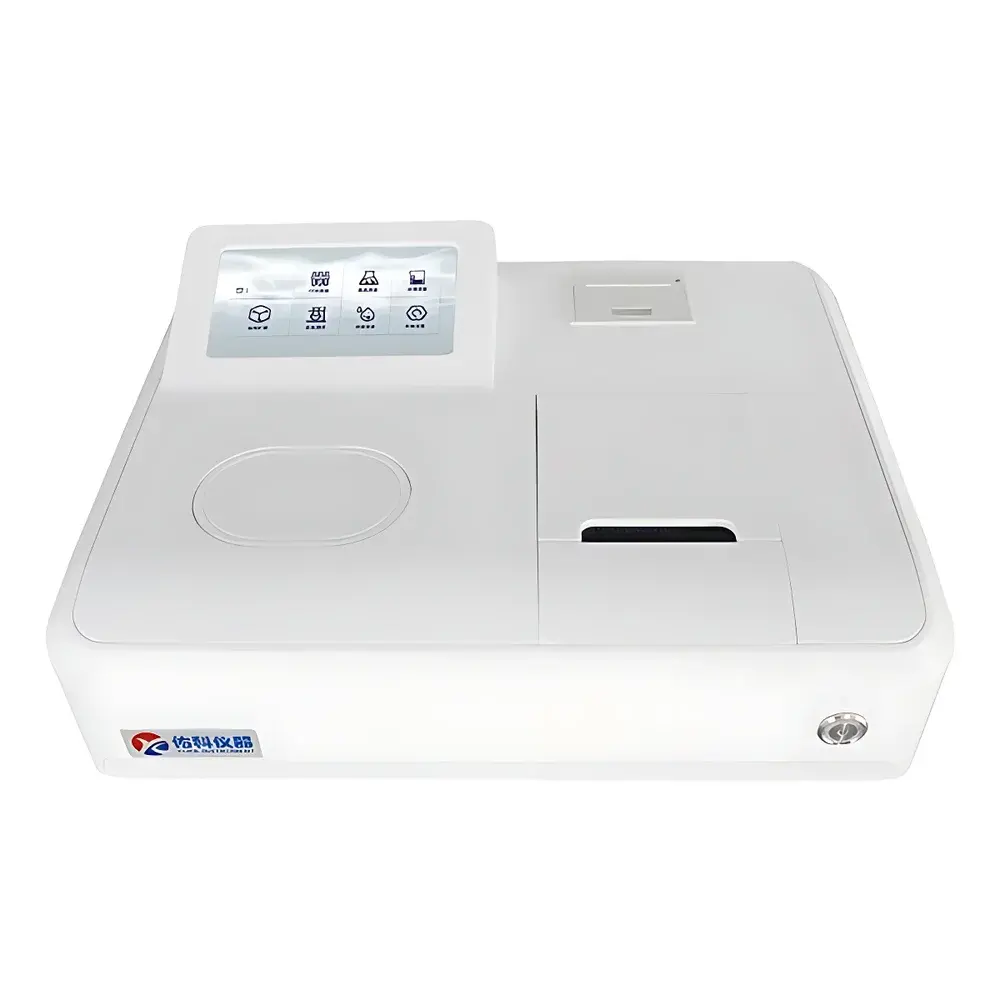
Yoke L3 IoT-Enabled Visible Spectrophotometer
| Brand | Yoke |
|---|---|
| Origin | Shanghai, China |
| Manufacturer Type | Direct Manufacturer |
| Regional Classification | Domestic (China) |
| Model | L3 |
| Price Range | USD 700–1,400 |
| Optical Design | Pseudo-Double-Beam |
| Detector | Photodiode Array (PDA) |
| Wavelength Range | 320–1100 nm |
| Automation Level | Motorized Wavelength Scanning |
| Spectral Bandwidth | 4 nm (2 nm optional) |
| Wavelength Accuracy | ±1 nm |
| Stray Light | ≤0.1% T |
Overview
The Yoke L3 IoT-Enabled Visible Spectrophotometer is a precision optical instrument engineered for routine quantitative and qualitative analysis in visible spectral regions (320–1100 nm). It employs a Czerny-Turner monochromator architecture incorporating a holographic blazed grating to deliver high optical throughput and consistent spectral resolution. The pseudo-double-beam optical path compensates for source intensity drift and detector sensitivity variation in real time, ensuring measurement stability without requiring mechanical beam choppers or reference-cell actuators. Designed for laboratory environments where reliability, data traceability, and networked operation are essential—such as QC labs in pharmaceutical manufacturing, environmental testing facilities, academic teaching laboratories, and food & beverage quality control—the L3 integrates core spectroscopic functionality with modern connectivity infrastructure while maintaining compliance-ready design principles.
Key Features
- 7-inch high-resolution (1024 × 768) color TFT touchscreen interface with intuitive icon-based navigation—no external PC required for basic operation.
- Integrated Wi-Fi, Bluetooth 5.0, and USB 2.0 interfaces enabling wireless printing, remote firmware updates, and direct data export to USB flash drives in CSV/Excel-compatible format.
- Holographic blazed grating monochromator with selectable spectral bandwidth (4 nm standard; 2 nm optional) optimized for signal-to-noise ratio and peak resolution across the visible range.
- 24-bit analog-to-digital conversion (Analog Devices AD-series ADC) ensures high dynamic range (up to 3.0 A absorbance), low baseline noise (<0.002 A RMS), and exceptional photometric reproducibility.
- Motorized wavelength drive achieving up to 3000 nm/min scanning speed, supporting rapid spectral acquisition, kinetic monitoring, and multi-wavelength overlay analysis.
- Onboard memory stores up to 2000 absorbance/transmittance measurements and 96 user-defined calibration curves—including nucleic acid (A260/A280), protein (BCA/Lowry), and custom linear/nonlinear models.
Sample Compatibility & Compliance
The L3 accepts standard 10-mm square or rectangular cuvettes (glass, quartz, or plastic), accommodating liquid, suspension, and clear solution samples. Its optical path design supports both single-beam and pseudo-double-beam modes, enabling flexibility in method development per ASTM E275, ISO 6059, and USP . While not certified for GMP production environments out-of-the-box, the instrument’s hardware architecture—combined with optional Yokelab PC software—supports audit-trail generation, electronic signatures, and 21 CFR Part 11-compliant data handling when deployed under validated SOPs. Firmware logs all critical events (lamp on/off, wavelength changes, calibration runs) with timestamps, facilitating GLP-aligned recordkeeping.
Software & Data Management
The optional Yokelab desktop application provides advanced spectral processing capabilities including derivative spectra calculation, peak integration, multi-curve overlay, kinetic time-series plotting, and nucleic acid/protein quantification modules compliant with standard extinction coefficient conventions. All exported datasets retain metadata (date/time, operator ID if logged, instrument serial number, wavelength settings) and are natively readable in Microsoft Excel, OriginLab, or Python pandas workflows. Cloud synchronization via YOKE@Cloud Data platform enables secure cross-device access, role-based sharing, and automated backup—accessible through QR-code-initiated mobile registration without proprietary client installation.
Applications
- Quantitative determination of transition metal ions (e.g., Fe²⁺/Fe³⁺, Cu²⁺, Cr⁶⁺) in wastewater per EPA Method 200.7 and ISO 11905-1.
- Routine assay of enzyme activity (e.g., LDH, ALP) using NADH/NADPH absorbance kinetics at 340 nm.
- Concentration verification of dyes, pigments, and food colorants in manufacturing QA workflows.
- Educational use in undergraduate chemistry labs for Beer-Lambert law validation, equilibrium constant determination (e.g., FeSCN²⁺), and spectral identification exercises.
- Stability testing of pharmaceutical formulations via UV-Vis degradation profiling under ICH Q1B guidelines.
FAQ
Does the L3 support regulatory-compliant data integrity requirements?
Yes—when used with Yokelab software and configured per internal validation protocols, it supports electronic records, user authentication, and immutable audit trails aligned with FDA 21 CFR Part 11 and EU Annex 11 expectations.
Can the instrument operate without a computer?
Yes—full standalone operation is supported via the built-in touchscreen, including method execution, calibration, data storage, and USB export.
Is quartz cuvette compatibility confirmed across the full 320–1100 nm range?
Quartz cells are recommended for measurements below 350 nm; standard optical glass cuvettes are suitable from 350–1100 nm.
What maintenance is required for long-term wavelength accuracy?
Annual verification using NIST-traceable holmium oxide or didymium filters is recommended; the instrument includes built-in self-diagnostic routines for lamp intensity and grating positioning.
How is firmware updated?
Updates are delivered over-the-air via Wi-Fi or manually loaded from USB drive; version history and changelogs are accessible within system settings.




