Yoke JA1003N Precision Analytical Balance
| Brand | Yoke |
|---|---|
| Origin | Shanghai, China |
| Manufacturer Type | Direct Manufacturer |
| Model | JA1003N |
| Instrument Type | Precision Balance |
| Maximum Capacity | 100 g |
| Readability | 1 mg |
| Repeatability | ≤ ±1 mg |
| Pan Size | 80 mm diameter |
| Working Height Under Draft Shield | 240 mm |
| Dimensions (W×D×H) | 350 × 215 × 340 mm |
| Weight | 7.5 kg |
| Power Supply | 220 V / 50 Hz |
| Display | Backlit LCD (120 × 55 mm) |
| Interface | RS232 standard port |
| Calibration | External weight-supported automatic calibration |
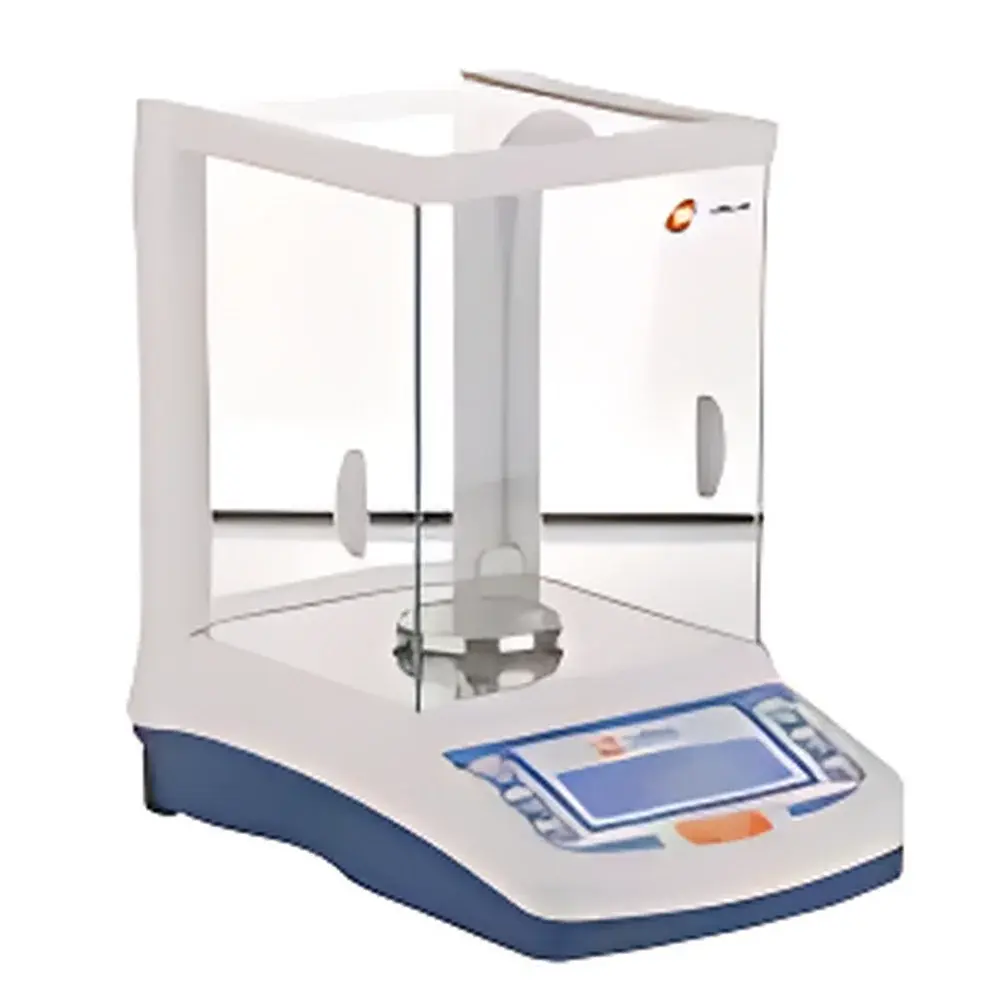
| Environmental Protection | Four-sided antistatic coated glass draft shield |
| Features | Linear four-point calibration, counting mode, unit conversion (g, oz, ct), adjustable integration time and stability/sensitivity settings |
Overview
The Yoke JA1003N Precision Analytical Balance is an electromagnetic force compensation balance engineered for laboratory environments requiring reliable 1 mg readability across a 100 g maximum capacity. It operates on the principle of electromagnetic force restoration—where sample mass is determined by the precisely regulated current required to maintain equilibrium in a magnetic field—ensuring high reproducibility and minimal drift under controlled ambient conditions. Designed for routine quality control, formulation verification, and sample preparation workflows, the JA1003N meets fundamental metrological requirements for Class II precision balances per OIML R76 and ISO 9001-compliant weighing processes. Its robust mechanical architecture—including vibration-damping feet and thermally stable internal housing—supports consistent performance in non-climate-controlled labs where temperature fluctuations and air currents are moderate.
Key Features
- Electromagnetic force compensation sensor with factory-optimized linearity and thermal compensation
- External calibration capability using certified weights (e.g., Class M2 or better), supporting traceable verification per ISO/IEC 17025 guidelines
- Four-point linear calibration routine—performed at zero, 25%, 50%, and 100% of full scale—to minimize nonlinearity error across the entire weighing range
- Antistatic four-sided glass draft shield with coated surface, reducing electrostatic interference and improving measurement stability during low-mass weighing
- Adjustable integration time and stability threshold settings, enabling optimization for volatile samples or dynamic environments
- Backlit large-format LCD display (120 × 55 mm) with clear numeric readout, status icons, and real-time stability indicator
- RS232 serial interface compliant with standard ASCII protocol, compatible with label printers, LIMS systems, and data acquisition software
Sample Compatibility & Compliance
The JA1003N accommodates solid, granular, and powdered samples up to 100 g, with optimal performance for masses between 10 mg and 100 g. The 80 mm diameter stainless steel pan provides sufficient surface area for standard weighing vessels while maintaining sensitivity. Its draft shield design ensures compatibility with common labware including crucibles, beakers, and weighing boats. The instrument complies with general-purpose regulatory expectations for non-automatic weighing instruments under Directive 2014/32/EU (Measuring Instruments Directive) and supports GLP documentation practices through timestamped weight output and external calibration logging. While not FDA 21 CFR Part 11–validated out-of-the-box, its RS232 output enables integration into validated systems when paired with compliant data capture software.
Software & Data Management
Data output follows standard asynchronous serial communication (9600 baud, 8N1), permitting direct connection to PCs, thermal printers, or laboratory information management systems without proprietary drivers. Each transmitted record includes weight value, unit identifier (g/oz/ct), stability flag, and optional date/time stamp if synchronized via host system. The balance supports manual or timed auto-output modes, facilitating batch recording in production or QC settings. For audit readiness, users may implement external electronic logbooks that capture calibration events, environmental notes, and operator IDs alongside weight data—aligning with ISO/IEC 17025 clause 7.7 on result reporting and traceability.
Applications
- Pharmaceutical tablet weight uniformity testing (USP <905>)
- Chemical reagent dispensing and dilution preparation in analytical chemistry labs
- Material density determination via mass/volume correlation
- Counting small components (e.g., screws, pills, micro-parts) using built-in piece-counting mode with reference sample input
- Educational laboratories requiring durable, entry-level precision instrumentation with intuitive operation
- Food and cosmetics QA/QC for raw material intake verification and packaging checks
FAQ
What calibration standards are recommended for the JA1003N?
Class M2 or better external weights conforming to ISO 9001 or ISO/IEC 17025 traceability requirements are advised for routine calibration.
Does the balance support internal calibration?
No—the JA1003N uses external calibration only; no motorized internal mass is included.
Can the unit convert between grams, ounces, and carats simultaneously?
Yes—unit selection is user-configurable and retained across power cycles; displayed units update in real time during weighing.
Is the RS232 interface compatible with modern Windows/macOS systems?
Yes—when used with a USB-to-RS232 adapter and terminal emulation software (e.g., Tera Term, PuTTY), it interfaces reliably with contemporary OS platforms.
What environmental conditions optimize repeatability performance?
Stable ambient temperature (18–25°C), relative humidity below 80% RH (non-condensing), and placement on a rigid, vibration-isolated surface are recommended for ≤±1 mg repeatability.