
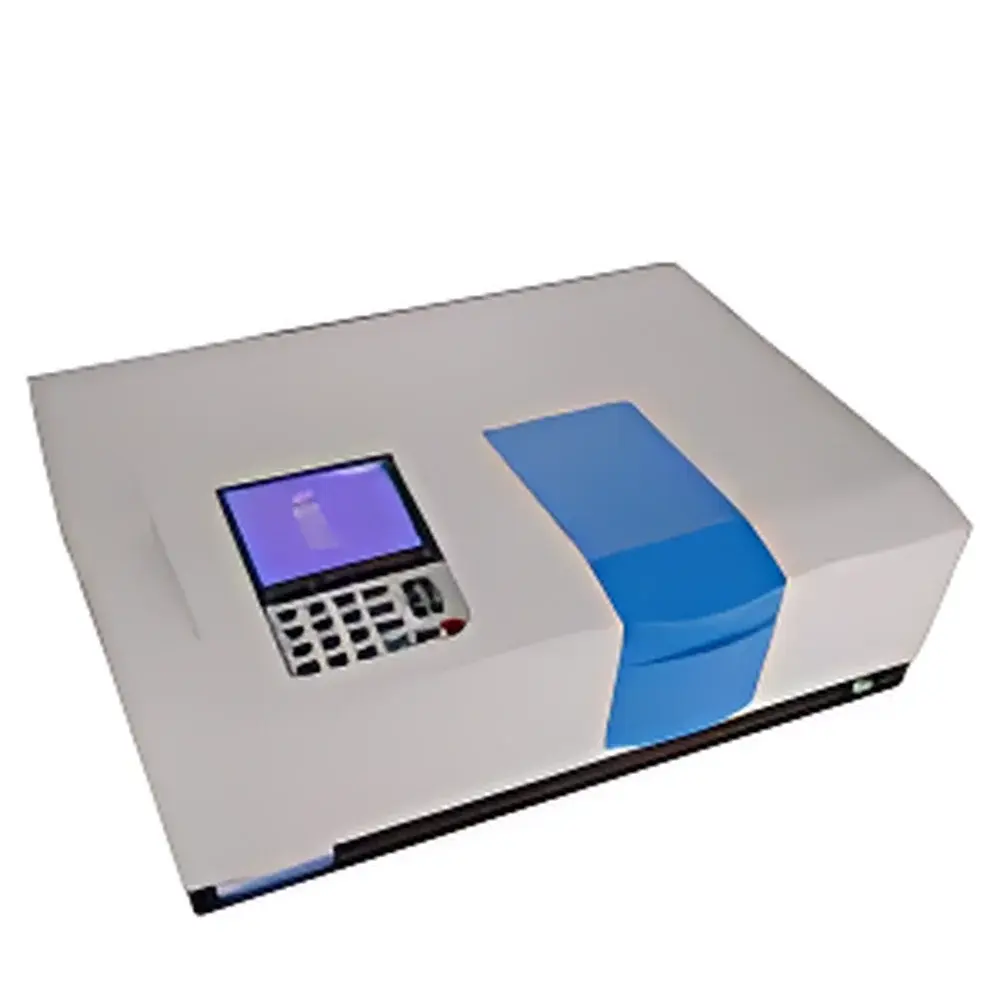
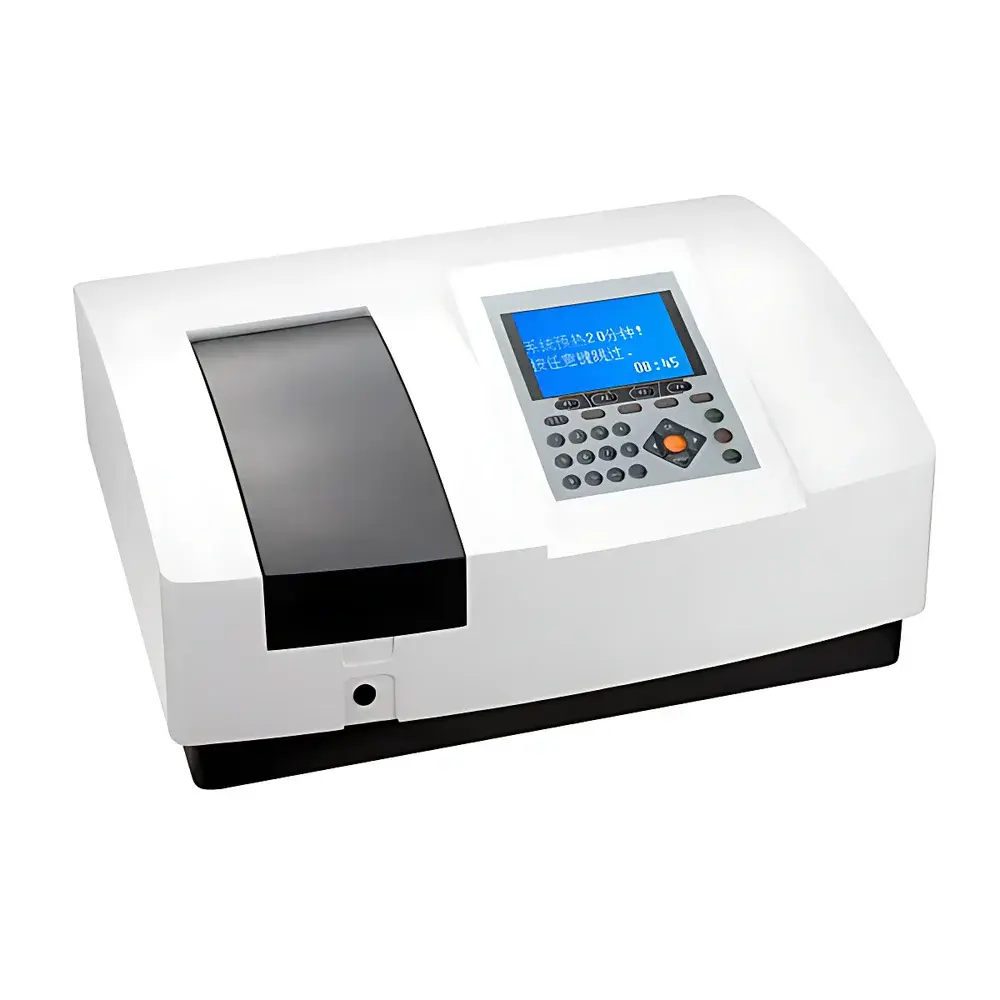
Yoke UV1900PC Dual-Beam Ultraviolet-Visible Spectrophotometer
| Brand | Yoke |
|---|---|
| Origin | Shanghai, China |
| Manufacturer Type | Manufacturer |
| Model | UV1900PC |
| Optical System | Dual-beam |
| Detector | Photodiode Array (PDA) |
| Wavelength Range | 190–1100 nm |
| Wavelength Accuracy | ≤ ±0.1 nm (at D₂ line, 656.1 nm) |
| Spectral Bandwidth | 1 nm |
| Stray Light | ≤ 0.03 %T |
| Auto-wavelength Scanning | Yes |
| Photometric Range | –3 to +3 A |
| Baseline Flatness | ≤ ±0.001 A |
| Photometric Accuracy | ±0.3 %T (0–100 %T) |
| Photometric Repeatability | 0.001 Abs (0–0.5 Abs) |
| Drift | ≤ ±0.0004 Abs/h |
| Noise | ≤ 0.0004 Abs/h |
| Wavelength Repeatability | ≤ 0.2 nm |
Overview
The Yoke UV1900PC Dual-Beam Ultraviolet-Visible Spectrophotometer is an analytical instrument engineered for precision molecular absorption spectroscopy across the ultraviolet, visible, and near-infrared spectral regions (190–1100 nm). Based on the dual-beam optical architecture, it continuously splits incident light into sample and reference paths using a high-stability beam splitter and synchronized chopper wheel—enabling real-time compensation for source intensity drift, lamp aging, and environmental fluctuations. This design ensures superior photometric stability and long-term measurement reproducibility without manual baseline recalibration. The system employs a high-efficiency holographic blazed grating and a photodiode array detector, delivering high signal-to-noise ratio and rapid spectral acquisition. Its optical path is optimized to minimize stray light (<0.03 %T at 220 nm using NaI solution), critical for accurate quantitation of low-absorbance samples and high-dynamic-range applications such as nucleic acid purity assessment or trace metal complex analysis.
Key Features
- Dual-beam optical configuration with real-time reference correction for enhanced photometric stability and reduced baseline drift (≤ ±0.0004 Abs/h)
- High-resolution wavelength scanning (1 nm spectral bandwidth) with accuracy ≤ ±0.1 nm (verified at deuterium 656.1 nm line) and repeatability ≤ 0.2 nm
- Photodiode array (PDA) detection enabling full-spectrum acquisition in under 1 second, supporting kinetic and multi-wavelength monitoring
- Modular sample compartment with tool-free access—compatible with standard 10 mm cuvettes, micro-volume adapters, integrating spheres, and fiber-optic probes
- Open-source lamp housing design facilitating rapid, alignment-free replacement of both tungsten-halogen (visible/NIR) and deuterium (UV) sources
- Robust mechanical construction (30 kg mass) with thermally stabilized optics and vibration-damped base plate for operation in shared laboratory environments
- Compliance-ready firmware architecture supporting audit trails, user-level access control, and electronic signature capability per FDA 21 CFR Part 11 requirements when operated under validated software protocols
Sample Compatibility & Compliance
The UV1900PC accommodates liquid, solid, and thin-film samples via interchangeable accessories—including fixed-pathlength quartz or fused silica cuvettes (1–100 mm), reflectance stands, and diffuse transmittance holders. It supports ASTM E275, ISO 6271, and USP methodologies for spectrophotometric assay validation. All photometric performance specifications—including stray light, wavelength accuracy, and baseline flatness (≤ ±0.001 A)—are verified against NIST-traceable standards. The instrument meets IEC 61010-1 safety requirements for laboratory electrical equipment and conforms to electromagnetic compatibility (EMC) standards EN 61326-1 and EN 61000-4 series.
Software & Data Management
Controlled via Windows-based YokeSpec Pro software, the UV1900PC provides fully compliant data handling workflows aligned with GLP/GMP documentation practices. The software includes built-in calibration verification routines, automatic wavelength and photometric validation reports, and timestamped audit logs for all method changes, measurements, and user actions. Data export adheres to ASTM E1382-compliant ASCII text format (.csv, .txt) and supports direct integration with LIMS platforms via ODBC drivers. Quantitative modules support linear/nonlinear regression (1st–4th order), multi-point calibration with up to nine standards, and multi-wavelength correction algorithms (e.g., for turbid or scattering samples). Kinetic modules allow time-resolved absorbance monitoring at user-defined intervals from 0.1 s to 1 h per point.
Applications
- Quantitative analysis of pharmaceutical actives and excipients per USP and EP 2.2.25
- Nucleic acid and protein concentration/purity assessment (A₂₆₀/A₂₈₀, A₂₆₀/A₂₃₀ ratios)
- Enzyme kinetics and ligand-binding studies requiring high-temporal-resolution spectral acquisition
- Colorimetric assays (e.g., BCA, Bradford, Lowry) and redox reaction monitoring
- Quality control of dyes, pigments, and optical filters in chemical manufacturing
- Environmental water testing (nitrate, phosphate, COD) following APHA Standard Methods
- Educational laboratories for teaching Beer–Lambert law fundamentals and spectral interpretation
FAQ
What is the maximum scan speed for full-spectrum acquisition?
Full 190–1100 nm scans are completed in ≤ 2.5 seconds at medium scan speed; fast mode achieves ~1.2 seconds with minor SNR trade-off.
Does the UV1900PC support GLP-compliant data archiving?
Yes—when used with YokeSpec Pro’s validated configuration, it maintains immutable audit trails, electronic signatures, and method versioning required for regulated environments.
Can the instrument perform simultaneous multi-wavelength quantitation?
Yes—it supports up to six discrete wavelengths in a single measurement cycle, with independent calibration curves for each channel.
Is the photodiode array detector cooled?
No—the PDA operates at ambient temperature; thermal stabilization is achieved via optical bench design and electronic offset compensation rather than active cooling.
What validation documentation is provided with the system?
Each unit ships with a Factory Acceptance Test (FAT) report, NIST-traceable wavelength and photometric calibration certificates, and IQ/OQ protocol templates compliant with ISO/IEC 17025 and GxP guidelines.





