
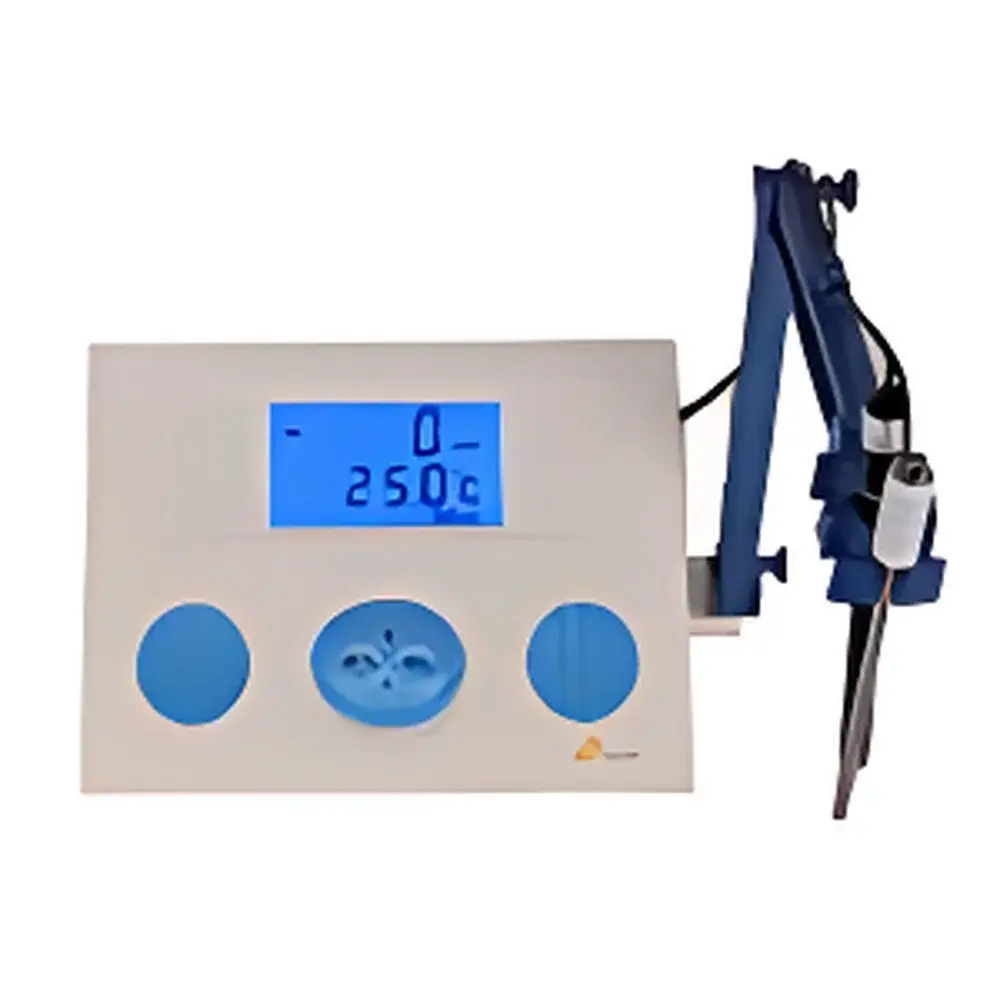
Yoke PHS-3E Benchtop pH Meter
| Brand | Yoke |
|---|---|
| Origin | Shanghai, China |
| Manufacturer Type | Direct Manufacturer |
| Instrument Type | Benchtop |
| Parameter Type | Single-Parameter (pH/mV) |
| pH Range | 0.00–14.00 pH |
| Extended pH Range | –2.00–18.00 pH |
| mV Range | –1999–+1999 mV |
| Temperature Range | 0.0–99.9 °C |
| Resolution | 0.01 pH / 1 mV / 0.1 °C |
| Accuracy | ±0.01 pH ±1 digit / ±1 mV ±1 digit / ±0.3 °C ±1 digit |
| Input Impedance | ≥1 × 10¹² Ω |
| Stability | ±0.01 pH ±1 digit / 3 h |
| Temperature Compensation | Manual (0–60 °C) or Automatic (0–100 °C) |
| Calibration Options | One-point or Two-point |
| Compatible Buffers | NIST-traceable and Chinese Standard pH buffer series |
| Display | Dual-line LCD with blue backlight |
| Electrode Compatibility | E-201-C pH composite electrode |
| Dimensions | 300 × 220 × 90 mm |
| Weight | 1.5 kg |
| Included Accessories | 1 × E-201-C electrode, 2 sets of pH standard buffer powders, 1 × T-818-B-6 temperature probe |
Overview
The Yoke PHS-3E Benchtop pH Meter is a precision electrochemical instrument engineered for reliable, repeatable measurement of hydrogen ion activity in aqueous solutions. Based on the potentiometric principle—measuring the potential difference between a pH-sensitive glass electrode and a stable reference electrode—the PHS-3E delivers high-fidelity pH readings across an extended operational range of –2.00 to 18.00 pH, supporting both routine quality control and research-grade applications where non-standard pH conditions (e.g., strongly acidic or alkaline process streams) are encountered. Its dual-range mV mode (–1999 to +1999 mV) enables direct electrode potential assessment, essential for redox monitoring, electrode characterization, and ion-selective electrode (ISE) validation. Designed for laboratory permanence rather than portability, the unit features a robust benchtop chassis with recessed electrical connectors to minimize corrosion risk and improve operator safety in humid or chemically active environments.
Key Features
- Dual-line backlit LCD display with blue illumination ensures legibility under variable ambient lighting, simultaneously showing pH (or mV) and temperature values.
- Flexible temperature compensation architecture supports both manual input (0–60 °C) and automatic compensation via integrated T-818-B-6 thermistor probe (0–100 °C), reducing thermal drift error in kinetic or temperature-variable assays.
- Two-point calibration protocol—using NIST-traceable or Chinese national standard buffer solutions—enables slope verification and asymmetric offset correction, meeting ISO 7888 and ASTM D1293 requirements for method validation.
- Input impedance exceeding 1 × 10¹² Ω minimizes loading effects on high-impedance pH electrodes, preserving signal integrity during low-conductivity sample measurements (e.g., deionized water, ethanol-water mixtures).
- Wide universal power input (80–265 V AC, 50/60 Hz) ensures stable operation in global laboratory settings without external voltage regulators or converters.
- Stability specification of ±0.01 pH ±1 digit over 3 hours meets Class 0.01 accuracy per JJG 119–2018 (Chinese National Verification Regulation for pH Meters) and aligns with GLP-compliant instrument performance thresholds.
Sample Compatibility & Compliance
The PHS-3E is optimized for aqueous and mildly organic-aqueous solutions with conductivity ≥20 µS/cm. It is not intended for non-aqueous solvents (e.g., pure methanol, acetonitrile), highly viscous media, or suspensions that may clog the reference junction. When used with the supplied E-201-C composite electrode—featuring a double-junction Ag/AgCl reference system and low-resistance pH glass membrane—the instrument complies with fundamental electrochemical measurement principles defined in IUPAC Technical Report “Measurement of pH” (Pure Appl. Chem., 2002). Calibration traceability to NIST SRM 186, 469, and 184 is achievable using certified buffer kits; documentation of calibration events satisfies audit requirements under ISO/IEC 17025 and FDA 21 CFR Part 11 when paired with controlled lab procedures.
Software & Data Management
As a standalone analog-digital hybrid instrument, the PHS-3E does not incorporate embedded data logging or USB/Bluetooth connectivity. All measurements are displayed in real time and must be manually recorded or transcribed into LIMS or ELN systems. However, its stable analog front-end design and calibrated digital conversion pathway ensure metrological consistency required for paper-based GLP records. Users implementing electronic recordkeeping may integrate the PHS-3E into validated workflows by pairing it with calibrated secondary recording devices (e.g., certified digital loggers with timestamping and audit trail capabilities), fulfilling ALCOA+ data integrity criteria when supported by documented SOPs.
Applications
- Environmental testing labs performing surface water, wastewater, and soil extract pH analysis per EPA Method 9045D and ISO 10523.
- Pharmaceutical QC laboratories verifying pH of injectables, ophthalmic solutions, and buffer preparations in accordance with USP and Ph. Eur. 2.2.3.
- Food & beverage R&D assessing acidity in dairy products, fermented beverages, and fruit juices under AOAC 973.41 and ISO 2918.
- Academic teaching labs conducting foundational electrochemistry experiments, including buffer capacity determination, titration endpoint detection, and electrode response characterization.
- Industrial process control for plating baths, boiler feedwater, and bioreactor media where continuous manual spot-checking replaces permanent online sensors.
FAQ
Does the PHS-3E support automatic calibration?
No. Calibration is performed manually using one-point or two-point protocols with user-selected standard buffers.
Can the instrument measure pH in non-aqueous samples?
It is not recommended. The E-201-C electrode and meter circuitry are designed for aqueous electrolyte systems; deviations cause unpredictable junction potentials and glass membrane hydration errors.
Is the temperature probe included standard equipment?
Yes. The T-818-B-6 thermistor sensor is supplied as part of the base configuration and enables full automatic temperature compensation.
What is the expected service life of the E-201-C electrode under normal use?
With proper storage (in 3 M KCl solution), regular cleaning, and avoidance of protein/sulfide fouling, typical functional lifespan is 12–18 months in moderate-use academic or QC settings.
How does the PHS-3E meet regulatory requirements for instrument qualification?
Its Class 0.01 accuracy, documented stability, and compatibility with traceable calibration standards enable successful completion of Installation Qualification (IQ), Operational Qualification (OQ), and Performance Qualification (PQ) protocols per GMP Annex 15 and ISO/IEC 17025 Clause 6.4.





