
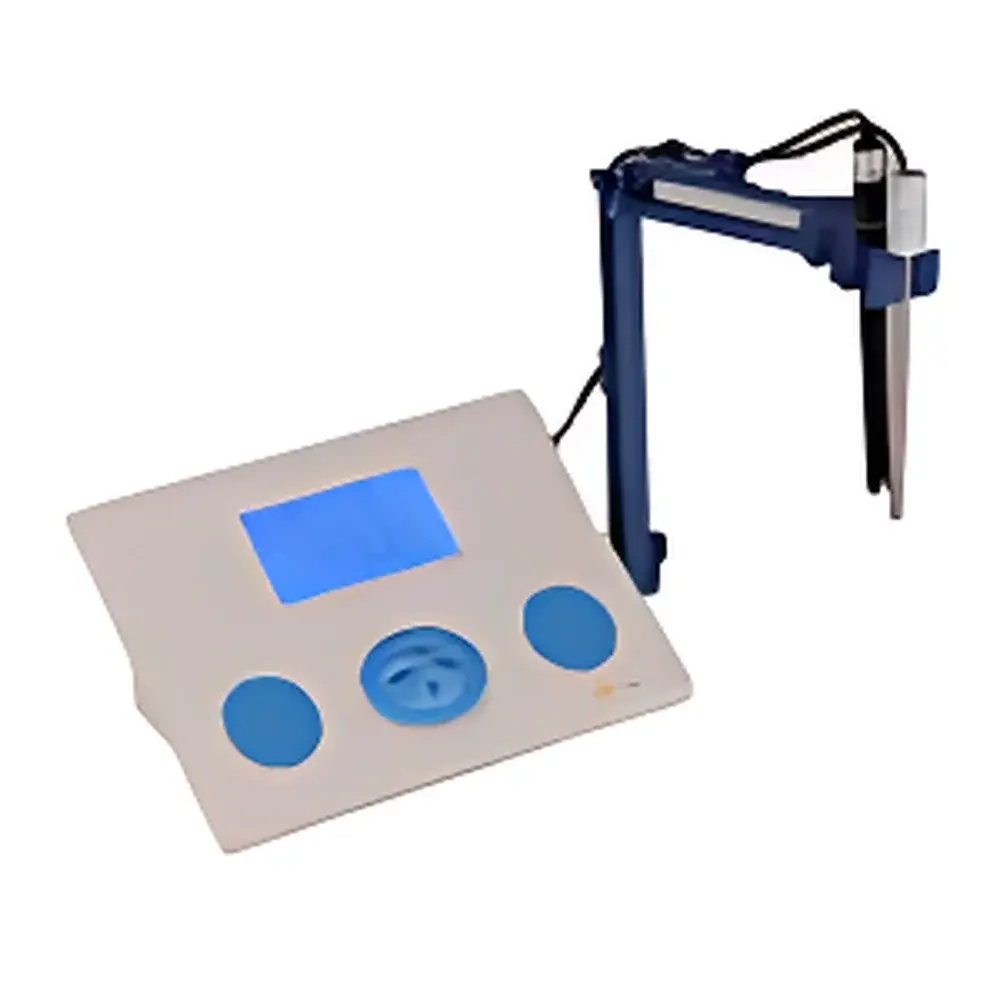
Yoke DDS-307A Benchtop Conductivity Meter
| Brand | Yoke |
|---|---|
| Origin | Shanghai, China |
| Manufacturer Type | Direct Manufacturer |
| Instrument Class | Benchtop |
| Model | DDS-307A |
| Measurement Parameters | Single-parameter (Conductivity/TDS/Resistivity/Salinity/Temp) |
| Conductivity Range | 0–199.9 mS/cm (6 auto-ranging spans: 0–1.999 µS/cm to 20.0–199.9 mS/cm) |
| TDS Range | 0–100 g/L (ppm or ppt, configurable) |
| Resistivity Range | 0–100 MΩ·cm |
| Salinity Range | 0–100 ppt (NaCl equivalent) |
| Temperature Range | −5 to +105 °C |
| Accuracy | ±1.0% FS (conductivity), ±0.5 °C (temperature) |
| Resolution | 0.01 µS/cm (lowest range), 0.01 °C |
| Temperature Compensation | Automatic, 0–100 °C, 2.0%/°C coefficient |
| Electrode Constant Compatibility | 0.01, 0.1, 1.0, and 10.0 cm⁻¹ |
| Display | Large LCD, multi-parameter simultaneous readout |
| Calibration | Auto-calibration with 1–3 point standard recognition |
| Compliance | Meets GB/T 11018–2021 (Chinese national standard for conductivity meters), ISO 7888:2012 (water quality — determination of electrical conductivity) |
Overview
The Yoke DDS-307A is a precision benchtop conductivity meter engineered for reliable, repeatable measurement of electrical conductivity, total dissolved solids (TDS), resistivity, salinity, and temperature in aqueous solutions. It operates on the principle of two-electrode AC conductometric measurement, applying a low-frequency alternating current across a pair of stainless-steel or platinum electrodes to minimize polarization effects and electrode fouling. The instrument implements automatic temperature compensation (ATC) using a built-in NTC thermistor (β = 3950 K), referenced to 25 °C, with a fixed 2.0 %/°C compensation coefficient per IEC 60746-3 and ISO 7888 guidelines. Its six-step auto-ranging architecture (spanning 0.00–1.999 µS/cm up to 20.0–199.9 mS/cm) ensures optimal signal-to-noise ratio across diverse sample matrices—from ultrapure water (≥18.2 MΩ·cm) to concentrated brines—without manual range selection. Designed for laboratory environments requiring GLP-compliant documentation, the DDS-307A supports traceable calibration via certified KCl standards (e.g., 84 µS/cm, 1413 µS/cm, 12.88 mS/cm) and maintains stability per its ±0.5% FS electronic unit drift specification over 24 h.
Key Features
- True six-range auto-ranging conductivity measurement (0.00–199.9 mS/cm), minimizing operator error and maximizing dynamic accuracy
- Simultaneous real-time display of conductivity, TDS (calculated as NaCl-equivalent), resistivity, salinity (ppt), and temperature on a high-contrast LCD
- Full automatic temperature compensation (0–100 °C) with selectable reference temperature (25 °C default) and standardized 2.0%/°C β-coefficient
- Universal electrode interface supporting four standard cell constants (0.01, 0.1, 1.0, and 10.0 cm⁻¹), enabling calibration traceability to NIST-traceable KCl solutions
- One- to three-point calibration routine with automatic standard recognition and deviation alerting for out-of-tolerance conditions
- Robust benchtop housing with chemical-resistant ABS casing, IP20-rated enclosure, and internal EMI shielding for stable operation near centrifuges or stirrers
Sample Compatibility & Compliance
The DDS-307A is validated for use with deionized water, potable water, wastewater effluents, boiler feedwater, pharmaceutical rinse solutions, and process brines. It complies with GB/T 11018–2021 (China’s national metrological verification regulation for conductivity meters) and aligns with the performance criteria of ISO 7888:2012 for routine water quality analysis. While not FDA 21 CFR Part 11–enabled (lacking audit trail or electronic signature functionality), its calibration logs, date/time stamps, and stability checks support basic GLP documentation requirements in non-regulated R&D and QC labs. For USP purified water testing, users must pair the instrument with a certified 0.01 cm⁻¹ cell and validate system suitability per pharmacopeial protocols.
Software & Data Management
The DDS-307A operates as a standalone instrument with no embedded data logging or PC connectivity. All measurements are displayed in real time; no internal memory or USB export is provided. Users record results manually or integrate with external lab notebooks or LIMS via visual transcription. Calibration history—including date, standard used, measured value, and deviation—is retained only on-screen during active calibration mode and is not stored persistently. For laboratories requiring electronic records, Yoke recommends pairing the DDS-307A with third-party serial-data capture tools (RS-232 optional adapter required, sold separately) and compliant spreadsheet templates aligned with ISO/IEC 17025 clause 7.7.
Applications
- Quality control of purified and ultrapure water systems in semiconductor fabrication and pharmaceutical manufacturing
- Monitoring conductivity drift in reverse osmosis and EDI polishing loops
- Field-adjacent bench validation of environmental water samples (surface water, groundwater, wastewater) per EPA Method 120.1
- TDS estimation in food & beverage production (e.g., syrup concentration, brine formulation)
- Electrolyte concentration verification in battery electrolyte R&D and fuel cell membrane hydration studies
- Teaching laboratories for fundamental electrochemistry experiments (Kohlrausch’s law, ion mobility, and solution conductivity modeling)
FAQ
What electrode constants are supported?
The DDS-307A accepts cells with k = 0.01, 0.1, 1.0, and 10.0 cm⁻¹. Cell constant entry is manual during calibration setup.
Does the instrument meet ASTM D1125 or ISO 7888 requirements?
Yes—the DDS-307A’s measurement methodology, temperature compensation logic, and accuracy specifications conform to the technical provisions of ISO 7888:2012 and are functionally compatible with ASTM D1125–22 for conductivity determination in water.
Can it measure conductivity below 0.1 µS/cm?
With a calibrated 0.01 cm⁻¹ cell and optimized shielding, the instrument resolves down to 0.01 µS/cm in its lowest range—but uncertainty increases above ±5% FS below 0.2 µS/cm due to ambient noise coupling.
Is temperature compensation adjustable?
No—the temperature coefficient is fixed at 2.0%/°C per ISO 7888 and cannot be user-modified.
What is the warm-up time before first measurement?
Allow 15 minutes after power-on for thermal stabilization of internal circuitry and sensor electronics to achieve rated accuracy.
Related Products





