
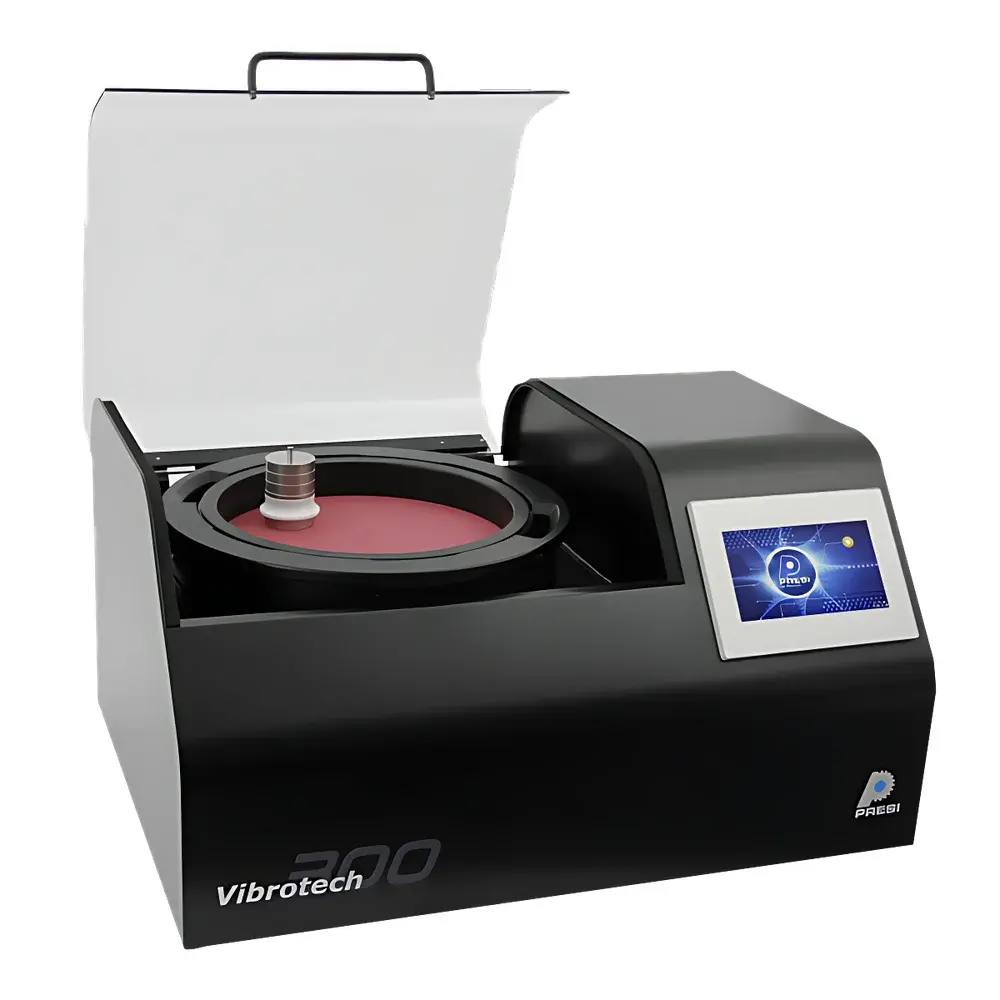
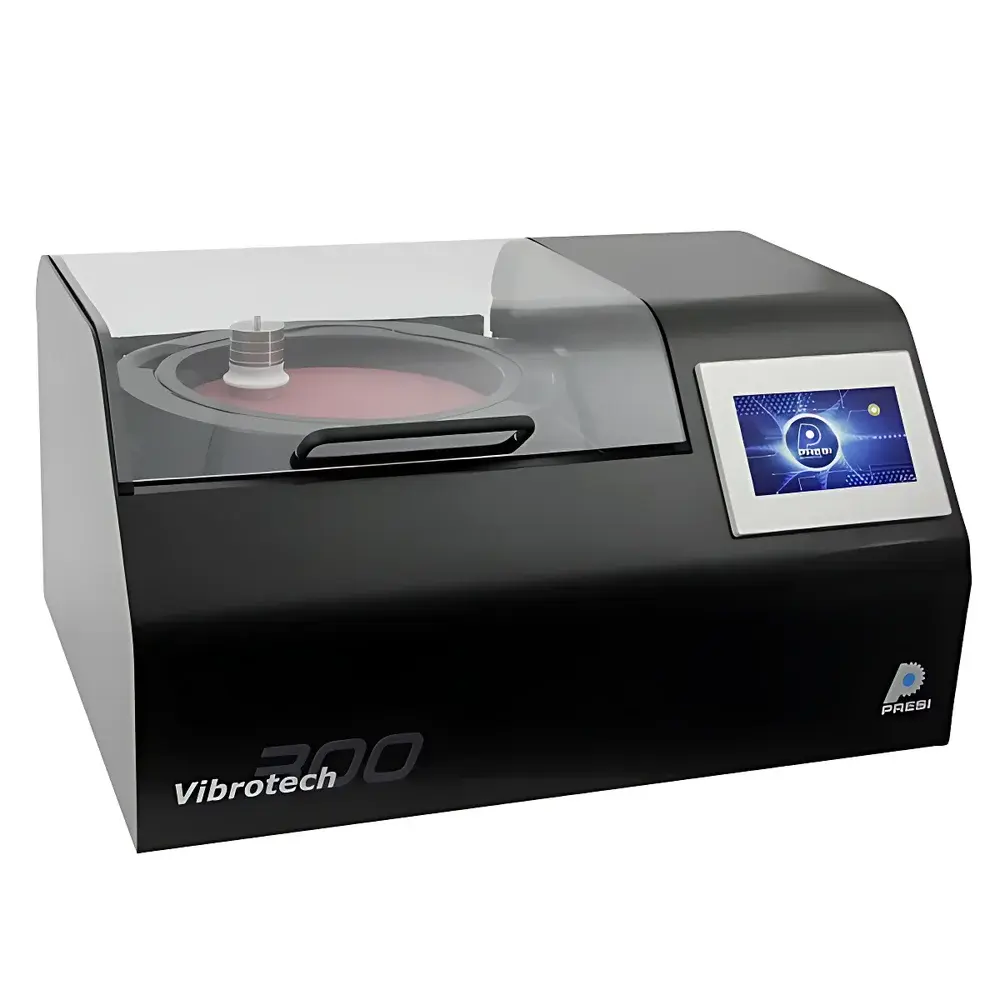
PRESI VIBROTECH 300 Vibratory Polisher
| Brand | PRESI |
|---|---|
| Origin | France |
| Model | VIBROTECH 300 |
| Power | 519 W |
| Bowl Diameter | 305 mm |
| Sample Capacity | 21 pcs per cycle |
| Speed Range | 80–110 rpm |
| Dimensions (L×W×D) | 715 × 554 × 676 mm |
| Display | 7-inch LCD touchscreen with password protection |
| Noise Level | Low operational noise |
| Vibration Damping | Integrated isolation system |
| USB Interface | For process import/export |
| Compliance | CE, RoHS |
| Weight | Approx. 78 kg |
Overview
The PRESI VIBROTECH 300 Vibratory Polisher is an engineered solution for high-fidelity surface preparation of metallic, ceramic, and geological specimens—specifically optimized for Electron Backscatter Diffraction (EBSD) analysis. Unlike conventional rotational polishing systems, the VIBROTECH 300 employs controlled orbital vibration rather than rotational shear to induce gentle, uniform material removal across the specimen surface. This mechanism minimizes subsurface plastic deformation, residual stress, and mechanical twinning—critical artifacts that degrade EBSD pattern quality and indexing reliability. The device operates on a horizontal oscillation principle with adjustable amplitude and frequency modulation, enabling precise control over energy transfer to the abrasive slurry (e.g., colloidal silica or alumina suspensions). Its design targets the final stage of metallographic sample preparation where elimination of the deformed layer—typically 85% and orientation measurement accuracy within ±0.5°.
Key Features
- Orbital vibratory motion with digitally regulated speed range (80–110 rpm), ensuring reproducible energy input without edge rounding or preferential wear.
- Single 305 mm diameter polyurethane-lined bowl capable of simultaneous processing of up to 21 standard 25 mm or 30 mm diameter mounted specimens.
- Integrated 7-inch capacitive touchscreen interface with multi-level password protection, supporting user-defined protocol storage (up to 99 programs) with timestamped parameter logging.
- Optically transparent polycarbonate safety lid with positive-locking hinge and integrated microswitch interlock—ensures full enclosure during operation and prevents contamination from ambient particulates.
- Low-noise motor assembly (<62 dB(A) at 1 m) coupled with elastomeric base isolation to minimize transmission of vibrations to adjacent instrumentation (e.g., SEM stages or AFM workbenches).
- USB 2.0 port for secure transfer of polishing protocols, calibration logs, and audit-ready session records—compatible with laboratory data management systems compliant with ISO/IEC 17025 and GLP requirements.
Sample Compatibility & Compliance
The VIBROTECH 300 accommodates a broad spectrum of conductive and non-conductive materials, including but not limited to: austenitic and ferritic steels, titanium alloys (Ti-6Al-4V, CP-Ti), nickel-based superalloys (Inconel 718, Hastelloy C-276), WC-Co hardmetals, silicon carbide ceramics, quartz and halite mineral sections, and sintered oxide composites. It is routinely employed in accredited metallurgical laboratories performing ASTM E3, ISO 14487, and EN 10365-compliant sample preparation. All electrical components meet CE marking requirements under Directive 2014/30/EU (EMC) and 2014/35/EU (LVD); materials comply with RoHS 2011/65/EU restrictions on hazardous substances. Optional documentation packages support FDA 21 CFR Part 11 compliance for electronic signatures and audit trails in regulated pharmaceutical or medical device R&D environments.
Software & Data Management
While the VIBROTECH 300 operates as a standalone instrument, its embedded firmware supports structured data exchange via USB mass storage mode. Each polishing session generates a timestamped .csv file containing start/stop time, selected program ID, actual rpm, duration, and operator ID (if entered). These files are compatible with LIMS integration workflows and may be imported into statistical process control (SPC) platforms such as Minitab or JMP for capability analysis (Cp/Cpk) of surface roughness outcomes measured by profilometry. Firmware versioning and calibration history are retained internally and exportable—supporting traceability under ISO/IEC 17025 clause 7.7 (Equipment Management) and internal quality audits.
Applications
- Preparation of EBSD-ready surfaces for crystallographic phase mapping, grain boundary characterization, and strain distribution analysis in multiphase alloys.
- Final polishing of cross-sectioned geological thin sections (e.g., granite, basalt, evaporites) to eliminate relief effects prior to cathodoluminescence imaging.
- Routine quality control polishing of sintered carbide inserts used in cutting tool manufacturing—ensuring consistent fracture surface morphology for SEM fractography.
- Surface conditioning of additively manufactured (AM) metal parts (e.g., Ti-6Al-4V LPBF builds) to reveal as-built porosity and melt pool boundaries without introducing artificial voids.
- Standardized polishing of reference materials (e.g., NIST SRM 2841, SRM 2842) for inter-laboratory round-robin studies in materials certification programs.
FAQ
What types of abrasive media are compatible with the VIBROTECH 300?
Colloidal silica (e.g., OP-S, MasterMet), alumina suspensions (0.05–0.3 µm), and diamond paste dispersions (1–6 µm) are validated for use; solvent compatibility must align with the polyurethane bowl liner (aqueous and mild alcohol-based carriers only).
Can the VIBROTECH 300 be integrated into automated sample prep lines?
Yes—via optional dry-contact relay outputs (24 V DC) for external PLC synchronization; no proprietary communication protocol is required.
Is routine maintenance required beyond cleaning the bowl and lid?
Annual verification of motor torque output and vibration amplitude linearity is recommended using PRESI-certified calibration fixtures; no user-serviceable internal components exist.
Does the device support variable amplitude control?
No—amplitude is fixed at 3.2 mm peak-to-peak displacement; process optimization is achieved solely through speed, time, and slurry formulation tuning.
How does the VIBROTECH 300 compare to electrochemical polishing for EBSD preparation?
It provides superior topographic uniformity on heterogeneous microstructures (e.g., duplex stainless steels) without risk of selective dissolution or hydrogen embrittlement—making it the preferred method for failure analysis and regulatory submissions.



