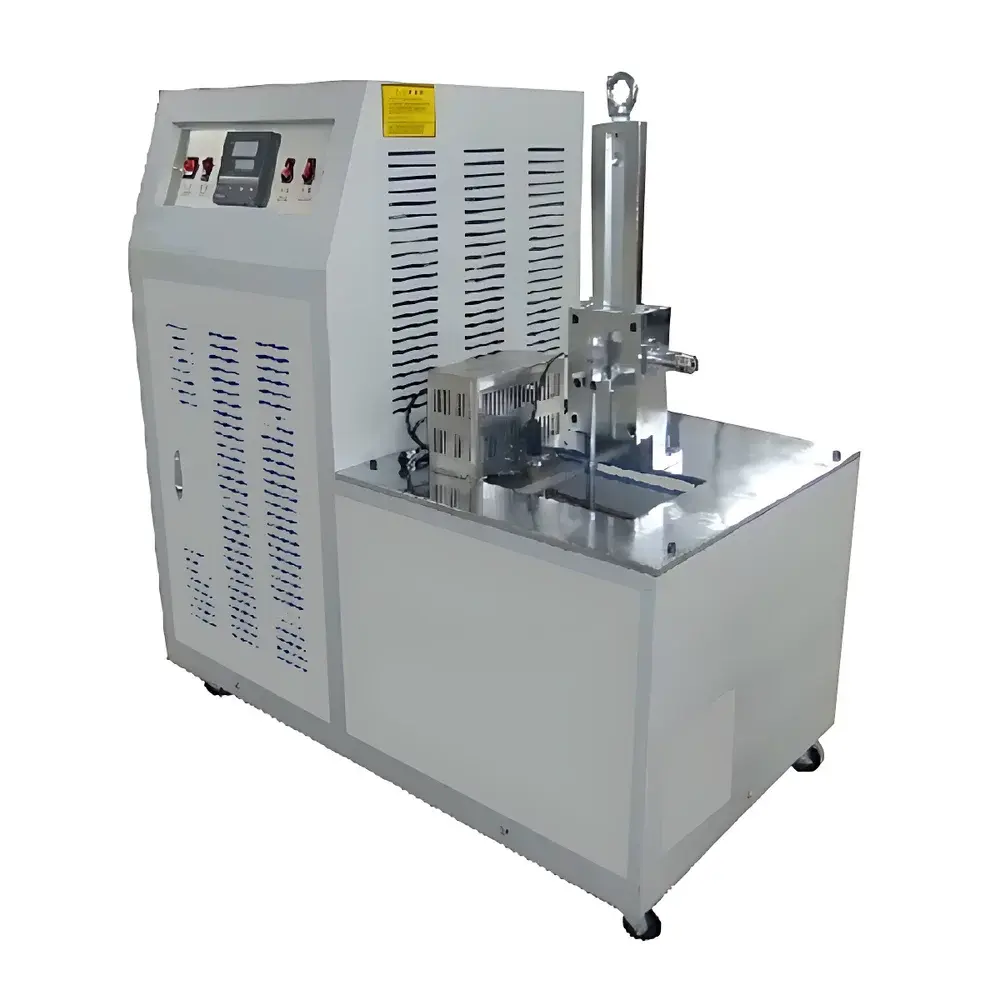
TianYuan TY-5003 Single-Specimen Low-Temperature Brittleness Tester for Rubber and Elastomers
| Brand | TianYuan |
|---|---|
| Origin | Jiangsu, China |
| Manufacturer Type | Direct Manufacturer |
| Country of Origin | China |
| Model | TY-5003 (Single-Specimen Method) |
| Cooling Range | −70 °C |
| Temperature Stability During Test | < ±0.5 °C (within 3 min hold) |
| Specimen Capacity | 1 per test cycle |
| Impact Velocity | 2.0 ± 0.2 m/s |
| Required Impact Energy | ≥3.0 J |
| Cooling Medium | Ethanol or other non-freezing liquid |
| Power Supply | 220–240 V AC, 50 Hz, 2 kW |
| External Dimensions | 720 × 1380 × 700 mm (L × H × W) |
| Chamber Internal Dimensions | 200 × 100 × 140 mm (L × W × H) |
| Stirring Motor | 15 W |
| Compliance | GB/T 1682–2014, GB/T 5470–2008, ISO 812:2006, ASTM D2137–94 |
Overview
The TianYuan TY-5003 Single-Specimen Low-Temperature Brittleness Tester is a precision-engineered instrument designed to determine the brittle temperature (BT) of vulcanized rubber, thermoplastic elastomers, and flexible polymeric materials under standardized cryogenic conditions. The brittle temperature is defined as the highest temperature at which a specimen—subjected to a controlled impact under specified geometric and kinetic constraints—exhibits fracture or cracking upon deformation. This measurement provides critical insight into low-temperature service limits, material formulation robustness, and comparative performance across polymer grades or compound variations. The TY-5003 implements the single-specimen method in strict accordance with GB/T 1682–2014, ISO 812:2006, and ASTM D2137–94, employing a gravity-driven impact system with kinematically constrained velocity (2.0 ± 0.2 m/s) and minimum energy delivery (≥3.0 J). Its core thermal architecture utilizes a cascade compression refrigeration system, enabling stable operation down to −70 °C with high thermal uniformity and minimal drift (< ±0.5 °C over 3-minute dwell periods).
Key Features
- Full compliance with international standards for low-temperature brittleness assessment: GB/T 1682–2014, GB/T 5470–2008, ISO 812:2006, and ASTM D2137–94.
- Cascade compressor cooling system delivering reliable, repeatable thermal control from ambient to −70 °C; optimized heat dissipation design includes front-accessible ventilation panels for sustained compressor efficiency.
- Single-specimen test configuration ensures precise mechanical isolation and eliminates inter-sample thermal cross-talk during sequential testing.
- Rigid cantilever-type specimen holder with calibrated clamping force—designed to prevent slippage or bending deformation while maintaining full exposure of the impact zone.
- Impact assembly featuring a self-locking drop hammer mechanism, precision-machined impact tip (radius 1.6 ± 0.1 mm), and defined anvil geometry for A- and B-type specimens per ISO/ASTM specifications.
- Digital temperature controller with real-time monitoring, programmable dwell timing (3.0 ± 0.5 min standard freeze duration), and alarm-triggered safety cutoff on thermal deviation exceeding ±1 °C during conditioning.
- Stainless-steel cold chamber with integrated magnetic stirrer (15 W) ensuring homogeneous coolant circulation and minimizing thermal stratification in ethanol or alternative non-freezing media.
Sample Compatibility & Compliance
The TY-5003 accommodates standard rectangular specimens conforming to dimensional tolerances defined in GB/T 1682–2014 and ISO 812:2006: length 31.75 ± 6.35 mm, width 6.35 ± 0.51 mm, thickness 1.91 ± 0.13 mm. Specimens must exhibit smooth, contaminant-free surfaces and be free of nicks, scratches, or processing artifacts. While primarily intended for vulcanized rubber compounds—including natural rubber (NR), styrene-butadiene rubber (SBR), nitrile rubber (NBR), and ethylene propylene diene monomer (EPDM)—the instrument is also applicable to thermoplastic elastomers (TPEs), flexible PVC, and coated textiles when evaluated under ASTM D2137–94 protocols. All mechanical and thermal parameters—including impact velocity, energy threshold, and cooling medium depth (75 ± 10 mm above clamp base)—are traceable to national metrological guidelines. The system supports GLP-aligned documentation practices through manual logbook integration and is compatible with laboratory audit requirements for method validation and equipment qualification (IQ/OQ).
Software & Data Management
The TY-5003 operates via embedded digital temperature and timing controls with LED display interface—no proprietary software required. All operational parameters (setpoint, actual bath temperature, elapsed freeze time, and impact trigger status) are directly observable and manually recordable. For laboratories implementing electronic data capture, the unit’s analog-compatible relay outputs allow integration with external PLC-based logging systems or LIMS platforms. Temperature stability data (±0.5 °C tolerance over 3-min hold) satisfies the repeatability criteria outlined in ISO/IEC 17025:2017 for accredited testing laboratories. While the instrument does not include built-in 21 CFR Part 11-compliant audit trails, its deterministic mechanical action and fixed thermal protocol enable full procedural traceability when used within documented SOP frameworks compliant with GMP/GLP principles.
Applications
- Quality control of incoming raw elastomer batches prior to compounding or extrusion.
- Formulation development and screening of low-temperature additives (e.g., plasticizers, antifreeze agents) in rubber compound design.
- Comparative evaluation of aging effects—thermal, oxidative, or UV-induced—on low-temperature flexibility retention.
- Validation of cold-weather performance for automotive seals, aerospace gaskets, medical tubing, and cryogenic cable jackets.
- Regulatory submission support for ISO 10993 biocompatibility assessments requiring low-temperature mechanical integrity data.
- Academic research into structure–property relationships in segmented copolymers and phase-separated thermoplastic elastomers.
FAQ
What cooling medium is recommended for routine operation?
Ethanol (≥99.5% purity) is the default medium specified in GB/T 1682–2014 and ISO 812:2006. Alternatives such as methanol–ethanol blends or commercial non-freezing fluids may be used if validated for thermal conductivity, viscosity, and chemical inertness toward test specimens.
Can the TY-5003 perform multi-specimen testing?
No—the instrument is engineered exclusively for single-specimen evaluation per test cycle, consistent with the methodology defined in GB/T 1682–2014 and ISO 812:2006. Multi-specimen configurations require separate instrumentation.
Is calibration certification included with shipment?
The unit ships with factory verification of temperature sensor accuracy (±0.3 °C at −40 °C and −70 °C) and impact velocity confirmation (via high-speed photogate validation). NIST-traceable calibration certificates are available upon request at additional cost.
What electrical infrastructure is required for stable operation?
A dedicated 220–240 V AC, 50 Hz circuit rated for ≥2 kW continuous load and equipped with proper grounding is mandatory. Voltage fluctuations exceeding ±5% may impair compressor longevity and thermal stability.
How is specimen failure assessed post-impact?
After impact, each specimen is manually bent to 180° along the impact axis under visual inspection at ≥2× magnification. Cracking, splitting, or delamination visible without magnification constitutes failure; microfractures observed only under microscopy do not meet the pass/fail criterion per standard definitions.