
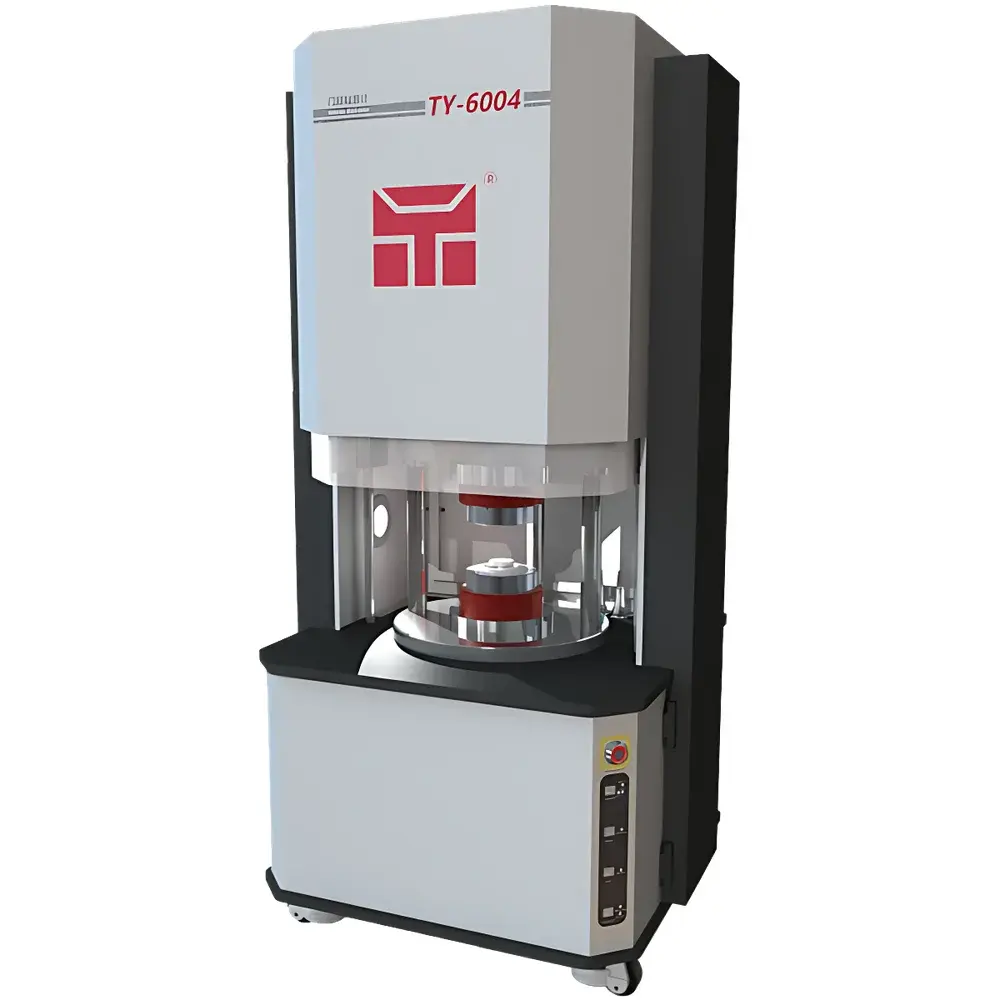
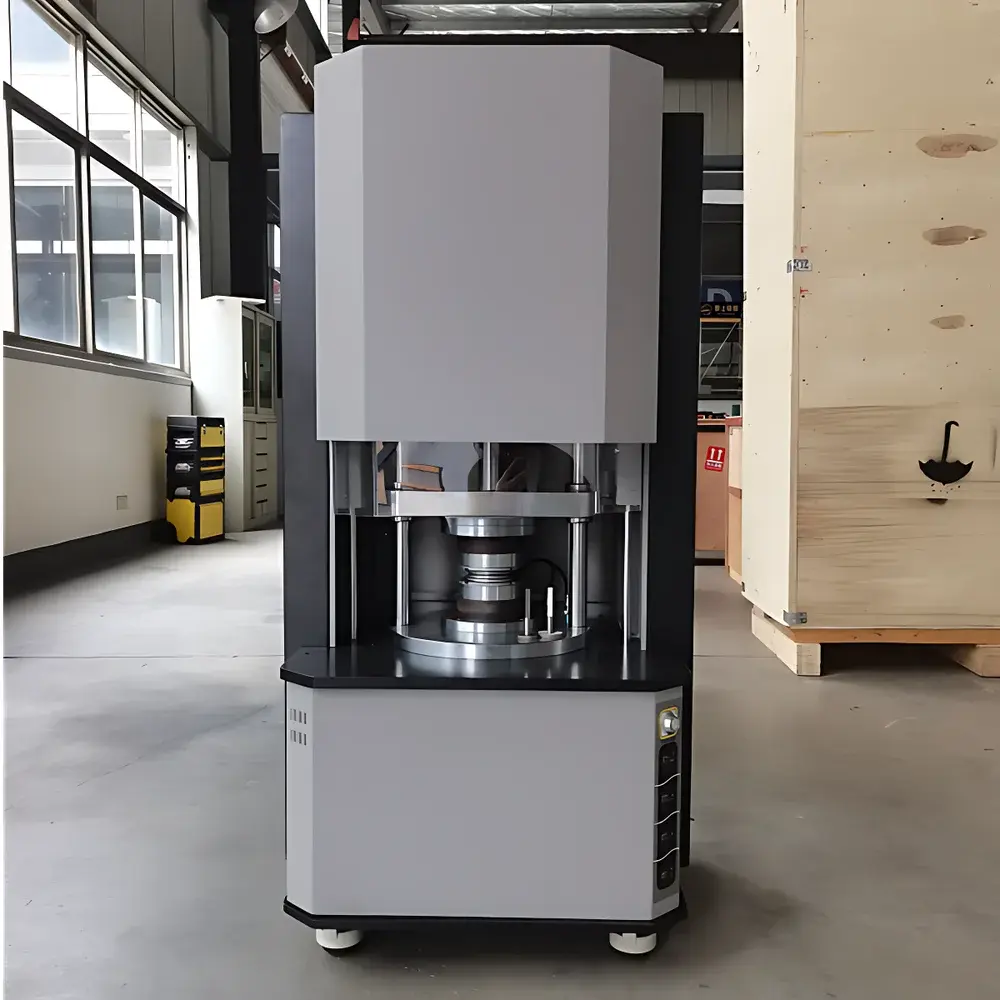
TYTESTER TianYuan TY6004 Mooney Viscometer
| Brand | TianYuan |
|---|---|
| Origin | Jiangsu, China |
| Manufacturer Type | Direct Manufacturer |
| Regional Classification | Domestic (China) |
| Model | TY6004 |
| Price Range | USD 4,200 – 7,000 (FOB China) |
| Measurement Range | 0–200 Mooney Units |
| Resolution | 0.1 MU |
| Accuracy | ±0.5 MU |
| Temperature Range | Ambient to 200 °C |
| Temp. Stability | ±0.5 °C |
| Rotor Speed | 2.00 ± 0.02 rpm |
| Applied Pressure | 0.5 MPa |
| Heating Rate | <5 min (RT to 100 °C) |
| Power Supply | AC 220 V, 50 Hz |
| Power Consumption | 800 W |
| Dimensions (W×D×H) | 660 × 570 × 1300 mm |
| Weight | 2160 kg |
| Rotor Material | Cr6WV tool steel |
| Data Interface | USB |
| Software Language Support | English, Simplified Chinese, Traditional Chinese, Russian |
Overview
The TYTESTER TianYuan TY6004 Mooney Viscometer is a precision-engineered instrument designed for the standardized determination of Mooney viscosity, scorch time (t5), and vulcanization index (Δt30) of raw and compounded rubber materials. It operates on the principle of rotational shear rheometry under controlled temperature and pressure conditions, conforming to the fundamental geometry and kinematic constraints defined in ASTM D1646, ISO 289, ISO 667, and GB/T 1232–2016 and GB/T 1233–2016. The device applies a calibrated torque to a standardized rotor rotating at 2.00 ± 0.02 rpm within a heated cavity containing a rubber test specimen compressed under 0.5 MPa. The resulting resistance—expressed in Mooney Units (MU)—quantifies the material’s resistance to shear deformation during early-stage thermal exposure, providing critical processability and safety data for rubber compound development, quality control, and incoming raw material verification.
Key Features
- High-accuracy torque sensing system with full-scale range of 0–200 MU and resolution of 0.1 MU, certified accuracy ±0.5 MU across the operational range.
- Dual-stage drive architecture: Panasonic AC servo motor coupled with planetary gear reduction ensures stable, low-vibration rotation and long-term speed fidelity (2.00 ± 0.02 rpm).
- Multi-point PID temperature control using intelligent multi-channel thermal measurement modules; achieves ±0.5 °C stability over 0–200 °C and heats from ambient to 100 °C in under 5 minutes.
- Cr6WV alloy steel rotor—heat-treated for high hardness and wear resistance—ensures dimensional stability and consistent shear field geometry over thousands of test cycles.
- Integrated safety interlock system: 5-mm acrylic shield synchronized with mold position; automatic illumination (LED) triggered by mold opening; physical-only mold closure via front-panel button to prevent accidental actuation.
- USB-based digital data acquisition with embedded firmware and TY Viscosity PC software—supports real-time curve plotting, comparative overlay of historical runs, adjustable test duration, and automated pass/fail flagging per user-defined thresholds.
Sample Compatibility & Compliance
The TY6004 accommodates standard 45 g rubber specimens (diameter 45 mm, thickness 12 mm) in accordance with ISO 289 Annex A and GB/T 1232. It supports natural rubber (NR), styrene-butadiene rubber (SBR), butadiene rubber (BR), ethylene-propylene-diene monomer (EPDM), nitrile rubber (NBR), and reclaimed rubber compounds. All mechanical, thermal, and data handling functions comply with the metrological requirements of ISO/IEC 17025 for testing laboratories. The instrument satisfies traceability requirements for GLP environments when paired with validated software configuration and audit-trail-enabled operation logs. While not pre-certified to FDA 21 CFR Part 11, its software architecture supports electronic signature implementation and secure user role management—enabling customization for regulated GMP/QA workflows upon site-specific validation.
Software & Data Management
TY Viscosity software (v4.2+) provides native Windows support (Windows 10/11, 64-bit), multilingual UI (English, Simplified/Traditional Chinese, Russian), and structured database storage compliant with SQL Server Express. Each test record includes timestamped metadata: operator ID, sample ID, test temperature, rotor type, start/stop times, raw torque vs. time series, derivative curves (dMU/dt), and annotated event markers (e.g., t5, t35, Δt30). Export options include CSV, PDF reports with embedded curves, and XML for LIMS integration. Audit trail functionality logs all parameter changes, report modifications, and user login/logout events—meeting baseline requirements for internal QA documentation and external inspection readiness.
Applications
- Rubber formulation screening: Quantifying polymer molecular weight distribution effects on processability via Mooney viscosity baseline shifts.
- Batch-to-batch consistency monitoring in synthetic rubber production (e.g., SBR, BR) against internal specification limits.
- Scorch safety evaluation of accelerator systems prior to extrusion or calendering processes.
- Reclaimed rubber reprocessing qualification—detecting excessive thermo-mechanical degradation through elevated scorch rates.
- Quality assurance of incoming natural rubber bales per ASTM D1416 or GB/T 8081 protocols.
- Research correlation studies linking Mooney data to downstream rheological behavior (e.g., oscillatory shear, capillary flow).
FAQ
What standards does the TY6004 comply with?
It fully implements test procedures and hardware specifications outlined in ISO 289, ISO 667, ASTM D1646, GB/T 1232–2016, and GB/T 1233–2016.
Is the software compatible with LIMS or ERP systems?
Yes—CSV and XML export formats are supported; custom API integration can be developed via documented COM interface for enterprise-level data synchronization.
Can the instrument operate unattended overnight?
Yes, with scheduled test queues and auto-shutdown after completion; however, continuous operation beyond 8 hours requires confirmation of cooling system integrity and ambient lab ventilation.
What maintenance intervals are recommended?
Rotor surface inspection and cavity cleaning after every 50 tests; full calibration verification annually or per 1,000 test cycles—using NIST-traceable Mooney reference standards.
Does the system support multiple user accounts with permission levels?
Yes—administrator, technician, and viewer roles are configurable within TY Viscosity software, with password protection and activity logging enabled by default.




