
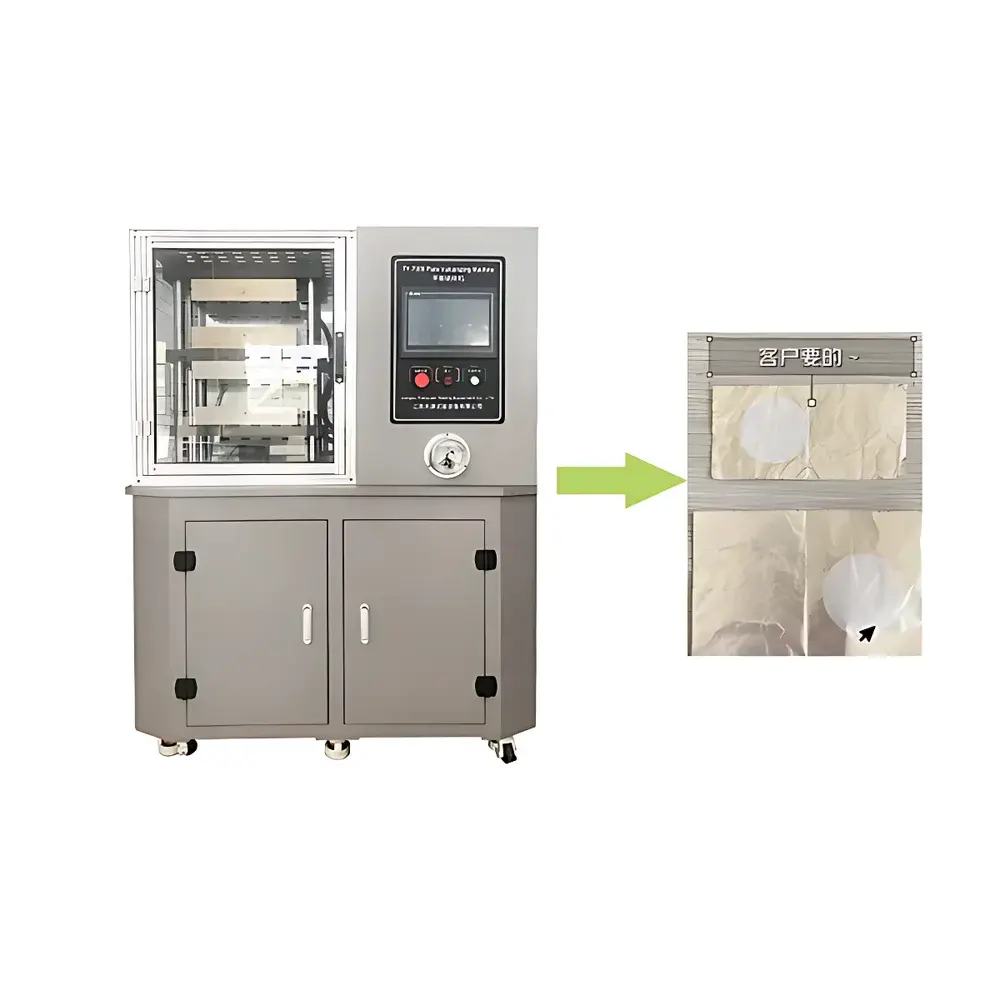
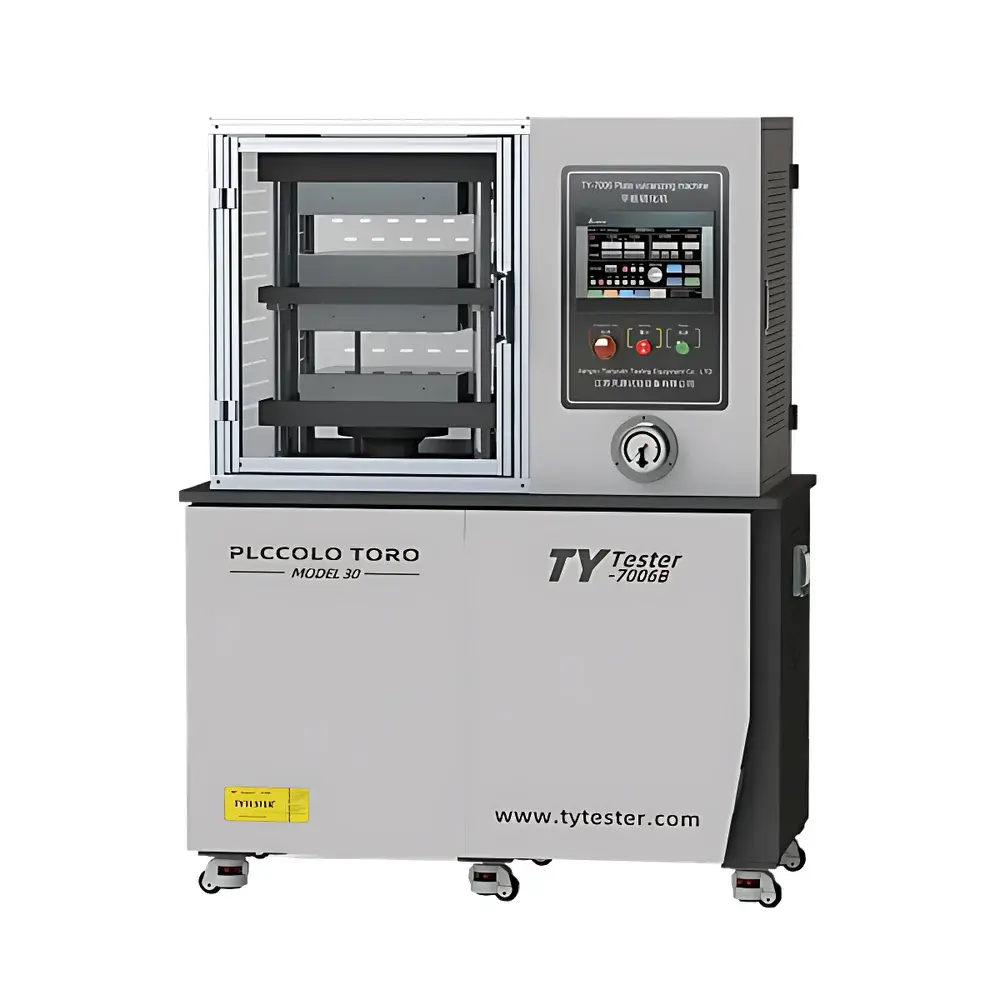
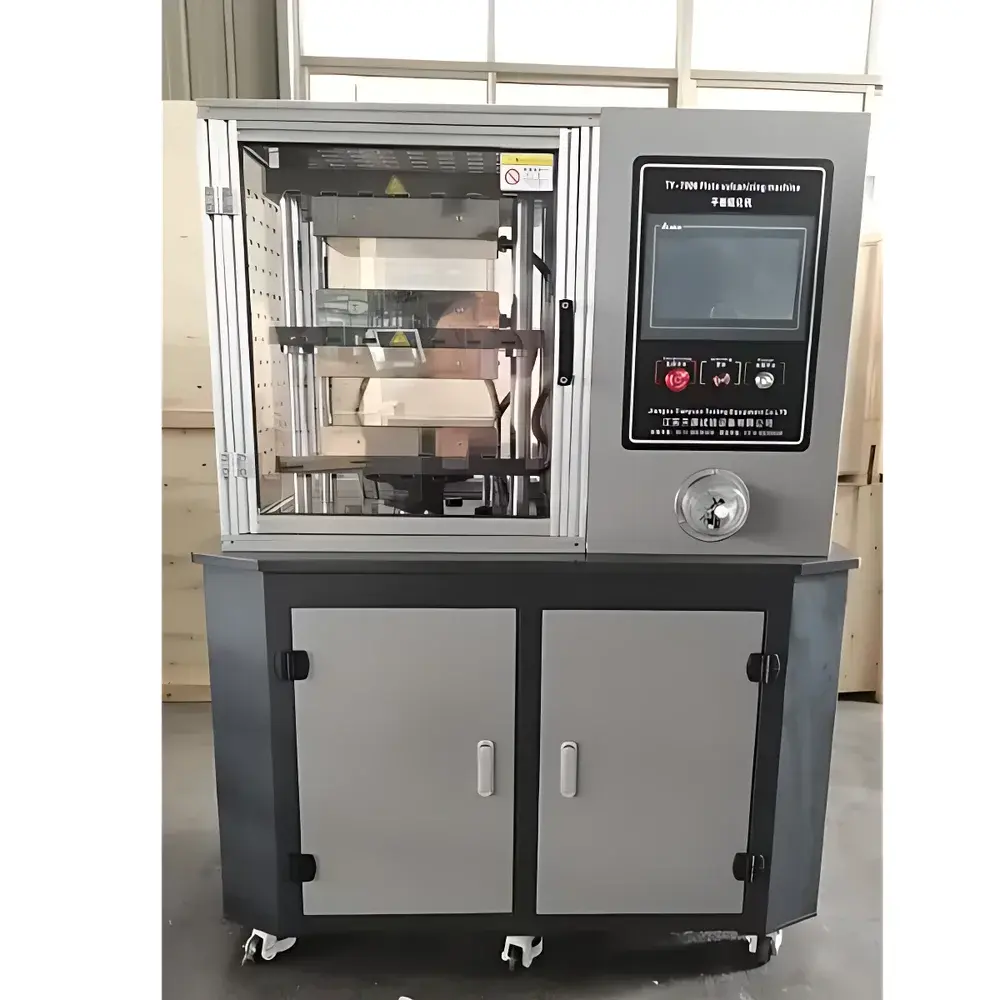
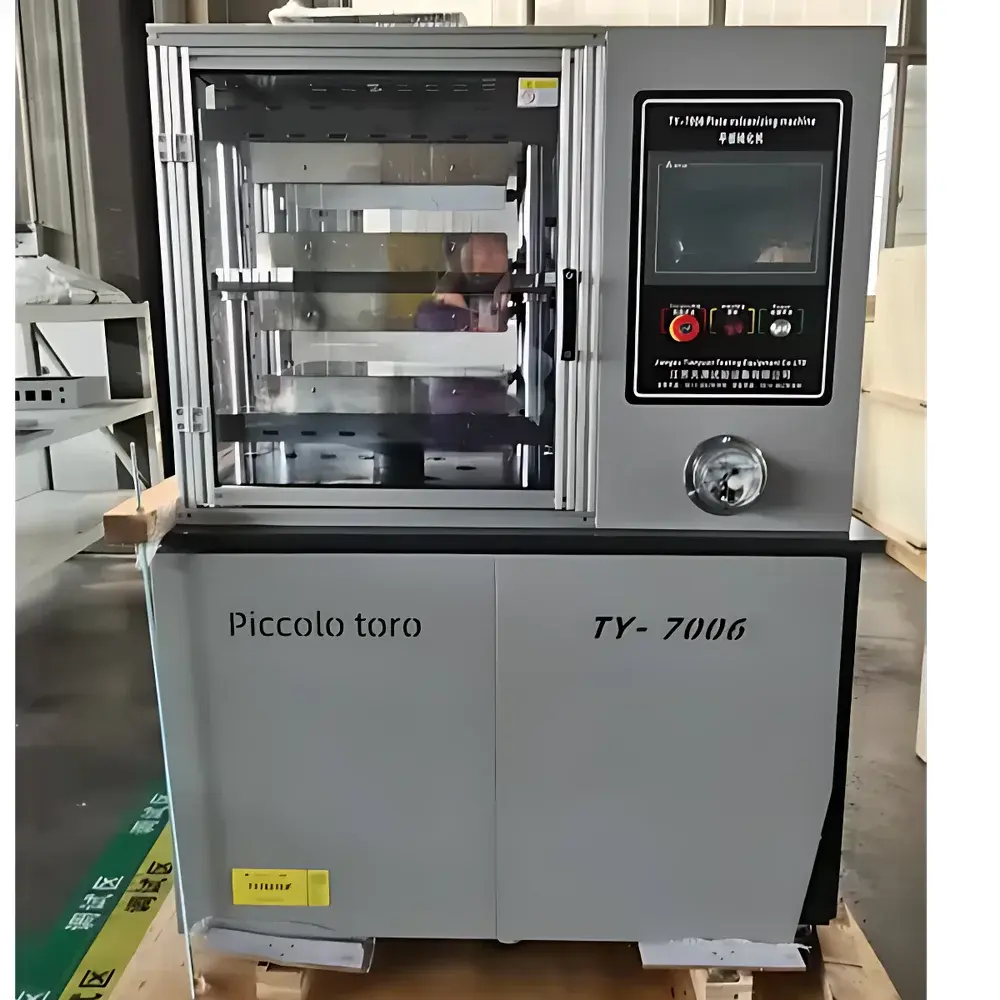
TianYuan TY-7006 Automatic Hydraulic Hot Press for Laboratory Sample Preparation
| Brand | TianYuan |
|---|---|
| Origin | Jiangsu, China |
| Manufacturer Type | Direct Manufacturer |
| Country of Origin | China |
| Model | TY-7006 |
| Instrument Type | Fully Automatic Hydraulic Hot Press |
| Function | Thermal Compression Molding of Polymer & Elastomer Samples |
| Max Stroke | 75 mm |
| Nominal Clamping Force | 30 metric tons (300 kN) |
| Actuation Method | Proportional Hydraulic System |
| Pressure Control Range | 5–16.6 MPa |
| Pressure Control Accuracy | ±10% |
| Temperature Range | Ambient to 300 °C |
| Temperature Stability | ±0.1 °C (steady-state), ±0.3 °C (dynamic ramping) |
| Heating Configuration | Star-connected (Y-type) Three-Phase Resistive Elements |
| Cooling Method | Dual-zone — Upper Platen Heated / Lower Platen Cooled via Tap Water Circulation |
| Platen Dimensions | 300 × 300 mm |
| Platen Material | Nitrided Steel with Precision Ground Surface and Hard Chromium Coating |
| Insulation Board | Imported High-Temperature Ceramic Fiber Board (Rated to 500 °C) |
| Exhaust Cycles | 0–9 Programmable |
| Hydraulic Fluid | L-HM 46 Anti-Wear Hydraulic Oil (ISO VG 46) |
| Safety Features | Interlocked Transparent Safety Guard Door |
| PLC Controller | Delta DVP Series with HMI Touchscreen Interface |
| Power Supply | AC 380 V ±10%, 3-Phase, 18 A |
| Total Power Consumption | 11 kW (Single-Zone Heating) / 22 kW (Dual-Zone Heating) |
| Net Weight | ~738 kg |
| Overall Dimensions | 1180 × 585 × 1460 mm |
Overview
The TianYuan TY-7006 is a fully automatic hydraulic hot press engineered for precision thermal compression molding of polymeric, elastomeric, and composite materials in R&D laboratories and quality control environments. It operates on the principle of controlled heat-and-pressure consolidation—applying uniform clamping force between heated platens while maintaining programmable temperature profiles and dwell times. Designed for ASTM D3182, ISO 37, ISO 6502, and GB/T 16584 compliant sample preparation, the TY-7006 enables reproducible fabrication of test specimens for tensile, hardness, tear, and rheological characterization. Its dual-zone thermal architecture—featuring independent upper-heating and lower-cooling platens—supports rapid thermal cycling and minimizes post-mold distortion. The system integrates a closed-loop proportional hydraulic control system, ensuring stable force delivery across the full 30-ton (300 kN) clamping capacity, with real-time pressure feedback and programmable exhaust sequences to eliminate trapped volatiles and voids during vulcanization or thermoplastic consolidation.
Key Features
- Programmable PLC-based HMI touchscreen interface (Delta DVP series) supporting multi-step thermal and mechanical cycles—including pressure ramping, dwell timing, and up to 9 programmable exhaust events.
- Star-connected (Y-type) three-phase resistive heating elements delivering balanced power distribution, eliminating phase-load asymmetry and reducing thermal overshoot; achieves ±0.3 °C ramping accuracy and ±0.1 °C steady-state stability.
- Dual-zone platen configuration: upper platen (300 × 300 mm) heated to 300 °C; lower platen actively cooled via tap-water circulation—enabling precise thermal gradient control and accelerated cycle times.
- Nitrided steel platens with precision-ground surfaces and hard chromium coating ensure dimensional stability, surface hardness > HV900, and long-term resistance to thermal fatigue and chemical exposure.
- Proportional hydraulic flow control with closed-loop pressure feedback ensures repeatable force application from 5 to 16.6 MPa, independent of ambient temperature or oil viscosity fluctuations.
- Interlocked transparent safety guard door halts all motion and thermal output immediately upon opening—fully compliant with EN ISO 13857 and IEC 60204-1 machine safety directives.
Sample Compatibility & Compliance
The TY-7006 accommodates a broad range of pre-formulated compounds including natural rubber (NR), styrene-butadiene rubber (SBR), ethylene propylene diene monomer (EPDM), silicone elastomers, thermoplastic polyurethanes (TPU), and filled polymer blends. It supports standard mold geometries per ASTM D3182 (e.g., dumbbell No. 1, ring, disk) and custom cavity inserts up to 300 × 300 mm footprint. All thermal and mechanical parameters are traceable and auditable—supporting GLP/GMP documentation requirements. While the unit itself does not carry CE or UL certification out-of-box, its electrical architecture (380 V, 3-phase), component-level approvals (Omron relays, Delta PLC, Taiwan-made temperature controllers), and mechanical design align with IEC 61000-6-2/6-4 EMC standards and ISO 12100 risk assessment frameworks. Optional calibration certificates (NIST-traceable pressure transducer and PT100 sensor verification) are available upon request.
Software & Data Management
The embedded Delta DOP-series HMI provides local data logging of time-stamped pressure, temperature, stroke position, and cycle status. Each run generates a CSV-compatible event log file exportable via USB port. While no cloud connectivity or remote monitoring is built-in, the PLC supports Modbus RTU protocol over RS-485—enabling integration into existing laboratory SCADA or MES platforms for centralized batch record management. Audit trails include operator ID (via optional login module), parameter change history, and alarm timestamps—facilitating 21 CFR Part 11 readiness when paired with validated third-party electronic lab notebook (ELN) systems. Firmware updates are performed offline via SD card, with version rollback capability.
Applications
- Preparation of standardized test specimens for tensile strength (ASTM D412), hardness (ASTM D2240), tear resistance (ASTM D624), and compression set (ASTM D395).
- Vulcanization optimization studies—evaluating cure kinetics, scorch time, and crosslink density via post-cure rheometry or DSC.
- Quality assurance of incoming raw materials: detection of gel particles (“fish eyes”), black specks, and dispersion homogeneity through visual and microscopic inspection of molded plaques.
- Color matching and pigment dispersion validation using 1–2 mm thick color-standard plaques pressed under identical thermal-mechanical conditions.
- Thermoplastic composite preforming—consolidating carbon fiber prepregs or glass-filled PA6 sheets prior to mechanical testing or further processing.
- Development of conductive polymer composites where controlled pressure prevents filler network disruption during melt consolidation.
FAQ
What is the maximum recommended operating temperature for continuous use?
The upper platen is rated for continuous operation at 300 °C; however, sustained use above 250 °C requires periodic verification of insulation integrity and thermocouple calibration.
Can the TY-7006 be used for powder metallurgy or ceramic green-body pressing?
No—it is specifically engineered for viscoelastic polymer and elastomer consolidation. Its pressure control algorithm, platen flatness tolerance (≤10 µm/m), and cooling architecture do not meet ISO 2738-1 requirements for sinterable metal/ceramic compaction.
Is the hydraulic oil included with shipment?
No. Users must supply ISO VG 46 anti-wear hydraulic oil (e.g.,长城 L-HM 46) prior to commissioning. Oil volume required: ~28 L.
Does the system support ASTM D3182-compliant mold insertion and ejection automation?
Manual mold handling is standard. Optional pneumatic mold lift assist and quick-clamp tooling interfaces are available as factory-installed accessories.
How is temperature uniformity across the platen verified?
Uniformity is specified at ≤±1.5 °C across the 300 × 300 mm surface at 150 °C (per internal QA test report). Users may perform verification using a 9-point PT100 grid per ASTM E220.



