
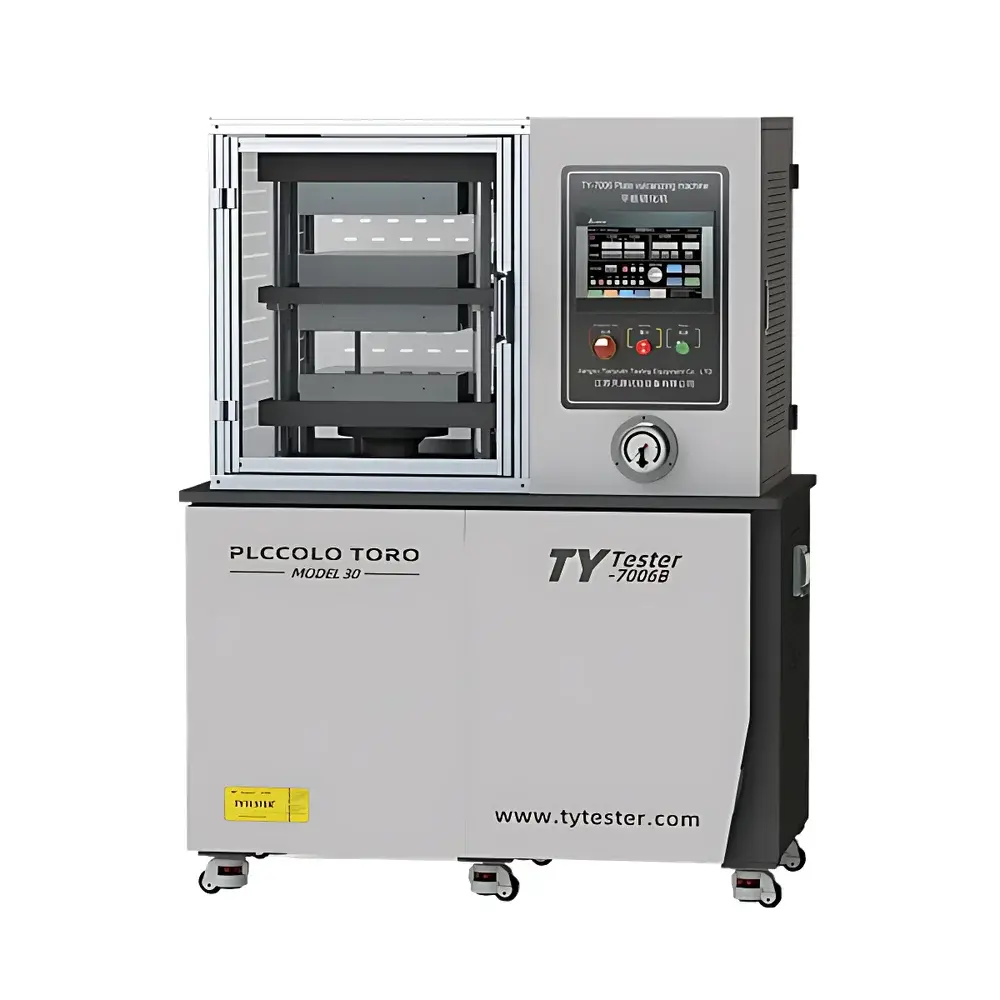
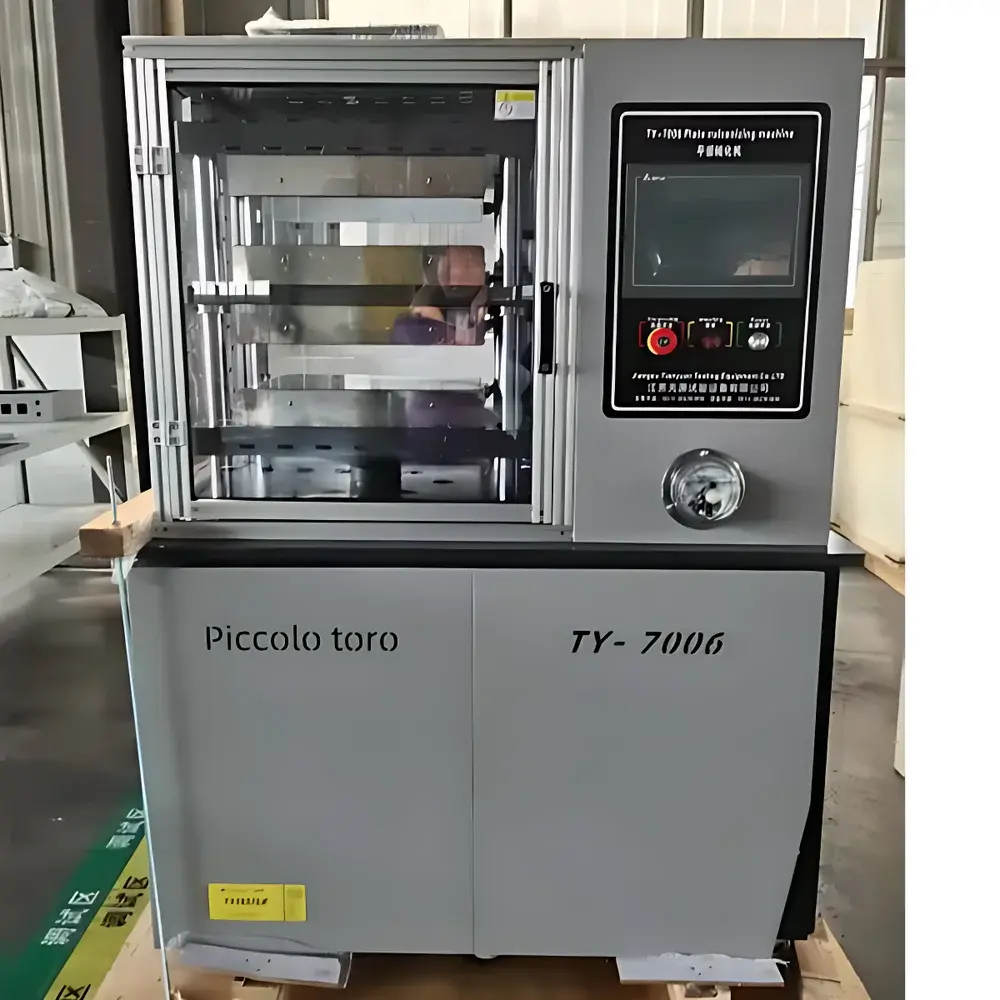
TianYuan TY-7006 Dual-Plate Laboratory Vulcanizing Press
| Brand | TianYuan |
|---|---|
| Origin | Jiangsu, China |
| Manufacturer Type | Direct Manufacturer |
| Region Category | Domestic (China) |
| Model | TY-7006 |
| Price Range | USD 4,200 – 12,600 (FOB) |
| Temperature Range | RT to 300 °C (optional up to 400 °C) |
| Temperature Accuracy | ±2 °C |
| Power Supply | AC 380 V ±10%, 18 A |
| Heating Power | 18 kW (dual-layer) |
| Plate Dimensions | 300 × 300 mm |
| Plate Material | Ductile Cast Iron (precision ground, corrosion-resistant) |
| Platen Spacing | 150 mm total (75 mm per layer) |
| Opening Stroke | 150 mm |
| Cooling Method | Tap-water-cooled lower platen |
| Exhaust Cycles | 0–10 programmable |
| Control System | PLC with color touchscreen HMI |
| Hydraulic System | Proportional flow control valve + closed-loop pressure regulation |
| Hydraulic Fluid | Mobil DTE 32 (customer-supplied) |
| Safety Features | Interlocked transparent safety door |
| Machine Dimensions (W×D×H) | 1180 × 585 × 1460 mm |
| Net Weight | 738 kg |
Overview
The TianYuan TY-7006 Dual-Plate Laboratory Vulcanizing Press is an engineered solution for precise, repeatable vulcanization and compression molding of rubber compounds, thermoplastic elastomers, and polymer blends under controlled temperature, pressure, and time conditions. Based on the fundamental principle of heat-and-pressure-induced crosslinking—governed by Arrhenius kinetics and rheological state transitions—the TY-7006 enables laboratory-scale replication of industrial curing profiles. Its dual-platen architecture allows simultaneous or independent thermal management: the upper platen is electrically heated via a Y-connected (star-wired) three-phase resistive system, while the lower platen is actively cooled using tap water circulation. This configuration supports rapid thermal equilibration, minimizes thermal lag, and facilitates accurate simulation of cooling phases critical to post-cure dimensional stability and network relaxation analysis.
Key Features
- Dual-zone thermal control: Independent heating (upper) and cooling (lower) platens enable precise simulation of industrial cure-cool cycles, supporting ISO 34-1, ASTM D3182, and GB/T 16584 test protocols.
- PLC-based HMI with 7-inch color touchscreen: Intuitive interface for programming multi-step vulcanization sequences—including preheat, compression, exhaust (0–10 cycles), dwell, and cooling—with real-time graphical monitoring of temperature, pressure, and elapsed time.
- Linear voltage regulation: Proprietary linear phase-angle control module ensures proportional power delivery—eliminating overshoot and improving thermal stability to ±2 °C across the full 25–300 °C operating range.
- Robust hydraulic architecture: Closed-loop proportional flow control valve maintains consistent pressure application (25–30 metric tons nominal force) with <±0.5% pressure deviation during dwell phases; compliant with ISO 7500-1 Class 1 load cell accuracy requirements.
- Corrosion-resistant ductile cast iron platens: Precision-ground (Ra ≤ 0.8 µm), stress-relieved surfaces ensure uniform heat transfer, minimal warpage, and long-term flatness retention—even after repeated thermal cycling.
- Interlocked safety enclosure: Transparent polycarbonate door with hardwired safety circuit interrupts all actuation immediately upon opening—meeting CE machinery directive EN ISO 13857 and OSHA 1910.212 requirements.
Sample Compatibility & Compliance
The TY-7006 accommodates standard test specimens per ASTM D5289 (MDR), ISO 6502 (oscillating disc), and GB/T 16584 (moving die), as well as custom molds up to 300 × 300 mm footprint. It supports gel content evaluation (e.g., ASTM D6084), scorch time determination (ts1/ts2), optimum cure time (t90), and post-vulcanization property correlation. The system is compatible with QC/QA workflows requiring traceability: all process parameters (setpoints, actuals, timestamps) are logged internally and exportable via USB. When integrated with validated LIMS or ELN platforms, it supports GLP-compliant data integrity per FDA 21 CFR Part 11 (audit trail, electronic signature readiness). Calibration certificates for temperature sensors (PT100 class A) and pressure transducers are provided with each unit.
Software & Data Management
The embedded PLC firmware records full-cycle process data at 1 Hz resolution—including platen surface temperature (dual-point), hydraulic pressure, cycle stage status, and exhaust event markers. Data exports in CSV format support direct import into statistical analysis tools (Minitab, JMP) or laboratory informatics systems. Optional Ethernet/IP or Modbus TCP interfaces enable centralized monitoring in multi-unit labs. All HMI configurations are password-protected with role-based access (Operator, Technician, Administrator), and firmware updates are performed via secure USB authentication to prevent unauthorized modification—aligning with IEC 62443-3-3 SL2 cybersecurity guidelines for industrial controllers.
Applications
- Rubber formulation development: Screening accelerator systems, sulfur donors, and filler dispersion effects on scorch safety and crosslink density.
- Compound quality assurance: Detection of gel particles (“fish eyes”), black specks, and contamination via visual inspection of compression-molded plaques (per ASTM D2240 hardness mapping or ASTM D412 tensile sampling).
- Thermoplastic elastomer (TPE) processing validation: Simulating injection-molding gate freeze times and evaluating melt reversion behavior under sustained pressure.
- Recycled rubber compound characterization: Assessing reversion resistance and network stability during extended dwell periods at elevated temperatures.
- Academic research in polymer physics: Correlating vulcanization kinetics with dynamic mechanical analysis (DMA) and differential scanning calorimetry (DSC) results.
FAQ
What is the maximum recommended operating temperature for continuous use?
The standard configuration is rated for continuous operation up to 300 °C; optional high-temp insulation and upgraded gasket materials allow validated use at 400 °C for short-duration research applications.
Can the lower platen be configured for heating instead of cooling?
No—the dual-layer thermal design is fixed: upper platen only heats; lower platen only cools. This asymmetry is intentional to replicate industrial press quenching behavior and prevent thermal inversion.
Is the hydraulic oil included with shipment?
No—Mobil DTE 32 (or equivalent ISO VG 32 anti-wear hydraulic fluid) must be supplied by the end user prior to commissioning; volume required is approximately 28 liters.
Does the system support ASTM D5289 MDR-style oscillatory testing?
No—the TY-7006 is a static compression press, not a moving-die rheometer. However, cured samples produced on this press are fully compatible as test specimens for subsequent MDR, RPA, or Mooney viscometer analysis.
What documentation is provided for regulatory compliance?
Each unit ships with Factory Calibration Report (temperature, pressure), CE Declaration of Conformity, Electrical Safety Test Report (IEC 61000-6-2/6-4), and User Manual with maintenance schedules and traceable spare parts list.



