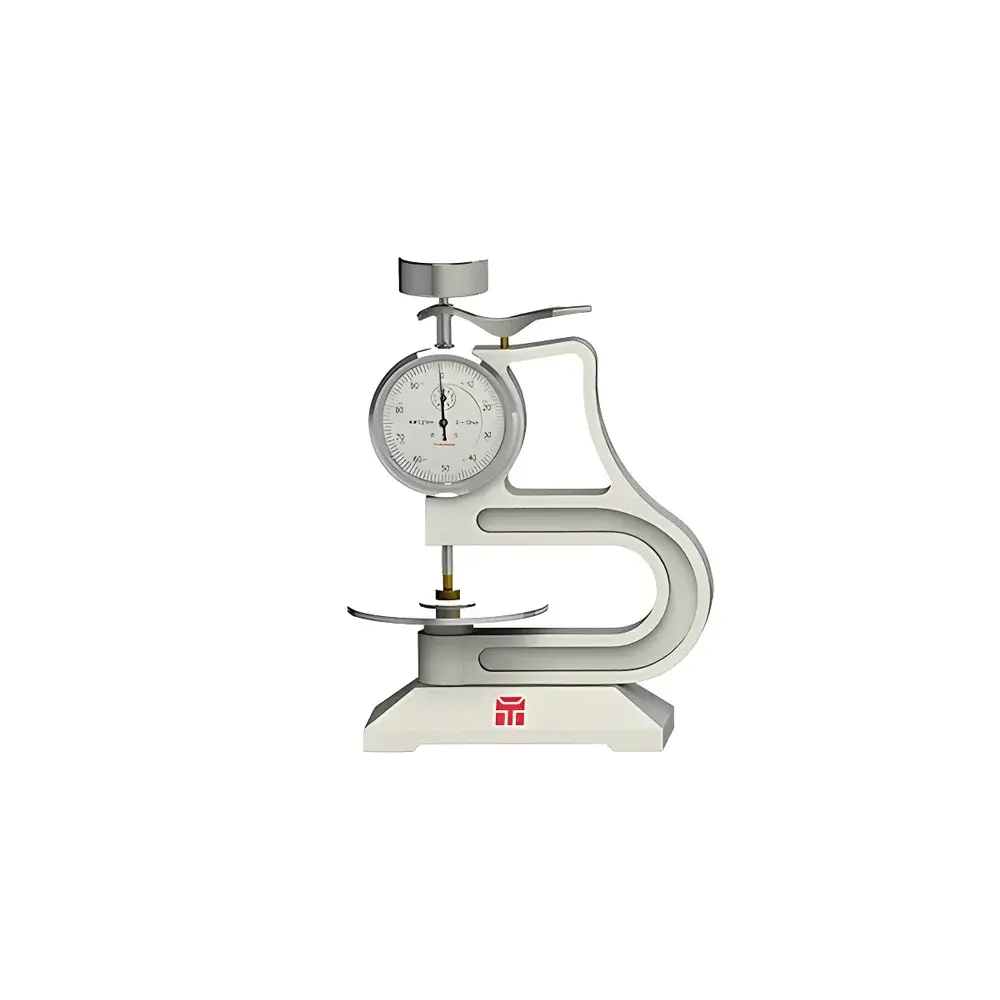
TianYuan TY-2002 Rubber and Plastic Thickness Gauge
| Brand | TianYuan |
|---|---|
| Origin | Jiangsu, China |
| Manufacturer Type | Direct Manufacturer |
| Country of Origin | China |
| Model | TY-2002 |
| Quotation | Upon Request |
| Measurement Range | 0–10 mm (customizable) |
| Resolution | 0.01 mm |
| Upper Anvil Diameter | 6 ± 0.05 mm |
| Applied Weights | 130 g, 110 g, 10 g |
| Probe Tip Diameters | φ2 mm, φ4 mm × 1 mm, φ5 mm, φ10 mm |
| Dimensions | 145 mm × 195 mm × 80 mm |
Overview
The TianYuan TY-2002 Rubber and Plastic Thickness Gauge is a precision mechanical thickness measurement instrument engineered for consistent, traceable thickness evaluation of elastomeric and thermoplastic materials under standardized loading conditions. It operates on the principle of controlled-force contact measurement: a calibrated anvil applies defined static pressure via standardized weights onto a specimen placed on a rigid base plate, while a high-resolution dial indicator or digital displacement sensor records the vertical deformation at the point of contact. This method conforms to fundamental metrological requirements for non-destructive, surface-normal thickness assessment—particularly critical for quality control in rubber compounding, extrusion, calendering, and cable insulation manufacturing. Unlike optical or ultrasonic alternatives, the TY-2002 delivers direct mechanical displacement data unaffected by material opacity, surface reflectivity, or acoustic impedance variations—making it especially suitable for black rubber compounds, filled polymers, and multi-layer insulated wires where signal attenuation or interference compromises alternative techniques.
Key Features
- Modular probe system with four interchangeable measuring tips (φ2 mm, φ4 mm × 1 mm rectangular, φ5 mm, and φ10 mm) to accommodate varying specimen geometries, surface curvatures, and ASTM/ISO-defined test zones.
- Triple-weight configuration (10 g, 110 g, 130 g) enables compliance with multiple industry-standard loading protocols—including HG/T 2041 (Rubber Thickness Gauge Technical Specification) and GB/T 5723 (Test Piece and Product Dimension Measurement Methods for Vulcanized Rubber).
- Upper anvil with precisely ground 6 ± 0.05 mm diameter ensures uniform pressure distribution across the contact area, minimizing edge effects and improving repeatability across repeated measurements.
- Compact benchtop footprint (145 × 195 × 80 mm) and rigid cast-aluminum housing provide mechanical stability during manual operation and resistance to thermal drift in ambient lab environments.
- 0.01 mm resolution dial indicator or optional digital transducer output supports manual data logging or integration with basic SCADA-compatible acquisition systems via analog voltage output (0–5 V DC, linear scale).
Sample Compatibility & Compliance
The TY-2002 is validated for use with vulcanized rubber sheets, thermoplastic elastomer films, PVC and PE insulation layers, rubber-coated fabrics, and cross-linked polymer tapes. Its force-controlled design meets the physical testing requirements of HG/T 2041 and GB/T 5723, and its dimensional repeatability aligns with ISO 2781 (Rubber—Determination of Density) and ISO 23529 (Rubber—General Procedures for Preparing and Conditioning Test Pieces). While not intrinsically compliant with FDA 21 CFR Part 11 or EU Annex 11 due to its analog/manual architecture, documented calibration records, weight traceability to national standards (e.g., CNAS-accredited mass standards), and operator training logs support GLP/GMP-aligned QC workflows in regulated manufacturing environments.
Software & Data Management
The base TY-2002 model operates without embedded firmware or proprietary software. However, when equipped with the optional digital displacement sensor module, raw analog output can be acquired using third-party DAQ hardware (e.g., National Instruments USB-6009 or Keysight 34972A) and processed in MATLAB, Python (with PyVISA), or LabVIEW. Calibration coefficients are stored externally; users maintain full control over data handling, audit trails, and metadata tagging. For laboratories requiring electronic records, the device supports CSV export of timestamped thickness values with associated weight, probe ID, and operator code—enabling alignment with internal SOPs for data integrity and reviewability.
Applications
- QC inspection of cured rubber sheet thickness prior to die-cutting or molding feedstock preparation.
- Uniformity profiling across extruded plastic film rolls (e.g., TPU, LDPE) to detect gauge banding or die lip wear.
- Insulation thickness verification on stranded copper cables per IEC 60227 and UL 62 specifications.
- Process validation of calendaring line settings by measuring thickness reduction ratios at multiple roll nip positions.
- Comparative analysis of compression set specimens before and after aging—when used with fixed-load fixtures and standardized dwell times.
FAQ
Is the TY-2002 compatible with ISO/IEC 17025-accredited calibration labs?
Yes—the instrument’s mechanical design allows full disassembly for independent verification of anvil geometry, weight mass, and indicator linearity. Accredited labs routinely calibrate it against traceable gauge blocks and certified masses.
Can the 0–10 mm range be extended beyond 10 mm?
Standard units are limited to 10 mm travel; however, TianYuan offers custom-engineered variants with extended indicator stroke and reinforced base plates for applications up to 25 mm—subject to structural stability and load distribution validation.
Does the device meet RoHS or REACH material compliance?
All metallic components comply with RoHS Directive 2011/65/EU; elastomeric seals and indicator dials are manufactured from halogen-free polymers meeting REACH SVHC thresholds per current Annex XIV revision.
What maintenance intervals are recommended for long-term accuracy?
Biannual verification of weight mass (±0.1% tolerance), annual re-certification of indicator linearity, and quarterly cleaning of anvil surfaces with isopropyl alcohol are advised per manufacturer guidelines.