
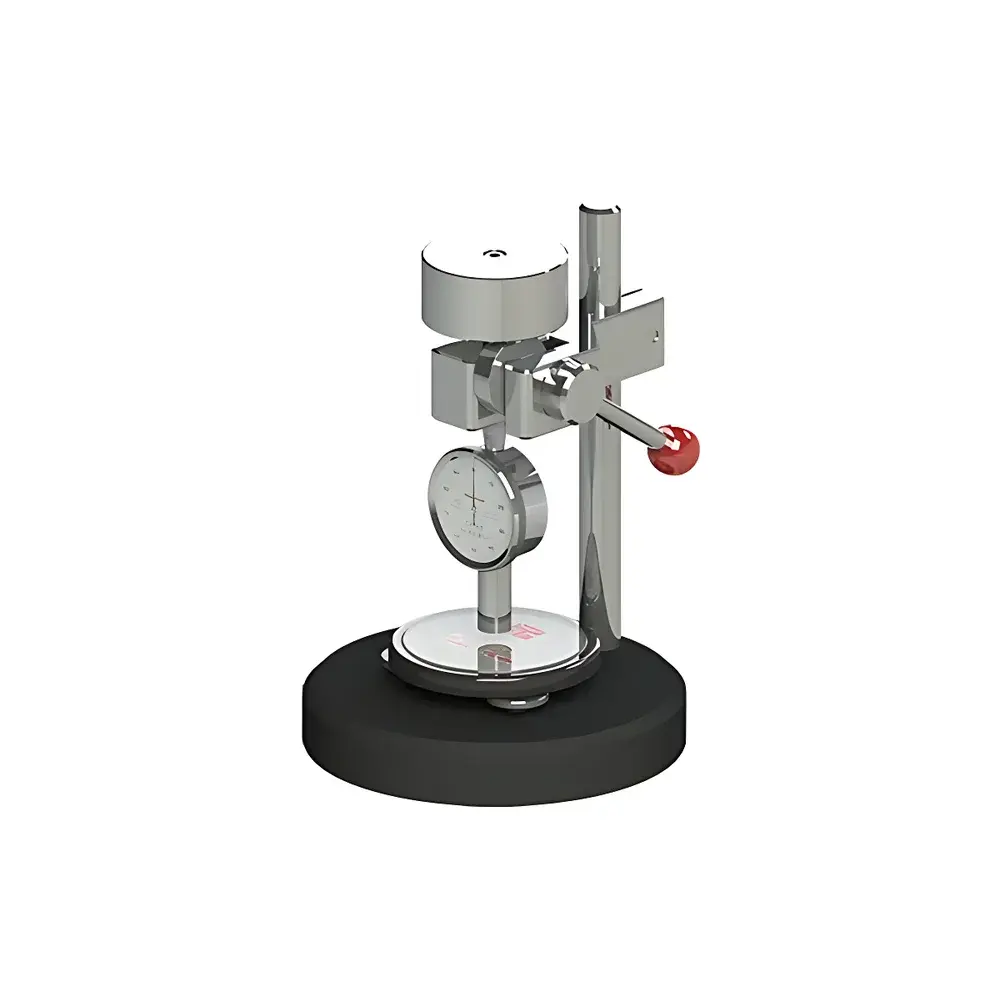
TianYuan TYLX-A Shore A Durometer
| Brand | TianYuan |
|---|---|
| Model | TYLX-A |
| Type | Shore A Hardness Tester |
| Standard Compliance | GB/T 531.1, GB/T 2411, HG/T 2489, JB 6148 |
| Indentor Tip Diameter | 1.25 mm ± 0.15 mm |
| Indentor Tip Radius (A-type) | 0.375 mm |
| Full Scale Range | 0–100 HA |
| Indentation Depth Range | 0–2.5 mm |
| Base Dimensions | 200 × 115 × 310 mm |
| Net Weight | 12 kg |
Overview
The TianYuan TYLX-A Shore A Durometer is a manually operated, spring-loaded indentation hardness tester engineered for precise and repeatable measurement of the indentation hardness of vulcanized rubber, thermoplastic elastomers, and soft polymeric materials. It operates in strict accordance with the fundamental principle defined in ISO 7619-1 and ASTM D2240—measuring the depth of penetration of a standardized truncated conical indenter under a defined spring force into the surface of a test specimen. The A-scale configuration employs a 35° conical indenter with a 0.375 mm radius tip and a nominal spring force of 0.822 N (83.8 gf), enabling reliable quantification of materials with hardness values ranging from 0 to 100 Shore A—covering low-to-medium stiffness elastomers commonly used in automotive seals, footwear soles, gaskets, and medical tubing. Unlike digital or motorized systems, the TYLX-A utilizes a robust mechanical analog dial gauge with direct optical readout, eliminating dependency on batteries or software calibration drift while maintaining long-term metrological stability under routine laboratory or production floor use.
Key Features
- High-stability steel frame with precision-machined base (200 × 115 × 310 mm) and 12 kg mass ensures minimal vibration-induced measurement error during manual operation.
- Spring-loaded indenter assembly conforms to ISO 7619-1 dimensional tolerances: conical angle 35° ± 0.25°, tip radius 0.375 mm ± 0.015 mm, and total travel range of 0–2.5 mm with mechanical stop.
- Analog dial scale calibrated to 0–100 HA with 1-unit graduation resolution; scale linearity verified per GB/T 531.1 Annex B and traceable to national metrology standards.
- Dual-purpose design accommodates both handheld and stand-mounted testing modes—supplied with integrated vertical stand for consistent perpendicular loading and operator-independent positioning.
- Mechanically isolated loading mechanism prevents hysteresis and creep effects; zero-reset function allows rapid sequential measurements without recalibration between samples.
Sample Compatibility & Compliance
The TYLX-A is validated for use with flat, smooth, and homogeneous specimens ≥6 mm thick and ≥15 mm in diameter, as specified in ISO 7619-1 Clause 6. It is unsuitable for foamed materials, fiber-reinforced composites, or curved surfaces unless mounted on auxiliary fixtures meeting ASTM D2240 Annex A requirements. All test procedures must adhere to environmental conditioning per ISO 23529:2016 (standard laboratory temperature 23 °C ± 2 °C, relative humidity 50 % ± 5 %) prior to measurement. The instrument meets mandatory requirements of Chinese national standards GB/T 531.1 (Rubber—Determination of indentation hardness—Part 1: Shore hardness), GB/T 2411 (Plastics and ebonite—Determination of indentation hardness by means of a durometer), HG/T 2489 (Rubber hardness tester technical specification), and JB 6148 (Mechanical industrial standard for hardness testers). While not certified to ISO/IEC 17025, its design and verification protocol support GLP-compliant hardness documentation when paired with controlled test logs and periodic verification using NIST-traceable reference blocks (e.g., Shore A 40, 70, and 90 standards).
Software & Data Management
The TYLX-A is a standalone mechanical instrument with no embedded electronics, firmware, or data output interfaces. Consequently, it does not require software installation, cybersecurity validation, or FDA 21 CFR Part 11 compliance for electronic records. Hardness values are recorded manually in laboratory notebooks or LIMS-compatible spreadsheets. For laboratories requiring digital traceability, optional external USB microscopes or calibrated digital calipers may be used to capture dial readings, with metadata (operator ID, timestamp, sample ID, ambient conditions) entered separately to satisfy internal QA audit trails. Calibration verification reports—including spring force verification, indenter geometry inspection, and scale linearity checks—must be retained for minimum 3 years per ISO/IEC 17025 Clause 7.7 and internal quality system requirements.
Applications
- Quality control of extruded EPDM, silicone, and natural rubber profiles in automotive and construction sealing applications.
- In-process verification of cure state in continuous vulcanization (CV) lines—correlating Shore A values with crosslink density via parallel DSC or rheometry.
- Batch release testing of TPE-based consumer product components (e.g., grips, soft-touch overmolds) against specification limits (e.g., 45–55 HA).
- Research-grade comparative analysis of polymer blends, filler dispersion effects, and plasticizer migration over accelerated aging cycles.
- Teaching laboratories demonstrating fundamental viscoelastic response principles through controlled indentation recovery experiments.
FAQ
What is the recommended specimen thickness for accurate Shore A measurement?
Minimum thickness is 6 mm; thinner specimens must be backed by rigid support to prevent substrate deformation and ensure valid readings.
Can the TYLX-A be used for foam or cellular rubber materials?
No—foamed or microcellular materials (e.g., shoe midsoles) require Shore C or IFD testing per ASTM D3574; the A-scale indenter over-penetrates such structures, yielding non-representative values.
How often should the instrument be verified with reference hardness blocks?
Daily before first use in regulated environments; weekly in R&D settings—using at least three certified blocks spanning the expected measurement range (e.g., 30 HA, 60 HA, 90 HA).
Is the TYLX-A compliant with ISO 7619-1:2018?
Yes—the indenter geometry, spring force, and scale calibration fully conform to ISO 7619-1:2018 Annex A requirements for Shore A instruments.
Does this model support D-scale or C-scale measurements?
No—the TYLX-A is exclusively configured for Shore A scale; separate models (TYLX-D, TYLX-C) are required for D- or C-scale testing per ASTM D2240.





