
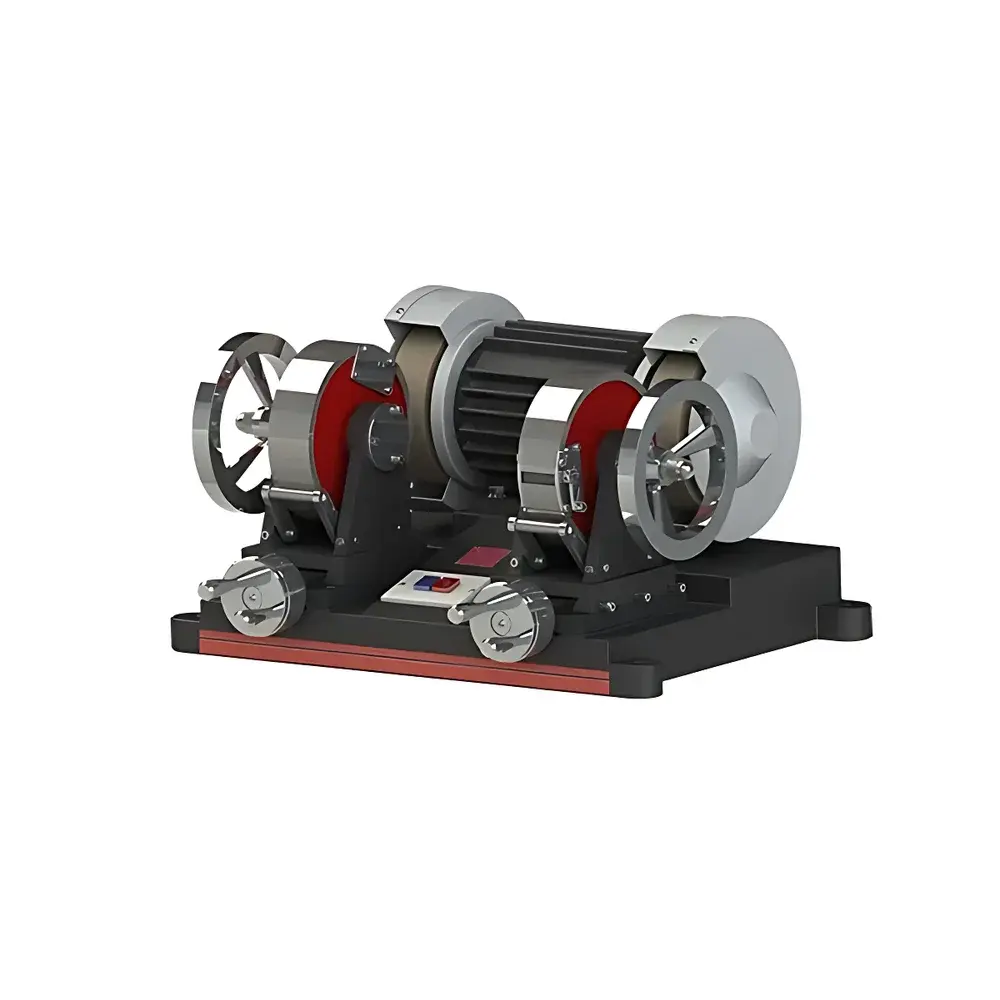
TYMP-II Dual-Head Abrasive Grinding Machine
| Brand | TianYuan |
|---|---|
| Origin | Jiangsu, China |
| Manufacturer Type | Direct Manufacturer |
| Country of Origin | China |
| Model | TYMP-II |
| Speed Options | 11 m/s or 20 m/s (selectable) |
| Motor Speed | 1400 rpm or 2800 rpm |
| Grinding Wheel Specifications | G260APRI, 150 × 40 × 32 mm (32-grit and 80-grit options available) |
| Worktable Diameter | 160 × 44 mm |
| Center Height | 214 mm |
| Traverse Stroke | 20 mm |
| Sample Dimensions | Length > 260 mm, Width ≤ 34 mm, Thickness ≤ 8 mm |
| Overall Dimensions | 500 × 400 × 314 mm |
| Weight | 80 kg |
| Dust Extraction Port | Ø50 mm |
Overview
The TYMP-II Dual-Head Abrasive Grinding Machine is a precision sample preparation instrument engineered for standardized thickness reduction of elastomeric and thermoplastic specimens prior to mechanical, physical, or chemical testing. Designed in strict accordance with ISO 9865-1 (equivalent to GB/T 9865.1) and HG/T 3654—key standards governing rubber and plastic test specimen conditioning—the TYMP-II employs a dual abrasive wheel configuration operating under controlled linear velocity conditions. Its core principle relies on orthogonal, parallel grinding using two independently mounted, high-stability bonded abrasive wheels rotating at precisely regulated surface speeds (11 m/s or 20 m/s). This ensures uniform material removal, minimal thermal distortion, and repeatable dimensional control across batches—critical prerequisites for compliant tensile, hardness, aging, and adhesion testing in R&D, QC, and certification laboratories.
Key Features
- Dual-head architecture with synchronized, counter-rotating abrasive wheels enabling simultaneous top-and-bottom surface grinding for enhanced planarity and reduced edge taper.
- Selectably configurable linear grinding speed: 11 m/s for fine finishing and heat-sensitive polymers; 20 m/s for high-throughput pre-grinding of rigid thermoplastics and reinforced elastomers.
- Modular wheel mounting system accommodating standard G260APRI wheels (150 × 40 × 32 mm) in two grit grades—32-grit for rapid stock removal and 80-grit for final thickness calibration.
- Adjustable traverse stroke of 20 mm with micrometer-graduated depth feed, supporting incremental thickness control within ±0.05 mm repeatability under routine operation.
- Integrated Ø50 mm industrial dust extraction interface compatible with centralized vacuum systems or standalone cyclonic collectors—ensuring OSHA-compliant particulate containment and extended wheel life.
- Rigid cast-iron base and precision-machined worktable (160 × 44 mm) with center height of 214 mm, optimized for stability during prolonged grinding cycles and alignment with downstream testing fixtures.
Sample Compatibility & Compliance
The TYMP-II accommodates flat, flexible, or semi-rigid specimens conforming to standard test strip geometries: minimum length >260 mm, maximum width ≤34 mm, and initial thickness ≤8 mm. It is routinely deployed for preparing specimens from natural rubber (NR), styrene-butadiene rubber (SBR), ethylene propylene diene monomer (EPDM), polyethylene (PE), polypropylene (PP), ABS, and PVC compounds. All operational parameters—including wheel speed, feed rate, and dwell time—are documented and traceable to support GLP-compliant workflows. The machine’s design and output consistency align with the procedural requirements of ASTM D3182, ISO 37, ISO 48, and ISO 179, and its use is recognized in internal audit protocols for ISO/IEC 17025-accredited rubber and plastic testing laboratories.
Software & Data Management
As a manually operated mechanical grinder, the TYMP-II does not incorporate embedded digital controls or software interfaces. However, its mechanical adjustability—particularly the calibrated depth feed dial and fixed-speed motor selection—is fully documentable within laboratory notebooks and electronic quality management systems (eQMS). Users may integrate operational logs (e.g., wheel type, speed setting, batch ID, operator, date/time) into LIMS platforms via structured CSV templates or barcode-scanned work orders. For FDA-regulated environments, manual recordkeeping practices comply with 21 CFR Part 11 when supported by institutional SOPs covering signature verification, audit trail retention, and version-controlled procedure documentation.
Applications
- Preparation of dumbbell- and strip-shaped specimens for tensile strength, elongation at break, and modulus testing per ISO 37 and ASTM D412.
- Thickness standardization of vulcanized rubber sheets prior to Shore A/D hardness measurement (ISO 7619-1, ASTM D2240).
- Surface conditioning of polymer films and molded parts prior to peel adhesion (ASTM D903) or shear bond testing.
- Controlled thinning of aged or weathered rubber samples for comparative degradation analysis in accelerated aging studies (ISO 1431, ASTM D573).
- Production of uniformly thick blanks for die-cutting into standardized test pieces used in compression set (ISO 815) and resilience (ISO 4662) evaluations.
FAQ
What standards does the TYMP-II comply with?
The TYMP-II is designed and validated to meet the mechanical and procedural requirements of GB/T 9865.1, HG/T 3654, ISO 9865-1, and related international specimen preparation norms.
Can both grinding wheels operate at different speeds?
No—the dual wheels are mechanically coupled and rotate at identical surface velocities (either 11 m/s or 20 m/s) to maintain parallelism and avoid differential wear or specimen warping.
Is wheel dressing or truing supported on this machine?
The TYMP-II does not include an integrated wheel dresser; however, standard diamond tooling compatible with G260APRI wheels may be applied externally following manufacturer-recommended maintenance intervals.
What safety certifications does the unit carry?
The TYMP-II conforms to CE machinery directive principles (2006/42/EC) as implemented under Chinese GB/T 5226.1–2019 (equivalent to IEC 60204-1), including emergency stop functionality, guarded wheel enclosure, and grounding continuity verification.
How is calibration verified during routine use?
Calibration is performed using certified micrometers and laser displacement sensors to validate traverse feed accuracy and wheel runout; recommended quarterly verification is documented per internal metrology SOPs aligned with ISO/IEC 17025 Clause 6.5.





