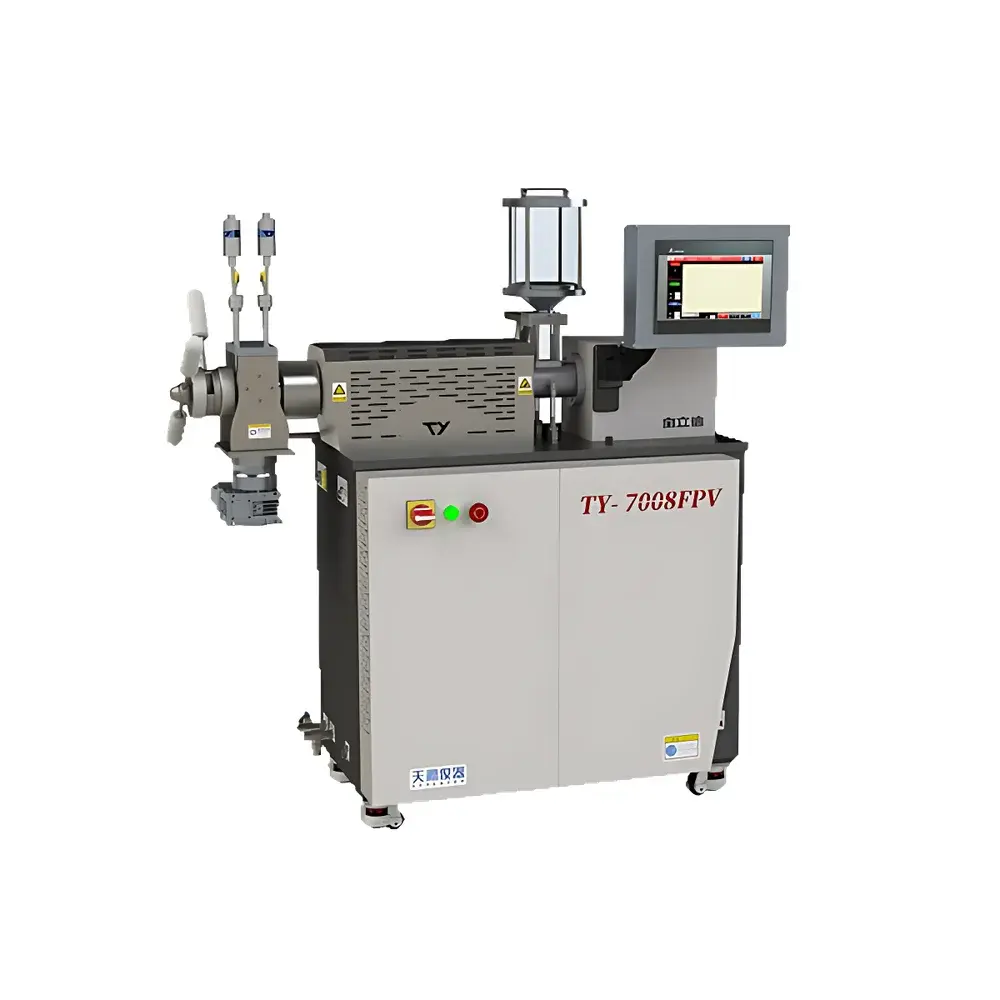
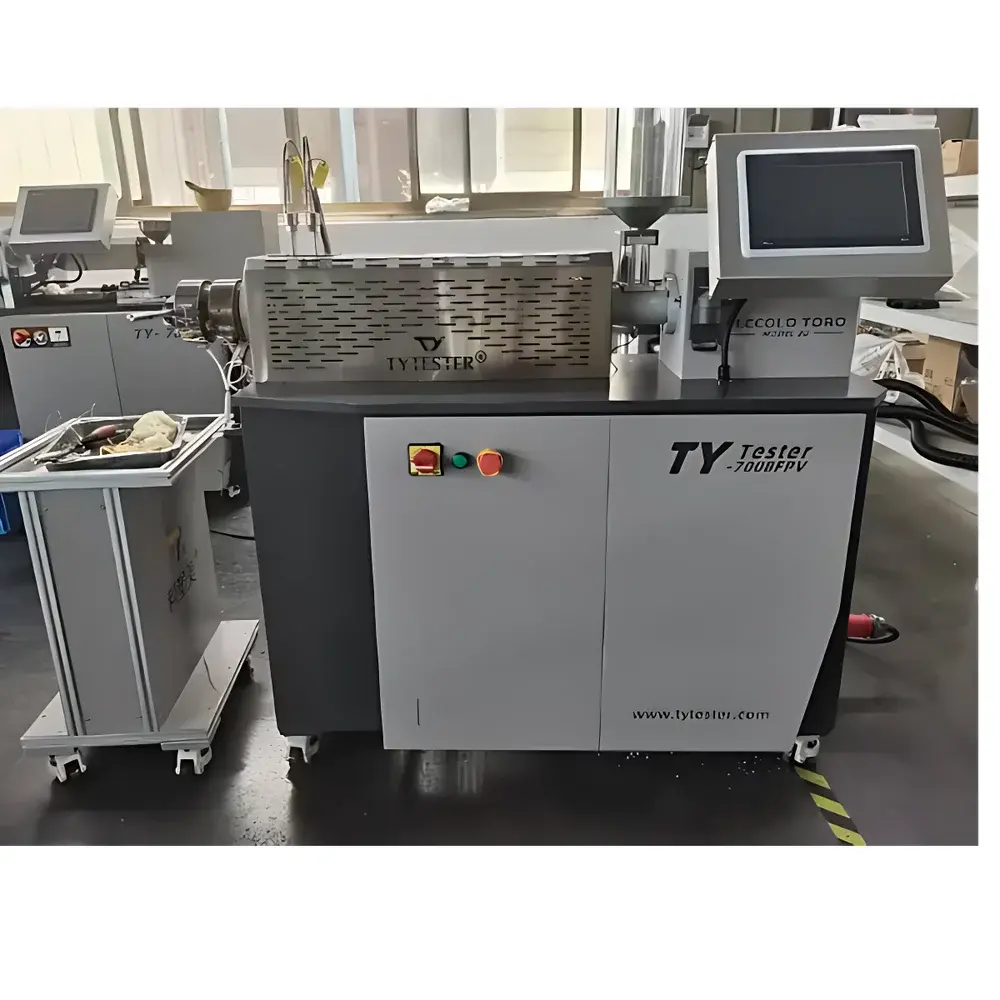
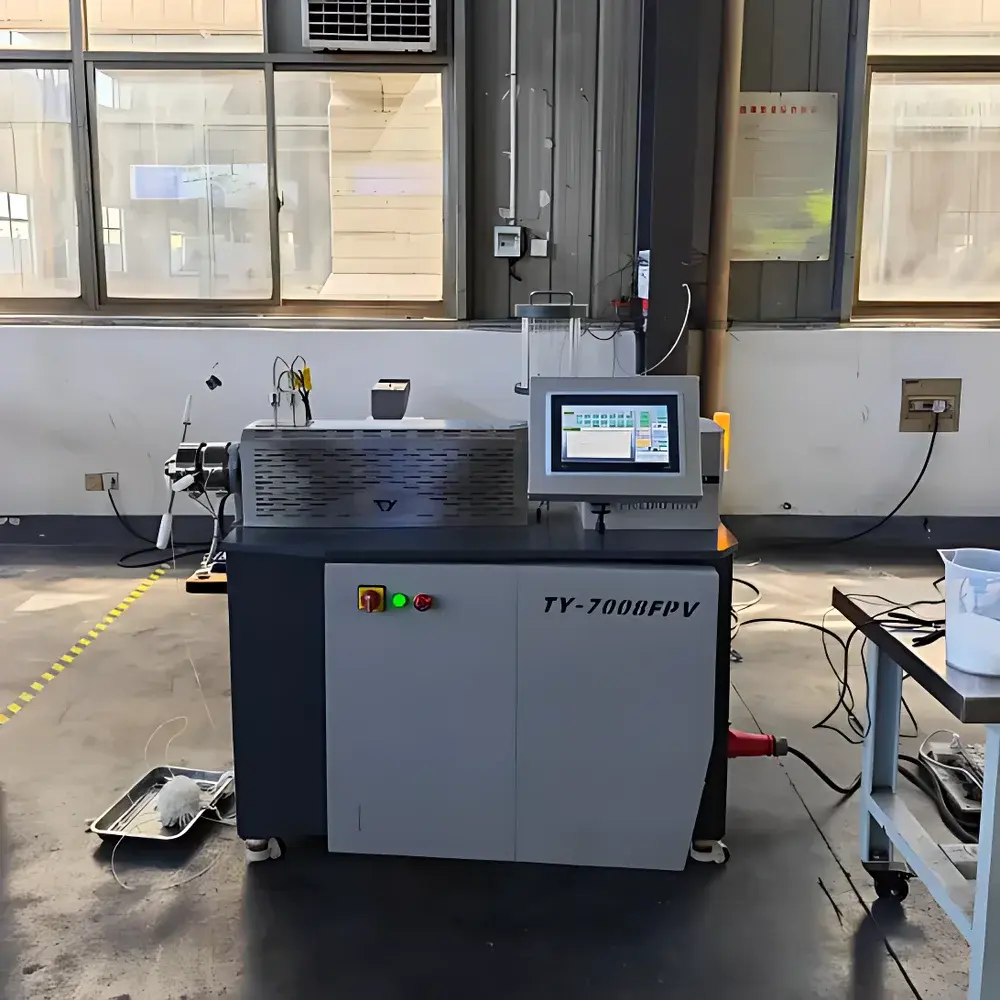
Lishumei TY-7008FPV Melt Filtration Tester for Rubber & Plastic Extrusion Processes
| Brand | Lishumei |
|---|---|
| Model | TY-7008FPV |
| Screw Diameter | 20 mm |
| L/D Ratio | 1:28 |
| Max Output | 3–5 kg/h |
| Screw Speed | 1–95 rpm |
| Compression Ratio | 2.4:1 |
| Zone Temperatures | Up to 360 °C (4 heating zones + die) |
| Melt Pressure Range | Inlet 0–10 MPa, Outlet 0–35 MPa |
| Pressure Accuracy | ±0.1% FS |
| Melt Temperature Accuracy | ±0.5 °C |
| Melt Pump Displacement | 3 cm³/rev, Max Speed 60 rpm, Max Pressure 270 bar |
| Main Motor Power | 1.5 kW |
| Total Heating Power | 5 kW |
| Overall Dimensions | 1050 × 570 × 1390 mm (L×W×H) |
| Weight | ~300 kg |
| Filter Assembly | Aluminum-framed, multi-layer stainless steel woven mesh |
Overview
The Lishumei TY-7008FPV Melt Filtration Tester is a bench-scale, integrated extrusion-based system engineered for quantitative assessment of polymer melt filtration performance under industrially representative processing conditions. It combines a precision single-screw extruder, positive-displacement melt pump, configurable filter housing, and high-fidelity process instrumentation into a compact, PLC-controlled platform. The system operates on the principle of controlled melt flow through standardized filter media—measuring real-time pressure differentials, temperature profiles, and throughput stability to quantify filter clogging kinetics, pressure build-up rates, and contaminant retention efficiency. Designed specifically for R&D laboratories and quality control departments in rubber compounding, thermoplastic compound formulation, and masterbatch development, it enables reproducible evaluation of raw material cleanliness (e.g., regrind, recycled content), additive dispersion homogeneity, and pigment agglomeration behavior prior to full-scale production.
Key Features
- Stainless steel barrel and screw fabricated from nitrided 38CrMoAla alloy—optimized for wear resistance, thermal stability, and corrosion resistance in abrasive or thermally sensitive polymer melts.
- Four independently controlled SSR-heated zones plus die zone, each with PID-regulated temperature control (±0.5 °C) and real-time digital monitoring; maximum operating temperature 360 °C per zone.
- High-accuracy dual-channel melt pressure sensing (inlet and outlet) with ±0.1% full-scale accuracy across ranges of 0–10 MPa and 0–35 MPa respectively—enabling precise ΔP calculation over time.
- Integrated gear-type melt pump (3 cm³/rev displacement) delivering stable, pulse-free flow up to 270 bar; speed adjustable from 0–60 rpm with encoder feedback for volumetric consistency.
- Modular filter holder accommodating standard aluminum-rimmed, multi-layer stainless steel woven mesh filters (custom mesh counts available per application requirement).
- PLC-based data acquisition system logging pressure, temperature, screw speed, motor current, and pump RPM at user-defined intervals (≥1 Hz sampling); exportable to CSV for post-processing.
Sample Compatibility & Compliance
The TY-7008FPV accommodates thermoplastic resins (PP, PE, PS, ABS, PC, PA), elastomers (EPDM, SBR, TPE), and filled compounds (CaCO₃, talc, carbon black, glass fiber). Feedstock forms include pellets, granules, and pre-compounded flakes. Its operational methodology aligns with EN 13900-5:2005 (“Plastics — Determination of filterability of thermoplastics — Part 5: Method using a capillary rheometer with filter”), adapted here for extrusion-driven melt filtration analysis. While not certified to ISO/IEC 17025, the system supports GLP-compliant documentation workflows when paired with validated SOPs and audit-trail-enabled data export protocols. All electrical components meet CE safety directives; grounding, insulation, and thermal cutoffs conform to IEC 61000-6-2/6-4 EMC standards.
Software & Data Management
Data collection and visualization are managed via an embedded HMI interface running proprietary firmware compliant with Modbus RTU protocol. Real-time curves display pressure differential (ΔP), melt temperature gradient, and throughput stability during test runs. Raw datasets—including timestamps, sensor IDs, engineering units, and operator annotations—are stored internally and exportable via USB to CSV or Excel-compatible formats. For integration into enterprise QC systems, optional OPC UA gateway support enables seamless connectivity to LIMS or MES platforms. Audit trail functionality includes user login logs, parameter change history, and test initiation/termination records—facilitating FDA 21 CFR Part 11 readiness when deployed with supplementary electronic signature and access control policies.
Applications
- Quantitative comparison of filtration resistance between virgin resin grades and post-consumer recycled (PCR) feedstocks.
- Evaluation of dispersing agent efficacy in color masterbatches by tracking ΔP rise rate during fixed-duration tests.
- Screening of filler surface treatment integrity via pressure stabilization profiles after initial breakthrough.
- Validation of inline screen changer performance parameters prior to extrusion line commissioning.
- Root-cause analysis of die lip buildup incidents through correlation of filter clogging kinetics with rheological fingerprinting data.
- Supporting ASTM D3835 and ISO 11443-compliant melt index and viscosity testing when configured with standard capillary dies.
FAQ
What polymer types are compatible with the TY-7008FPV?
Thermoplastics (e.g., PP, HDPE, ABS), engineering resins (PC, PA6, POM), thermoplastic elastomers (TPE, TPU), and compounded elastomers (EPDM, NBR) — provided melt temperatures remain within the 360 °C upper limit and shear sensitivity permits stable extrusion.
Can the system be used for qualitative filter rating (e.g., “mesh count” determination)?
No — the TY-7008FPV is designed for quantitative pressure-differential-based filtration performance assessment, not mesh sizing. Filter specifications (e.g., wire diameter, open area %) must be supplied by the vendor; results reflect functional clogging behavior, not geometric classification.
Is calibration traceable to national standards?
Pressure and temperature sensors ship with factory calibration certificates referencing NIST-traceable references; end-user recalibration is recommended annually or after mechanical shock events, using accredited metrology services.
Does the system support automated test sequences?
Yes — up to 10 programmable test profiles can be stored in PLC memory, each defining ramp rates, dwell times, target pressures, and termination conditions (e.g., ΔP > 15 MPa or runtime ≥ 30 min).
What maintenance intervals are recommended?
Screw/barrel inspection every 500 operating hours; nitrogen purge of heater bands quarterly; melt pump oil replacement every 2,000 hours; thermocouple verification before each qualification run.