
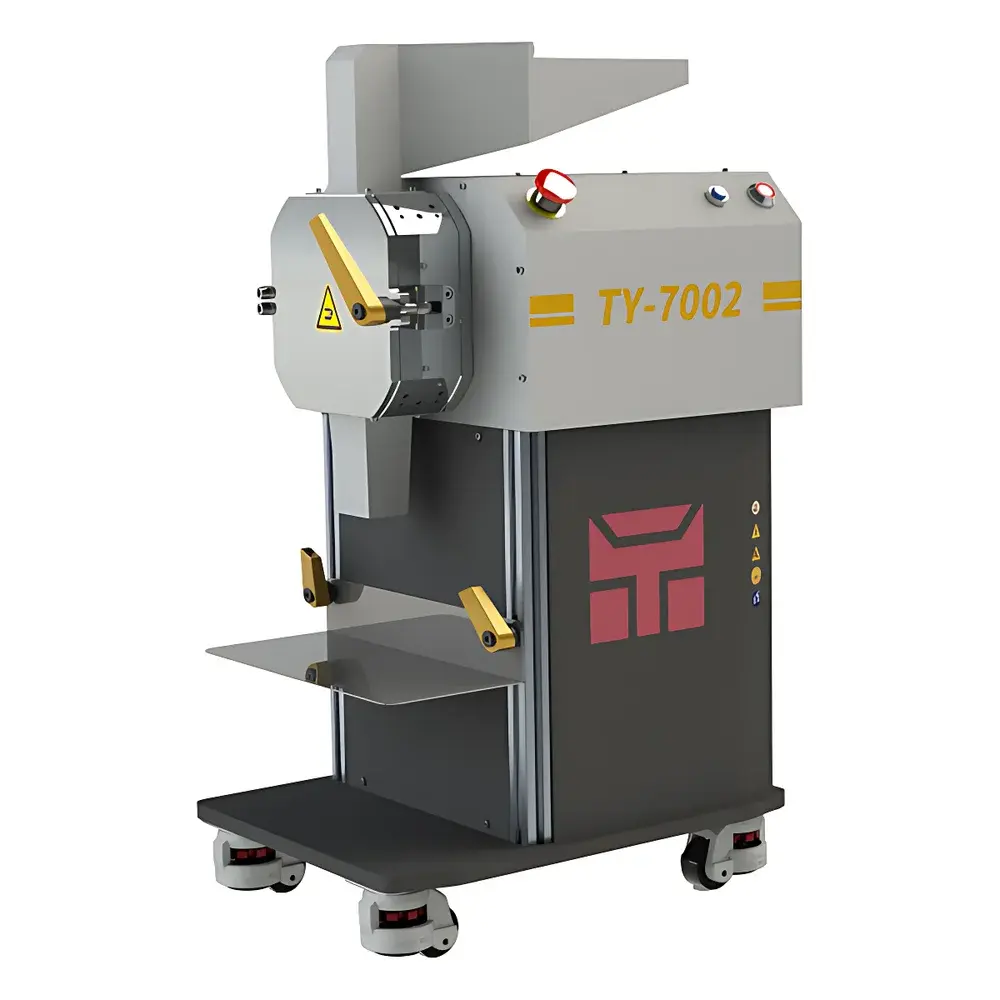
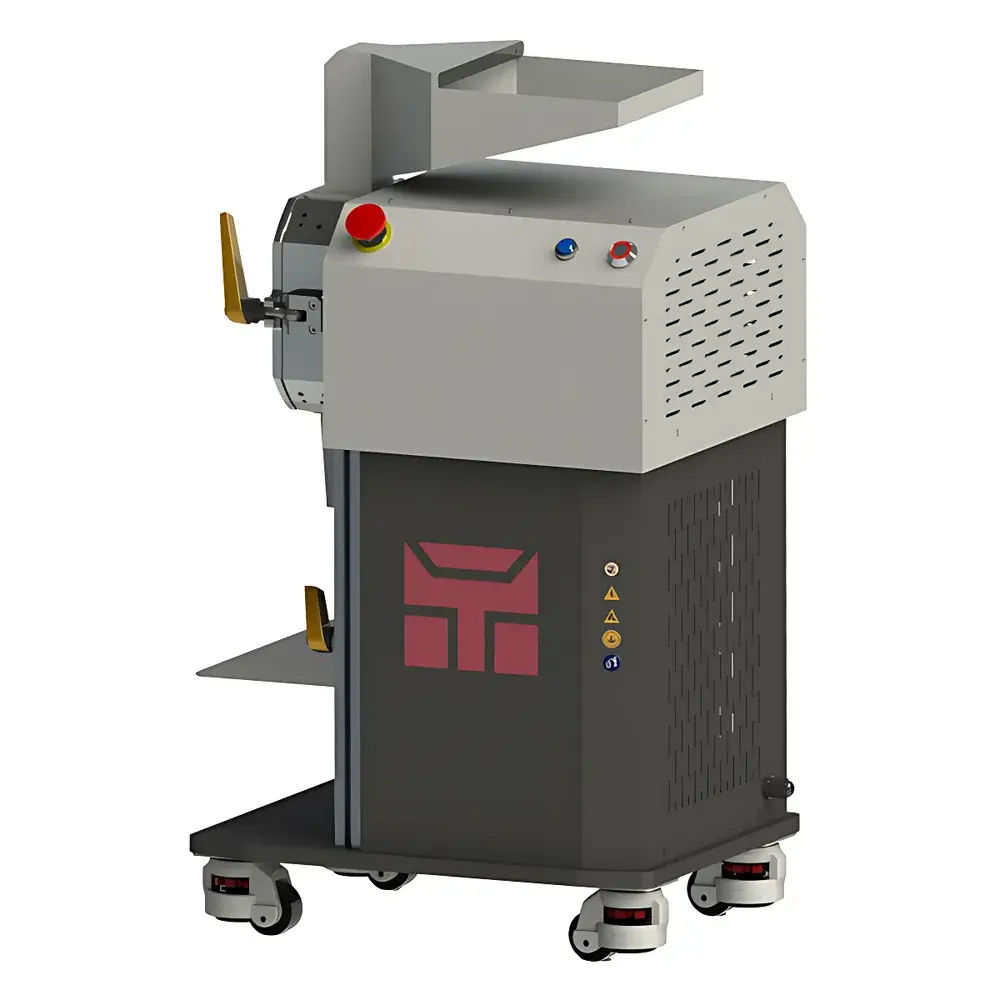
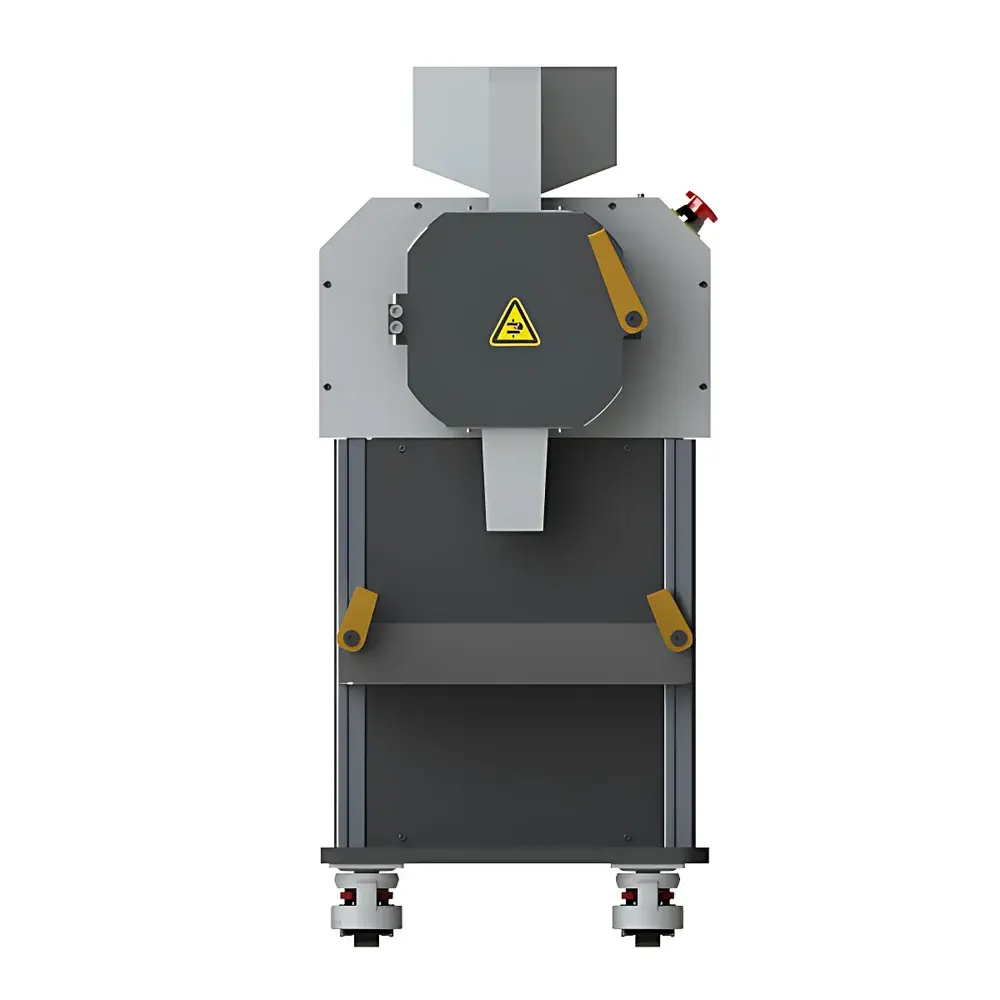
TianYuan TY-7002 Laboratory-Scale Plastic Granulator
| Brand | TianYuan |
|---|---|
| Origin | Jiangsu, China |
| Manufacturer Type | Direct Manufacturer |
| Country of Origin | China |
| Model | TY-7002 |
| Motor Power | 2.2 kW |
| Voltage Input | 380 V AC three-phase convertible to 220 V AC single-phase via integrated converter |
| Grinding Chamber Diameter × Depth | Φ160 mm × 70 mm |
| Throughput Capacity | 15–30 kg/h |
| Base Construction | Welded carbon steel plate |
| Rotor Blade Material | Alloy steel |
| Rotor Blade Count | 3 |
| Stator Blade Count | 4 |
| Blade Geometry | Flat-profile (planar) cutting edges |
| Feed Hopper Material | Mild steel plate |
| Collection Bin Material | AISI 304 stainless steel |
| Sieve Mesh Aperture Options | 6 mm, 8 mm, or 10 mm |
| Sieve Material | Carbon steel |
| Motor Brand | Wannan Motor Co., Ltd. |
| Inverter Brand | Delixi Electric |
| Overall Dimensions (W × D × H) | 380 mm × 501 mm × 860 mm |
| Net Weight | 95 kg |
Overview
The TianYuan TY-7002 Laboratory-Scale Plastic Granulator is a precision-engineered sample preparation system designed specifically for controlled size reduction of thermoplastic and thermoset polymer scrap—commonly referred to as “sprue”, “runner”, or “flash” material—in rubber and plastics R&D laboratories and quality control environments. Operating on the principle of high-speed rotary shearing, the unit employs a fixed-stator and rotating-blade configuration to achieve consistent particle size distribution under repeatable mechanical conditions. Its compact footprint and modular design support integration into ISO/IEC 17025-compliant lab workflows where traceability, operator safety, and material integrity are critical. Unlike industrial-scale granulators, the TY-7002 prioritizes process repeatability over throughput, enabling comparative studies across polymer grades, recycled content batches, or post-molding residue characterization per ASTM D1895 (Standard Test Methods for Apparent Density, Bulk Factor, and Pourability of Plastic Materials) and ISO 1873-2 (Plastics — Polypropylene (PP) — Part 2: Preparation of test specimens).
Key Features
- Robust welded carbon steel base frame ensures vibration-dampened operation and long-term dimensional stability during repeated start-stop cycles.
- Three-piece alloy steel rotor blades mounted on a dynamically balanced shaft deliver uniform torque transmission and minimize thermal distortion during extended grinding sessions.
- Four fixed stator blades—precision-aligned within the Φ160 mm × 70 mm grinding chamber—provide symmetrical shear geometry for reproducible particle morphology.
- Interchangeable carbon steel sieve inserts (6 mm, 8 mm, or 10 mm aperture) allow rapid adaptation to downstream processing requirements, including extrusion feedstock conditioning or FTIR sampling preparation.
- AISI 304 stainless steel collection bin prevents cross-contamination and complies with Good Manufacturing Practice (GMP) hygiene expectations for polymer testing labs handling medical-grade or food-contact resins.
- Integrated Delixi variable-frequency drive enables precise speed regulation (typically 1,500–3,000 rpm range), facilitating optimization of energy input versus particle size output for sensitive or heat-sensitive polymers.
- Wannan-branded 2.2 kW motor meets IEC 60034 efficiency standards and supports continuous-duty operation at rated load without thermal derating in ambient temperatures up to 40 °C.
Sample Compatibility & Compliance
The TY-7002 accommodates rigid and semi-flexible plastic feedstocks—including ABS, PS, PP, PE, PC, and filled composites—with nominal maximum feed dimensions of ≤30 mm × 30 mm × 10 mm. It is not intended for fibrous, elastomeric, or highly plasticized materials that may clog the grinding chamber or deform under shear. All wetted surfaces conform to FDA 21 CFR §177.1520 (for indirect food additives) when used with 304 SS collection bin and clean maintenance protocols. The machine’s electrical architecture complies with GB/T 5226.1–2019 (equivalent to IEC 60204-1) for safety of machinery, and its grounding system satisfies Class I protection requirements per IEC 61000-6-2/6-4 for electromagnetic compatibility.
Software & Data Management
As a standalone mechanical granulator, the TY-7002 does not incorporate embedded firmware or digital connectivity. However, its Delixi inverter includes analog 0–10 VDC and digital RS-485 interfaces compatible with third-party SCADA or LIMS platforms for operational logging (e.g., runtime, speed setpoint, fault codes). Users may record batch-specific parameters—including sieve selection, feed mass, grinding duration, and ambient temperature—in laboratory notebooks aligned with GLP documentation standards. Audit trails for equipment calibration (e.g., tachometer verification, blade clearance measurement) are maintained per internal SOPs referencing ISO/IEC 17025 Clause 6.4.2.
Applications
- Preparation of homogenized polymer granules for melt flow index (MFI) testing per ASTM D1238.
- Size reduction of injection-molded sprue for regrind ratio evaluation in closed-loop recycling trials.
- Generation of standardized feedstock for differential scanning calorimetry (DSC) or thermogravimetric analysis (TGA) sample pans.
- Routine QC grinding of incoming resin lots prior to spectroscopic identification (FTIR, NIR).
- Supporting ASTM D5630 (Plastic Materials — Determination of Ash Content) through consistent ash-sample particle sizing.
FAQ
Can the TY-7002 process PET bottle flakes?
Yes, provided flakes are pre-dried to <0.2% moisture content and fed uniformly to avoid bridging; use the 8 mm sieve for optimal throughput and particle uniformity.
Is blade sharpening supported in-house?
Alloy steel blades are serviceable using standard surface grinders; TianYuan provides blade geometry specifications and tolerance limits upon request for certified sharpening vendors.
Does the unit meet CE marking requirements?
The TY-7002 is supplied without CE marking; however, it conforms to essential health and safety requirements of the Machinery Directive 2006/42/EC when installed with appropriate local guarding and interlocked access doors per risk assessment.
What maintenance intervals are recommended?
Lubricate rotor bearings every 500 operating hours; inspect blade clearance and sieve integrity before each shift; replace carbon steel sieves after 200 hours of cumulative operation with abrasive fillers.
Can the collection bin be replaced with a pneumatic conveying adapter?
Yes—the 304 SS bin features standardized 150 mm diameter flange mounting per ISO 2852; custom adapters for dilute-phase vacuum transfer systems are available through TianYuan’s OEM engineering group.





