
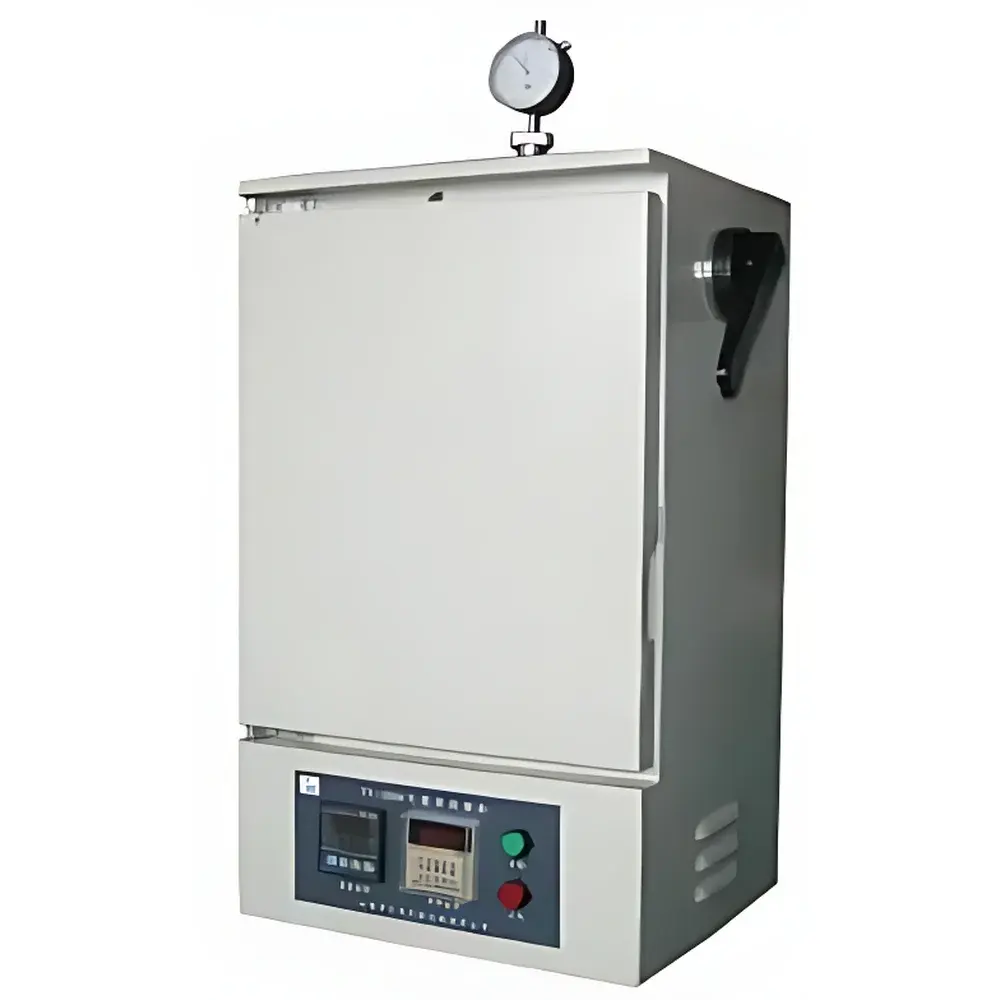
TianYuan TY-2004 Plasticity Tester
| Key | Load between parallel plates: 49 ± 0.05 N (including spring force from dial indicator) |
|---|---|
| Temperature control range | 70 ± 1 °C (adjustable up to 100 °C) |
| Timing range | 0–3 min (digitally programmable) |
| Dial indicator range | 0–30 mm |
| Dial indicator resolution | 0.01 mm |
| Power supply | 220 V, 50 Hz |
| Rated power | 700 W |
| Dimensions (W×D×H) | 360 × 280 × 570 mm |
| Net weight | 35 kg |
Overview
The TianYuan TY-2004 Plasticity Tester is a precision mechanical instrument engineered for the standardized determination of plasticity and reversion values of raw rubber, plasticized rubber, and compounded elastomers using the parallel-plate compression method. It operates on the fundamental principle of controlled thermal compression: a cylindrical test specimen is placed between two horizontally aligned, temperature-regulated metal plates; subjected to a precisely defined static load for a fixed duration; and its deformation—measured as axial compression—is quantified using a calibrated mechanical dial indicator. The resulting plasticity value (expressed in millimeters of compression) reflects the material’s ability to undergo irreversible flow under heat and pressure, while the reversion value—measured after recovery at ambient conditions—indicates elastic recovery behavior. This methodology aligns with the physical rheological response of uncured elastomers and is widely adopted in rubber compound development, quality control laboratories, and raw material certification workflows.
Key Features
- High-stability parallel-plate loading system delivering a nominal compressive force of 49 ± 0.05 N—including contribution from the integrated dial indicator’s internal spring mechanism—ensuring compliance with GB/T 12828 and equivalent international protocols.
- Digital temperature controller with PID regulation, enabling accurate setpoint adjustment from ambient to 100 °C; maintained within ±1 °C tolerance at the standard test temperature of 70 °C.
- Programmable digital timer with 1-second resolution, supporting user-defined dwell times from 0 to 3 minutes—critical for reproducible thermal-mechanical conditioning per ASTM D926 and ISO 2007.
- Mechanical dial indicator with 0–30 mm range and 0.01 mm graduation, mounted on a rigid, vibration-damped frame to minimize parallax and mechanical drift during measurement.
- Integrated heating element (700 W, 220 V/50 Hz) housed within an insulated aluminum alloy platen assembly, ensuring uniform thermal distribution across the contact surface.
- Compact benchtop architecture (360 × 280 × 570 mm), constructed with corrosion-resistant steel housing and ergonomic front-panel layout for unambiguous operation in ISO 17025-accredited environments.
Sample Compatibility & Compliance
The TY-2004 accommodates cylindrical specimens conforming to GB/T 12828 specifications: 10.0 ± 0.2 mm diameter and 10.0 ± 0.2 mm height, prepared from homogeneous, air-free rubber stock. It supports natural rubber (NR), styrene-butadiene rubber (SBR), butadiene rubber (BR), ethylene-propylene diene monomer (EPDM), and chloroprene (CR) formulations. All operational parameters—including load calibration, thermal uniformity, and timing accuracy—are traceable to national metrological standards. The instrument satisfies mandatory requirements of GB/T 12828–2022, and its measurement protocol is technically harmonized with ASTM D926 (Standard Test Method for Rubber Property—Plasticity) and ISO 2007 (Rubber—Determination of Plasticity). Routine verification procedures follow GLP principles, including daily zero-load checks, annual load cell calibration (using NIST-traceable deadweight standards), and temperature uniformity mapping per IEC 60584-2.
Software & Data Management
The TY-2004 operates as a standalone electromechanical instrument without embedded microprocessor control or digital data output. All parameter inputs (temperature setpoint, dwell time) and measurement readings (compression displacement) are manually entered and recorded by the operator. To support regulatory documentation integrity, laboratories routinely integrate the device into broader QC workflows using external electronic lab notebooks (ELNs) or LIMS platforms. Manual entries must include operator ID, sample ID, environmental conditions (ambient temperature/humidity), equipment ID and calibration status, raw dial indicator reading, calculated plasticity value (P = h₀ − h₁, where h₀ = initial height, h₁ = compressed height), and reversion measurement (R = h₂ − h₁, where h₂ = recovered height after 30 min at 23 °C). Such records comply with audit requirements under ISO/IEC 17025:2017 Clause 7.7 and FDA 21 CFR Part 11 when supported by appropriate procedural controls and signature logging.
Applications
- Raw material acceptance testing of natural and synthetic rubber grades prior to compounding.
- Batch-to-batch consistency evaluation of plasticized masterbatches in tire and industrial rubber manufacturing.
- Correlation studies between plasticity values and downstream processing performance (e.g., calendering uniformity, extrusion stability, mold fill efficiency).
- Research into polymer degradation kinetics during mastication or thermomechanical aging.
- Validation of plasticizer efficacy and dispersion homogeneity in high-filler formulations.
- Supporting specification conformance for rubber products supplied to automotive OEMs referencing SAE J200 or ISO 1629 material classifications.
FAQ
What standard test methods does the TY-2004 support?
It is designed specifically for GB/T 12828 and functionally compatible with ASTM D926 and ISO 2007.
Is the applied load independently verified or factory-calibrated?
Yes—the 49 N load system includes pre-calibrated springs and is validated using traceable deadweight standards prior to shipment; users must perform periodic verification per internal SOPs.
Can the instrument operate continuously at 100 °C?
While temperature is adjustable up to 100 °C, sustained operation above 70 °C requires extended stabilization periods and may affect long-term dial indicator accuracy; GB/T 12828 specifies 70 °C as the primary test condition.
Does the TY-2004 meet requirements for ISO/IEC 17025 accreditation?
Yes—when operated within documented procedures, with calibrated ancillary tools (e.g., micrometers, thermometers), and supported by full traceability records, it fulfills technical requirements for accredited plasticity testing.
Is operator training required for compliant use?
Yes—proper specimen preparation, load application sequence, timing synchronization, and dial indicator reading technique are critical; TianYuan provides basic operational guidance, but laboratory-specific competency assessment is mandatory per ISO/IEC 17025 Clause 6.2.5.
Related Products





