
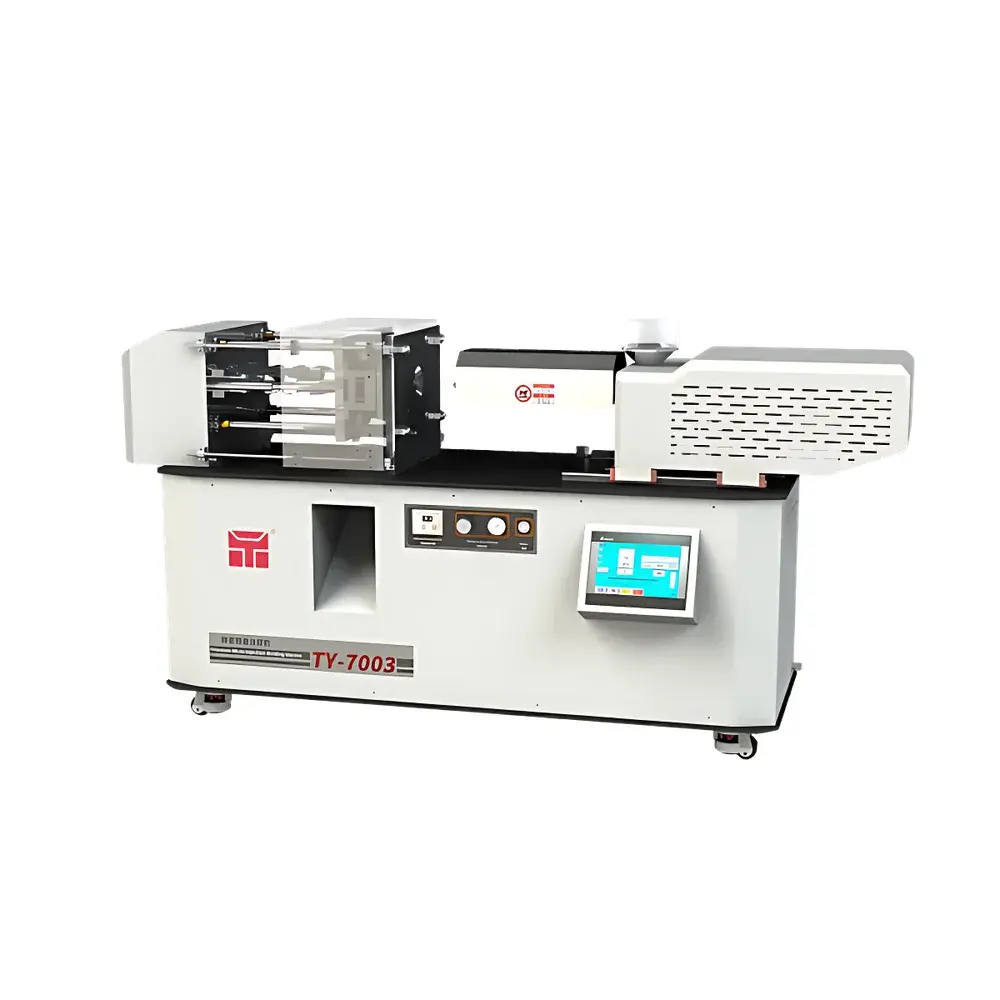
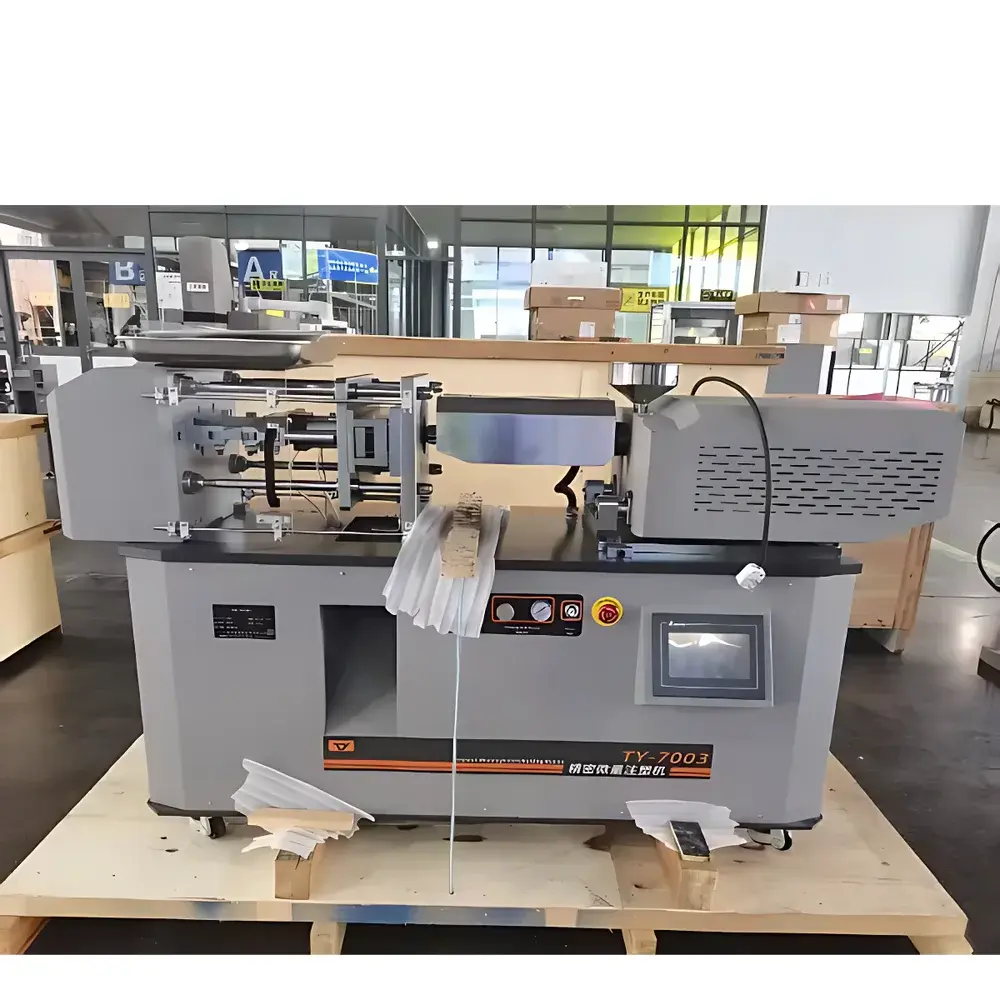
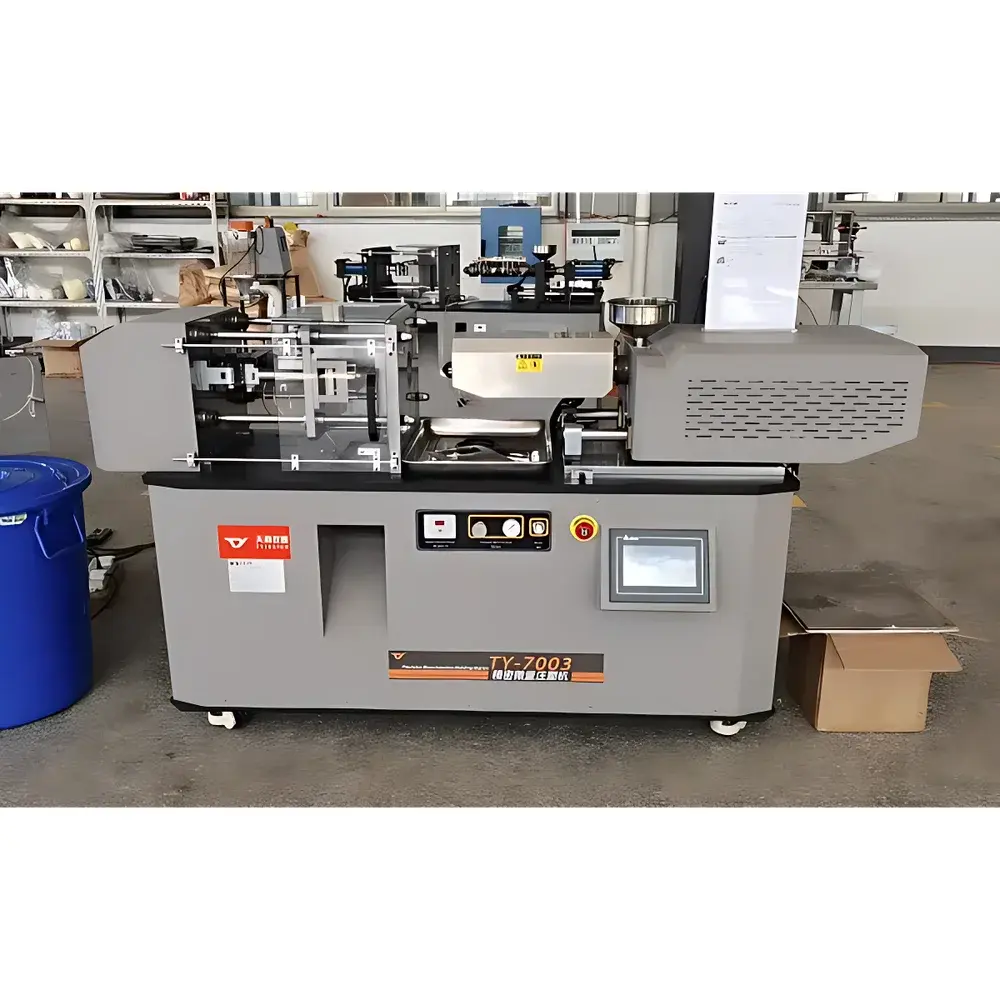
LiSuMei TY-7003 Micro Injection Molding Machine by TianYuan
| Key Features | Screw Diameter 20 mm |
|---|---|
| L/D Ratio 1 | 20 |
| Mold Dimensions Support | 360 × 90 × 72 mm (L×W×H) |
| Machine Footprint | 1700 × 500 × 950 mm |
Overview
The LiSuMei TY-7003 Micro Injection Molding Machine is an engineering-grade, benchtop-scale injection molding system developed by TianYuan (Jiangsu, China) for precision specimen preparation in polymer research, quality control laboratories, and academic teaching environments. Designed as a functional downscaled replica of industrial injection molding equipment, the TY-7003 implements core thermoplastic processing principles—including plastication via reciprocating screw, melt homogenization under controlled shear and temperature profiles, and high-fidelity cavity filling—within a compact, single-phase-powered architecture. Its modular mechanical layout integrates clamping, plastication, injection, and thermal regulation subsystems into a unified platform engineered for repeatability, operator safety, and compliance with fundamental ISO 294-1 and ASTM D3641 test specimen geometry requirements.
Key Features
- Compact benchtop footprint (1700 × 500 × 950 mm) enables deployment in university labs, R&D cleanrooms, and QC testing bays without dedicated industrial power or compressed air infrastructure.
- Planetary servo-driven plastication system (105 N·m torque, 1–130 rpm adjustable) delivers consistent melt homogeneity across low-viscosity polyolefins (PP, PE) and higher-melt-strength engineering resins (PA, ABS, TPU, PLA).
- Dual-safety interlock architecture: mechanical limit switches combined with electronic PLC-based monitoring ensure immediate shutdown during abnormal mold separation, overpressure, or thermal excursion.
- Three-zone barrel heating (up to 360 °C per zone, ±0.5 °C stability in steady state) supports broad material compatibility—from standard commodity plastics to high-temperature thermoplastics such as PEEK precursors.
- Human-machine interface (HMI) featuring Delta PLC and color touchscreen enables one-touch cycle programming, real-time parameter logging, and intuitive fault diagnostics without external software dependency.
- Pneumatically actuated clamping (≥0.8 MPa supply pressure) eliminates hydraulic oil contamination risk and simplifies maintenance in regulated environments requiring GLP-compliant documentation.
Sample Compatibility & Compliance
The TY-7003 accommodates standardized mold cavities up to 360 × 90 × 72 mm, enabling fabrication of ASTM D638 Type I tensile bars, ISO 527-2 specimens, UL 94 flame-test samples, and custom micro-parts down to 0.5 g mass. Its precise shot volume control (25 cm³ nominal, with optional force-multiplying system extending effective injection pressure to 3.6 tons) ensures dimensional reproducibility critical for mechanical property correlation studies. The machine conforms to CE machinery directive (2006/42/EC) safety architecture and supports traceable operation under ISO/IEC 17025-accredited laboratory quality systems. All electrical components—including Omron solid-state relays and Sonko planetary gearboxes—meet RoHS and IEC 61800-5-1 insulation class standards.
Software & Data Management
While the TY-7003 operates autonomously via embedded Delta DOP series HMI, its controller logs cycle parameters—including melt temperature, screw position, injection speed, and clamp tonnage—to internal non-volatile memory. Data export is supported via USB port in CSV format for post-processing in MATLAB, Excel, or LIMS platforms. Optional RS-485 Modbus RTU interface allows integration into centralized lab automation networks. Audit trails comply with basic 21 CFR Part 11 expectations through user-access-controlled password protection and timestamped event records (e.g., parameter changes, emergency stops, mold open/close cycles).
Applications
- Routine preparation of standardized test specimens for tensile, impact, flexural, and heat deflection temperature (HDT) analysis per ASTM D638, D256, D790, and ASTM D648.
- Material screening and formulation development for additive manufacturing feedstocks, biodegradable polymers (PLA, PHA), and medical-grade thermoplastics (USP Class VI compliant candidates).
- Teaching laboratory use for demonstrating polymer rheology, thermal transitions (Tg, Tm), and processing–structure–property relationships in undergraduate and graduate polymer science curricula.
- Pre-validation trials prior to full-scale production molding—enabling gate design optimization, weld line prediction, and shrinkage mapping at minimal material cost.
- Micro-molding of functional prototypes for microfluidic devices, optical lenses, and sensor housings where sub-gram part mass and micron-level surface finish are required.
FAQ
What types of thermoplastic materials can be processed on the TY-7003?
Polypropylene (PP), polyethylene (PE), acrylonitrile-butadiene-styrene (ABS), polyamide (PA6/PA66), polyvinyl chloride (PVC), thermoplastic polyurethane (TPU), and polylactic acid (PLA) are routinely processed. High-temperature grades require verification of thermal stability below 360 °C.
Is water cooling integrated or optional?
Water cooling is not standard but can be retrofitted upon request; users must supply chilled water (10–25 °C) and compatible plumbing connections.
Does the machine support multi-cavity molds?
Yes—provided total projected area remains within the 5-ton clamping capacity and mold dimensions conform to the 360 × 90 × 72 mm envelope.
What safety certifications does the TY-7003 hold?
The unit complies with EN ISO 13857 (safety distances) and EN 60204-1 (electrical equipment of machines); CE marking is applied per Machinery Directive 2006/42/EC.
Can process data be exported for regulatory submission?
Raw cycle logs (CSV) include timestamps, setpoints, and actual values—sufficient for internal QA review; full 21 CFR Part 11 compliance requires supplemental validation documentation and electronic signature implementation by the end user.





