
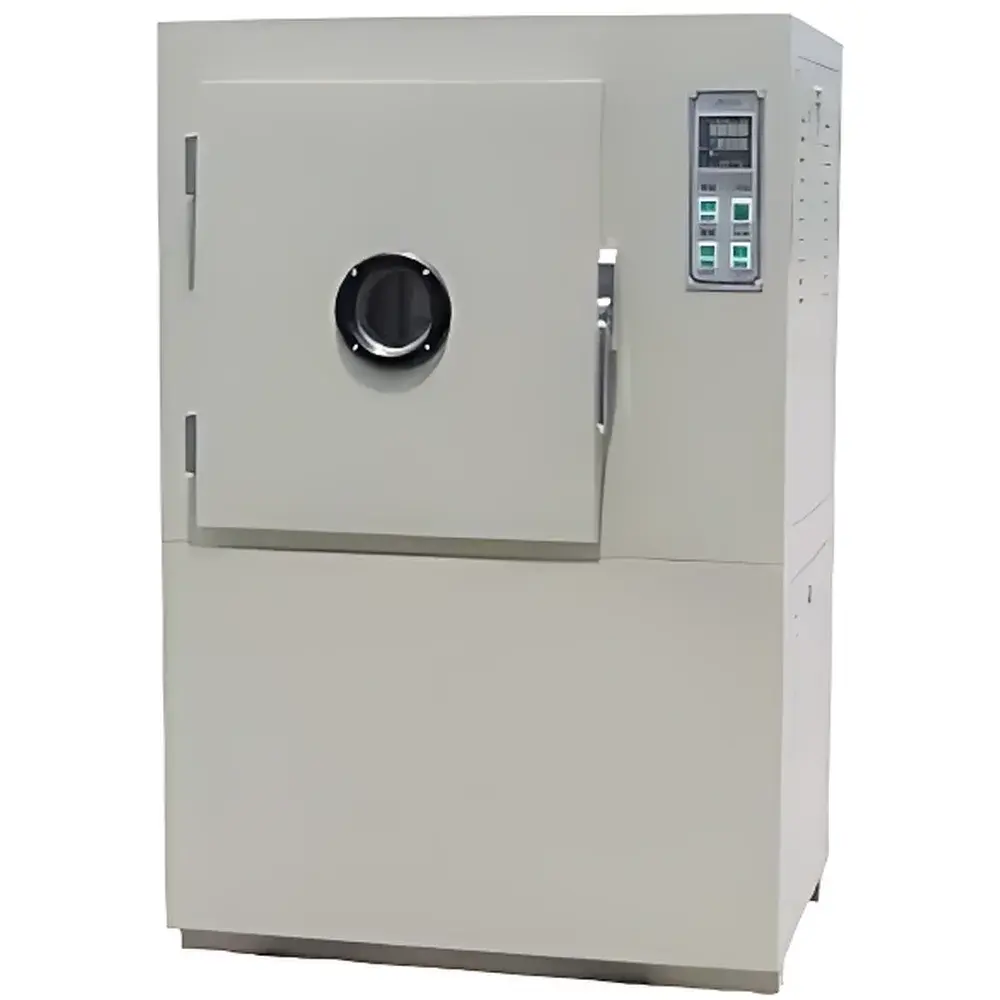
TY-401A High-Temperature Aging Test Chamber by TianYuan
| Brand | TianYuan |
|---|---|
| Origin | Jiangsu, China |
| Manufacturer Type | Direct Manufacturer |
| Model | TY-401A |
| Max Operating Temperature | 300 °C |
| Temperature Range | RT to 300 °C |
| Temperature Uniformity | ≤ ±1 °C |
| Temperature Fluctuation | ≤ ±0.5 °C |
| Temperature Deviation | ±2.0 °C |
| Heating Time (RT → 300 °C) | ≤60 min |
| Air Exchange Rate | 3–10 times/h |
| Internal Chamber Dimensions (W×H×D) | 450 × 450 × 500 mm |
| Turntable Speed | 11–12 rpm |
| Airflow Velocity | 0.5–1.5 m/s |
| Power Consumption | 2.2–4 kW |
| Supply Voltage | AC 220 V, 50 Hz |
Overview
The TY-401A High-Temperature Aging Test Chamber by TianYuan is an engineered environmental test system designed for accelerated thermal aging evaluation of polymeric and insulating materials under controlled, repeatable conditions. It operates on the principle of forced-air convection heating within a thermally insulated stainless-steel chamber, enabling precise simulation of long-term thermal stress exposure over defined time intervals. This instrument supports standardized aging protocols required in quality assurance, R&D, and regulatory compliance workflows—particularly for rubber compounds, thermoplastics, elastomers, cable insulation, and electrical component housings. Its architecture integrates PID-based digital temperature control with real-time feedback, ensuring stable thermal profiles across the entire working volume. The inclusion of a low-speed rotating turntable (11–12 rpm) mitigates positional bias during exposure, promoting uniform thermal history across all specimens—a critical factor in achieving inter-laboratory reproducibility per ASTM D573, ISO 188, and GB/T 3512.
Key Features
- Stainless-steel inner chamber (304 grade) resistant to oxidation and thermal degradation up to 300 °C
- Digital PID temperature controller with dual-display interface (setpoint & actual temperature), offering resolution of 0.1 °C and programmable ramp/soak cycles
- Forced-air circulation system with adjustable fan speed, delivering consistent airflow velocity between 0.5–1.5 m/s
- Integrated rotating specimen turntable (11–12 rpm) to minimize spatial thermal gradients and ensure homogeneous aging exposure
- Precise air exchange regulation (3–10 air changes per hour) via calibrated inlet/outlet dampers, supporting oxygen-dependent aging mechanisms
- Robust thermal insulation design with double-layer door seal and high-density mineral wool insulation, minimizing external heat loss and energy consumption
- Programmable timer with auto-shutdown function (up to 999 hours), supporting unattended operation in compliance with GLP documentation requirements
Sample Compatibility & Compliance
The TY-401A accommodates standard-sized test specimens—including dumbbell-shaped tensile bars (per ISO 37), strip samples (ASTM D412), and insulated wire segments—within its 450 × 450 × 500 mm internal workspace. Its thermal performance meets the uniformity and stability criteria specified in GB/T 3512-2014 (“Rubber—Determination of ageing characteristics in hot-air ovens”), and aligns with key international standards including ISO 188:2011, ASTM D573-19, and IEC 60811-201. All control logic and data logging functions are structured to support audit-ready documentation practices, and the unit’s mechanical and electrical design complies with IEC 61000-6-3 (EMC) and IEC 61000-6-2 (immunity). While not inherently 21 CFR Part 11 compliant, its digital controller output can be interfaced with validated third-party data acquisition systems for regulated environments.
Software & Data Management
The TY-401A operates as a standalone hardware platform with embedded firmware; no proprietary PC software is bundled. However, analog voltage outputs (0–5 V or 4–20 mA) are provided for external temperature monitoring and integration into centralized lab management systems (LIMS) or SCADA networks. Optional RS485 Modbus RTU communication enables remote parameter readout (current temperature, setpoint, elapsed time, alarm status) and basic control commands (start/stop, setpoint update) when connected to industrial PLCs or custom-built dashboards. For traceability, users may log operational parameters manually or via external chart recorders meeting ISO/IEC 17025 calibration requirements. Firmware revision history and calibration certificates (traceable to NIM or CNAS-accredited labs) are available upon request.
Applications
- Evaluation of oxidative degradation kinetics in vulcanized rubber formulations
- Comparative aging studies of polymer blends used in automotive under-hood components
- Pre-qualification testing of flame-retardant cable jackets per UL 1581 and EN 50305
- Thermal endurance assessment of epoxy encapsulants in power electronics modules
- Accelerated life modeling for silicone-based gaskets and seals in HVAC applications
- Supporting QC release testing in accordance with internal material specifications derived from IEC 60216
FAQ
What is the maximum continuous operating temperature of the TY-401A?
The chamber is rated for continuous operation at up to 300 °C, with internal construction using SUS304 stainless steel and high-temperature-resistant insulation.
Does the unit include validation documentation for IQ/OQ?
Factory calibration reports (as-found/as-left) are supplied with each unit; full IQ/OQ protocol development and execution must be performed by the end user or qualified third-party service provider.
Can the air exchange rate be calibrated and verified independently?
Yes—the inlet and exhaust damper positions are mechanically indexed and field-adjustable; verification requires a calibrated anemometer and volumetric flow measurement per ISO 5801.
Is the turntable load capacity specified?
The turntable supports up to 15 kg distributed load; uneven mass distribution may affect rotational balance and thermal uniformity.
What maintenance intervals are recommended for long-term reliability?
Fan motor lubrication and door gasket inspection are advised every 6 months; periodic verification of temperature sensor drift (using NIST-traceable reference probes) is recommended annually.



