
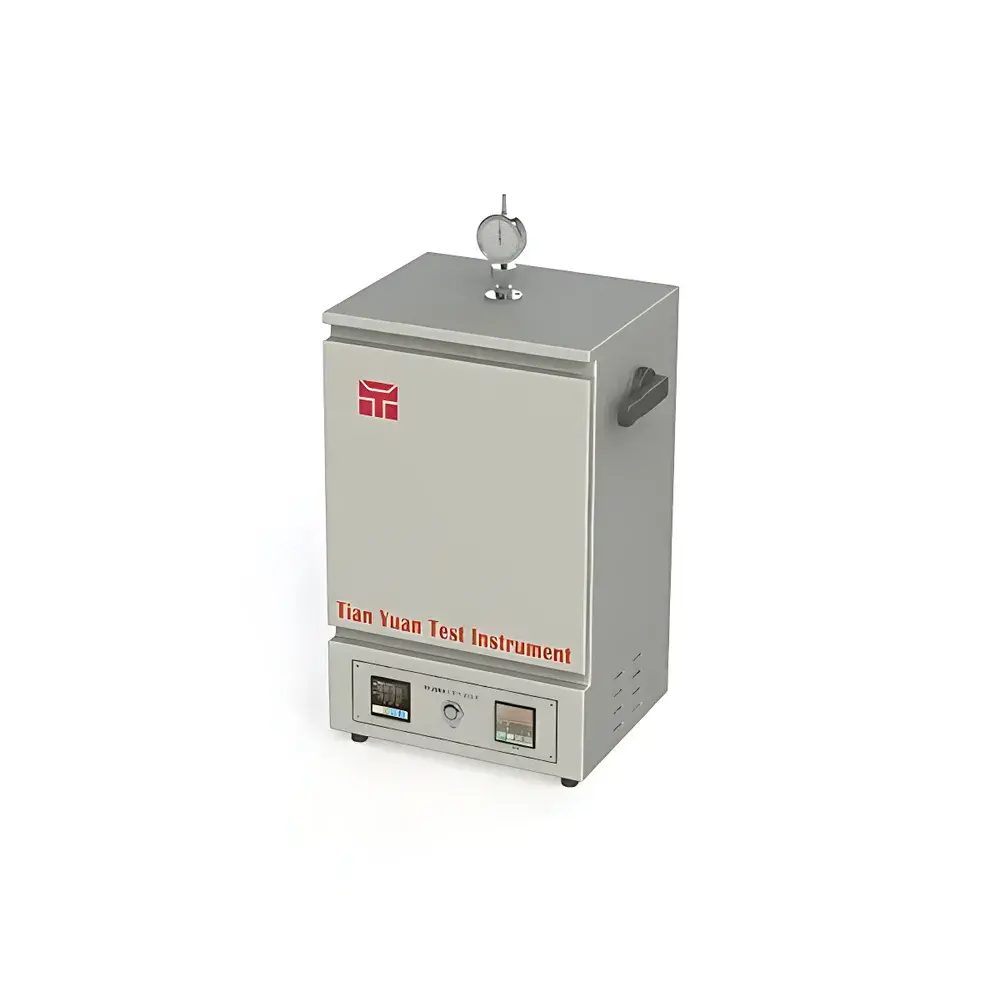
TianYuan TY-2004A Plasticity Tester
| Brand | TianYuan |
|---|---|
| Origin | Jiangsu, China |
| Manufacturer Type | Direct Manufacturer |
| Region of Origin | Domestic (China) |
| Model | TY-2004A |
| Pricing | Upon Request |
| Applied Standard | GB/T 12828 |
| Test Method | Parallel-Plate Compression |
| Applied Load | 49 ± 0.05 N (including spring force from dial indicator) |
| Temperature Control Range | 70 ± 1 °C (adjustable up to 100 °C) |
| Timing Range | 0–3 min (digitally programmable) |
| Dial Indicator Range | 0–30 mm |
| Dial Indicator Resolution | 0.01 mm |
| Power Supply | 220 V, 50 Hz |
| Rated Power | 700 W |
| Dimensions (W×D×H) | 360 × 280 × 570 mm |
| Net Weight | 35 kg |
Overview
The TianYuan TY-2004A Plasticity Tester is a precision mechanical instrument engineered for the standardized determination of plasticity and reversion values in raw rubber, plasticized rubber compounds, and vulcanized rubber sheets—using the parallel-plate compression method defined in GB/T 12828. This test method quantifies the permanent deformation behavior of elastomeric materials under controlled thermal and mechanical conditions, providing critical rheological insight into polymer processability, mixing efficiency, and scorch safety. The device operates on a fundamental principle: a pre-conditioned cylindrical specimen is compressed between two parallel, temperature-regulated stainless steel plates under a fixed load (49 ± 0.05 N) for a defined dwell time (typically 3 minutes at 70 ± 1 °C). The resulting thickness reduction—measured via a calibrated dial indicator—is used to calculate both the plasticity value (P) and, following a specified recovery period, the reversion value (R), enabling comparative assessment across batches and formulations.
Key Features
- High-stability temperature control system with digital PID regulation, ensuring ±1 °C uniformity across the plate surface within the 30–100 °C operating range;
- Preloaded mechanical compression assembly delivering consistent 49 ± 0.05 N force—including contribution from the integrated dial indicator’s internal spring—eliminating operator-dependent variability;
- Digital timer with programmable interval setting (0–3 min in 1-second increments), synchronized with thermal stabilization logic to initiate timing only after target temperature is achieved and maintained for ≥30 s;
- Calibrated analog dial indicator (0–30 mm range, 0.01 mm resolution) mounted on a rigid, vibration-damped support frame to minimize parallax and mechanical drift;
- Compact benchtop footprint (360 × 280 × 570 mm) with insulated heating chamber and front-accessible specimen port for rapid loading/unloading;
- All structural components fabricated from corrosion-resistant anodized aluminum and hardened stainless steel; no plastic or painted surfaces in thermal zones.
Sample Compatibility & Compliance
The TY-2004A accommodates standard cylindrical specimens per GB/T 12828: diameter 16.0 ± 0.1 mm, height 10.0 ± 0.1 mm, prepared using a dedicated cutter and conditioning at 23 ± 2 °C / 50 ± 5 % RH for ≥16 h. It supports natural rubber (NR), styrene-butadiene rubber (SBR), nitrile rubber (NBR), ethylene propylene diene monomer (EPDM), and chloroprene rubber (CR) matrices. The instrument conforms fully to GB/T 12828–2006 and is functionally aligned with ISO 2007 and ASTM D926 (Standard Test Method for Rubber Property—Plasticity—Parallel Plate Method), facilitating cross-laboratory data comparability. All calibration procedures—including load verification with traceable deadweight standards and temperature validation using Class A Pt100 probes—are documented to support GLP-compliant quality systems.
Software & Data Management
While the TY-2004A operates as a standalone electromechanical instrument without embedded microprocessor control, its design incorporates intentional interfaces for laboratory integration. Analog outputs from the dial indicator (via optional LVDT transducer kit) and temperature sensor (Pt100) are compatible with third-party data acquisition systems (e.g., National Instruments DAQmx, Keysight BenchVue). Users may implement automated logging of compression displacement vs. time and thermal profiles using compliant software that meets FDA 21 CFR Part 11 requirements—including electronic signatures, audit trails, and user access controls—for regulated QC environments. TianYuan provides full calibration documentation, including uncertainty budgets per ISO/IEC 17025 guidelines, upon request.
Applications
- Quality control of incoming raw rubber lots for consistency in Mooney viscosity correlation;
- Evaluation of plasticizer efficacy and thermal stability during mastication and mixing process development;
- Scorch delay analysis by measuring reversion loss after extended heat exposure;
- Formulation screening for low-viscosity masterbatches intended for extrusion or calendering;
- Teaching laboratories demonstrating fundamental polymer viscoelastic response under constrained compression;
- Supporting ISO/TS 16949 and IATF 16949 process validation protocols in Tier-1 automotive rubber supply chains.
FAQ
Does the TY-2004A comply with international standards beyond GB/T 12828?
Yes—the mechanical configuration, load accuracy, temperature uniformity, and timing resolution meet the essential requirements of ISO 2007 and ASTM D926. Full equivalence documentation is available upon technical review.
Can the instrument be calibrated externally by an accredited lab?
Absolutely. All critical subsystems—including applied load (via traceable force calibration), temperature (using NIST-traceable RTD), and displacement (with certified gauge blocks)—are accessible for third-party accreditation per ISO/IEC 17025.
Is the 49 N load inclusive of the dial indicator’s spring force?
Yes. The total compressive force is engineered to be 49 ± 0.05 N, accounting for both the deadweight load and the spring reaction force inherent to the dial indicator mechanism—ensuring compliance with GB/T 12828’s net-load specification.
What maintenance is required to sustain measurement integrity?
Monthly cleaning of plate surfaces with ethanol and light lubrication of the vertical guide rods; annual verification of dial indicator linearity and zero stability; biannual recalibration of temperature controller against reference thermometers.
Is there an optional digital readout upgrade available?
TianYuan offers an OEM-compatible digital displacement module (TY-DIGI-2004) with RS-232 output, 0.005 mm resolution, and real-time graphing capability—designed for seamless integration into LIMS or MES platforms.






