
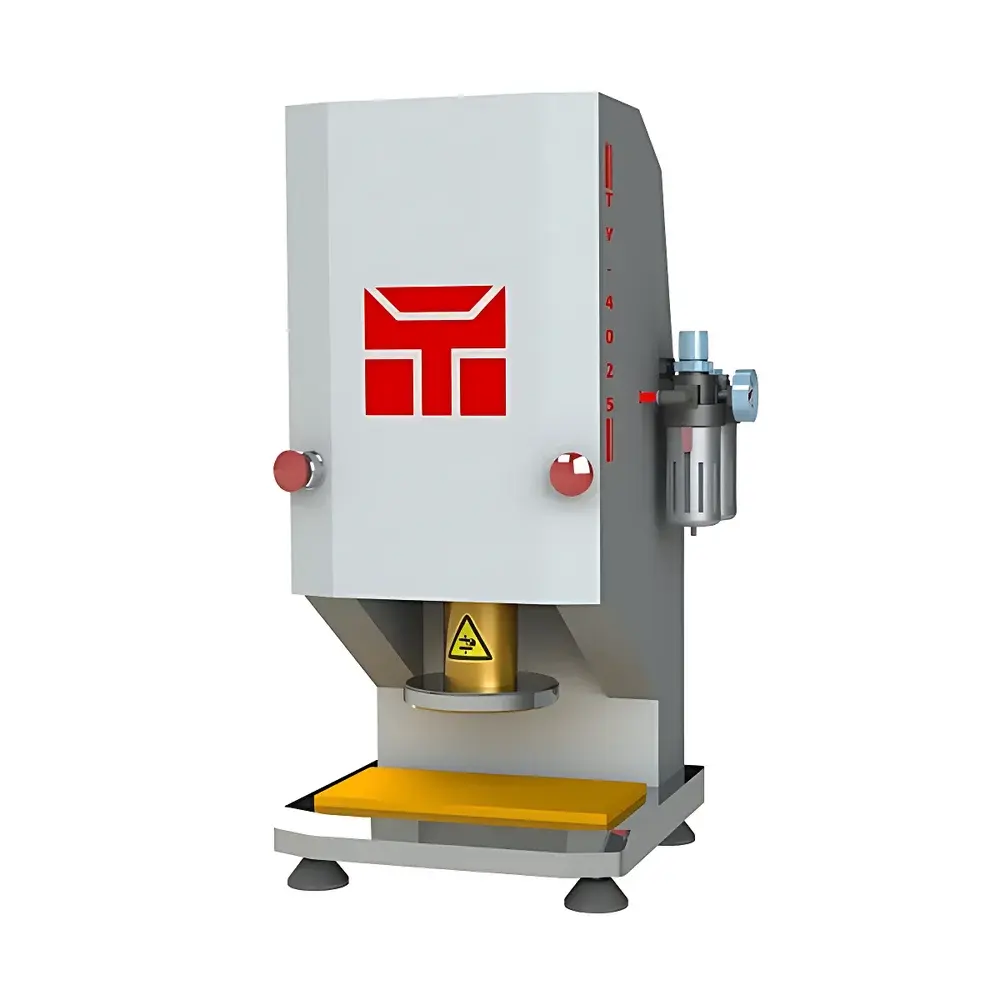
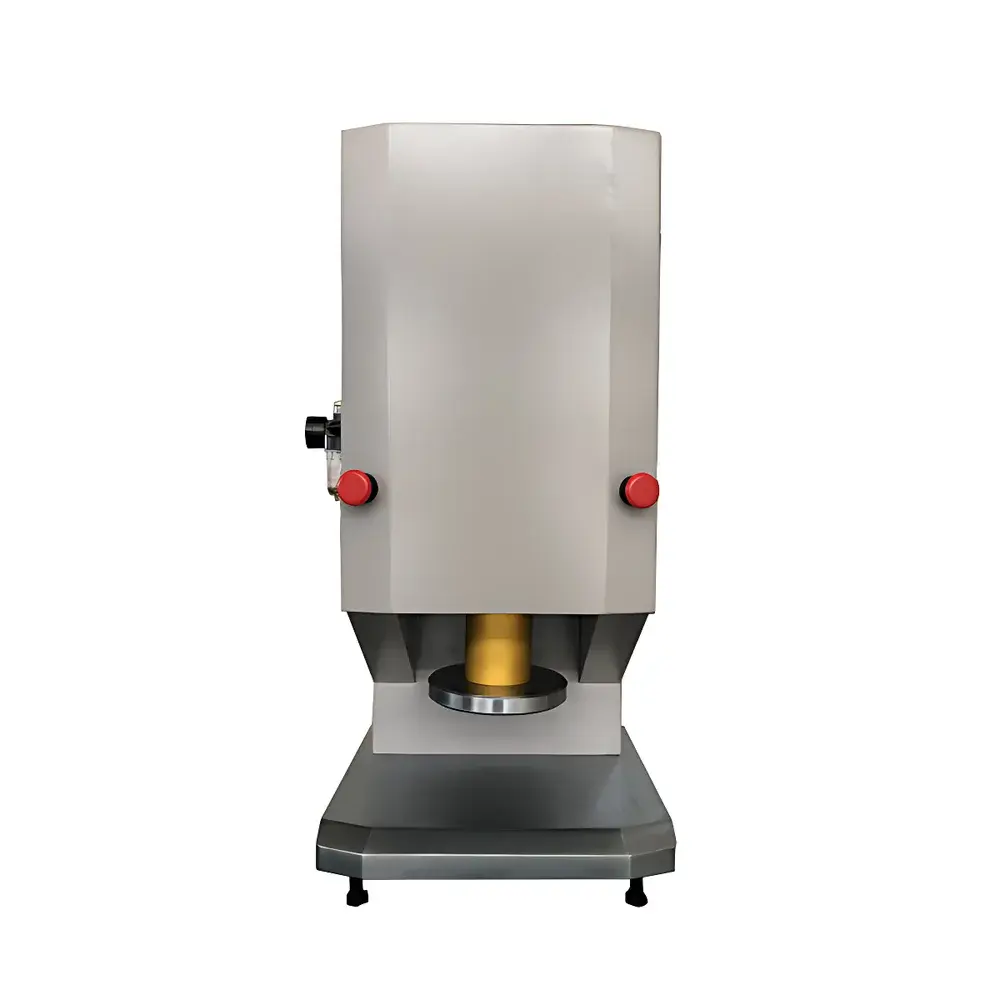
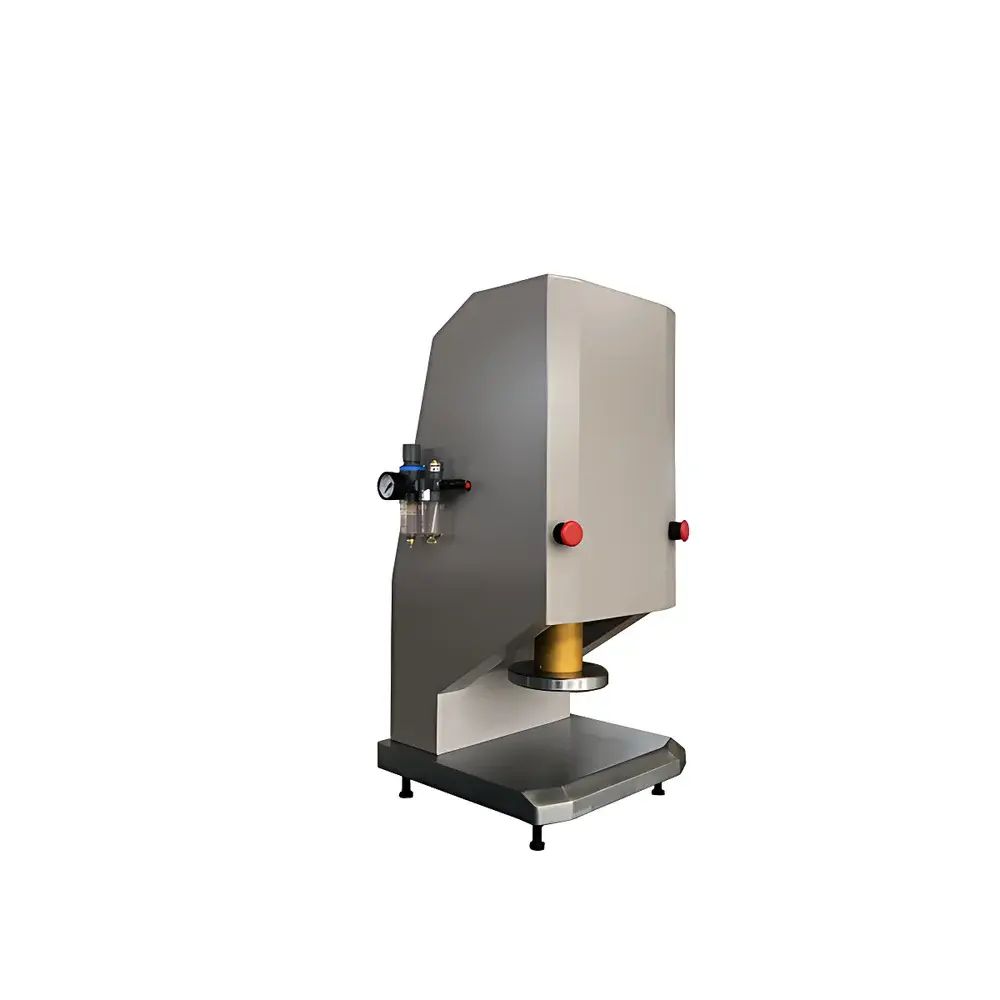
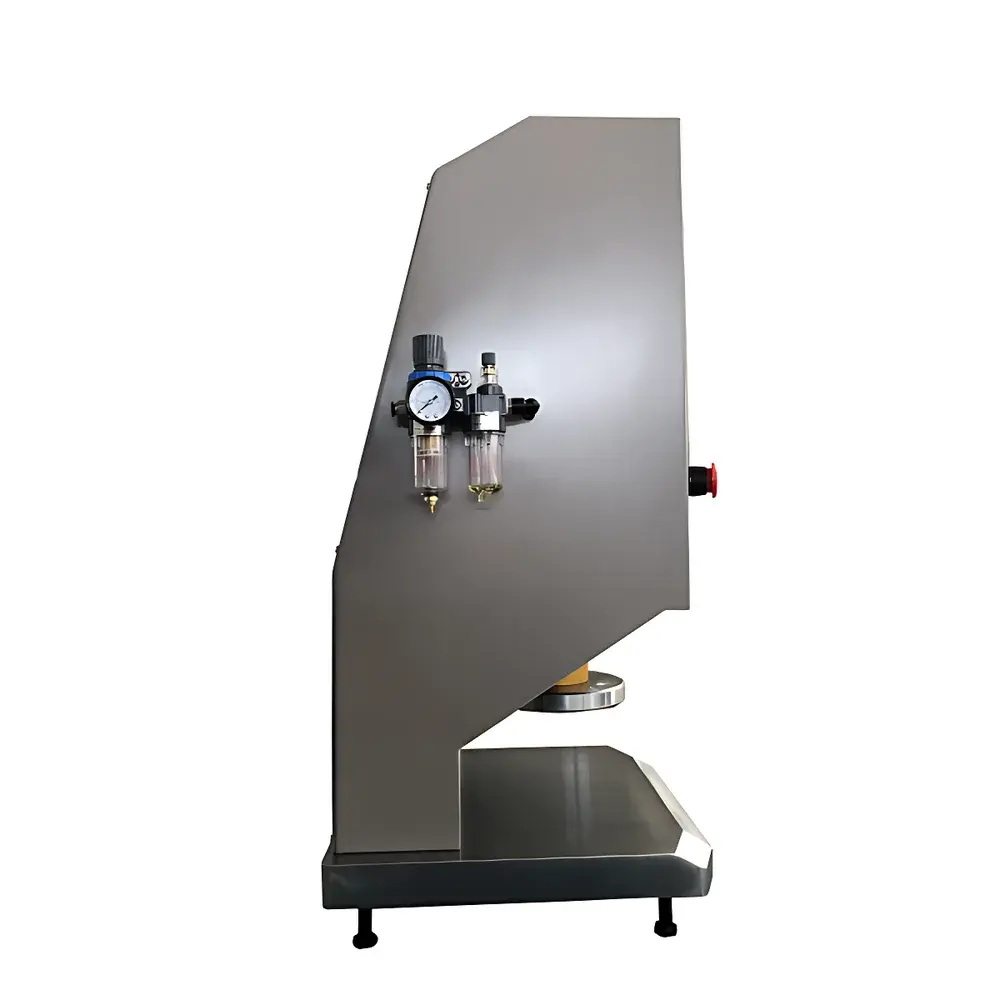
TYTESTER TY-4025 Pneumatic Specimen Punch Press
| Brand | TYTESTER |
|---|---|
| Model | TY-4025 Pneumatic |
| Type | Fully Automatic Pneumatic Pellet Press |
| Max. Force | 28 kN (at 0.7 MPa air supply) |
| Stroke | 100 mm |
| Table Dimensions | 30 mm × 200 mm |
| Platen Diameter | Ø150 mm |
| Nylon Backing Plate | 150 mm × 200 mm |
| Air Supply Range | 0.4–0.7 MPa |
| Sample Surface Flatness Tolerance | ±2 mm |
| Overall Dimensions (H×D×W) | 757 mm × 431 mm × 363 mm |
| Net Weight | 110 kg |
Overview
The TYTESTER TY-4025 Pneumatic Specimen Punch Press is an engineered solution for high-reproducibility, standardized specimen preparation in materials testing laboratories. Designed around a robust pneumatic actuation system, it delivers consistent compressive force—up to 28 kN at nominal 0.7 MPa supply pressure—to cut precise test specimens from elastomeric, polymeric, thin-film, leather, and composite sheet materials. Unlike manual or hydraulic alternatives, the TY-4025 eliminates operator-induced variability by coupling controlled air-driven descent with a fixed-stroke (100 mm), dual-acting cylinder architecture. Its core function aligns with international standards for physical testing sample conditioning—including ASTM D3767 (rubber sheeting), ISO 37 (tensile properties of vulcanized rubber), and GB/T 528 (Chinese national standard for vulcanized rubber tensile testing)—where geometric fidelity, edge integrity, and thickness uniformity are prerequisites for valid mechanical data. The press operates on compressed air only, requiring no electrical power at the point of actuation—enhancing intrinsic safety and simplifying integration into clean-room or explosion-proof environments.
Key Features
- Dual-hand safety activation system: Both palm buttons must be depressed simultaneously to initiate the punching cycle, complying with ISO 13857 and IEC 60204-1 requirements for safeguarded machinery.
- Adjustable parallelism mechanism: Precision-ground platen and calibrated leveling screws ensure uniform load distribution across the full Ø150 mm contact area, minimizing shear-induced specimen distortion.
- Integrated nylon backing plate (150 mm × 200 mm): Provides resilient, low-friction support that preserves die edge geometry and prevents substrate deformation during high-force punching.
- Fixed-stroke pneumatic cylinder: Eliminates over-travel risk and ensures repeatable penetration depth—critical when preparing specimens for thickness-sensitive tests such as hardness (ASTM D2240) or tear resistance (ASTM D624).
- Modular tool-mounting interface: Accepts industry-standard circular dies (e.g., ASTM D1445 dumbbell, ISO 37 Type 2, GB/T 528 ring) via threaded or clamping fixtures; compatible with optional quick-change die carriers.
- Compact footprint (363 mm W × 431 mm D × 757 mm H) and 110 kg net weight enable stable benchtop deployment without anchoring, while maintaining structural rigidity under peak load conditions.
Sample Compatibility & Compliance
The TY-4025 accommodates flexible sheet materials up to 10 mm thickness—including natural/synthetic rubbers, thermoplastic elastomers (TPE), PVC films, PU foams, nonwovens, and coated textiles—provided surface flatness remains within ±2 mm tolerance. Its worktable (30 mm × 200 mm) supports both strip feeding and discrete sheet placement. All mechanical components conform to RoHS Directive 2011/65/EU. The pneumatic circuit meets ISO 8573-1 Class 4 purity requirements when supplied with filtered, dried compressed air. Safety documentation includes CE Declaration of Conformity (2006/42/EC Machinery Directive), and design principles adhere to EN 62061 (functional safety of control systems). For regulated QC labs, audit-ready operation logs can be generated via optional RS-485 interface integration with LIMS.
Software & Data Management
While the TY-4025 operates as a standalone electromechanical device, its optional digital control module (TY-4025-DIGI) provides programmable cycle parameters—including dwell time (0–5 s), pressure ramp rate, and actuation count—with timestamped event logging compliant with FDA 21 CFR Part 11 Annex 11 requirements. Data export is supported via USB-C or Modbus TCP to laboratory information management systems (LIMS) or electronic lab notebooks (ELN). Audit trails record operator ID, cycle start/stop timestamps, pressure deviations (>±0.05 MPa), and emergency stop events—enabling traceability for GLP/GMP validation protocols.
Applications
- Preparation of ASTM D412 dumbbell-shaped tensile specimens from cured rubber compounds.
- Cutting ISO 37 Type 1A and Type 2 specimens for elongation-at-break and modulus evaluation.
- Generating GB/T 528 ring specimens for hardness and compression set testing.
- Producing standardized discs for Shore A/D durometer calibration and comparative wear studies.
- Preparing film strips for peel adhesion (ASTM D903) and puncture resistance (ASTM F1306) assays.
- Quality control sampling in tire cord, conveyor belt, and gasket manufacturing lines.
FAQ
What compressed air specifications are required for optimal performance?
A clean, dry air supply between 0.4–0.7 MPa (60–100 psi) is mandatory; filtration to ISO 8573-1 Class 4 and dew point ≤3°C is recommended to prevent cylinder seal degradation.
Can the TY-4025 accommodate custom die geometries beyond standard ASTM/ISO profiles?
Yes—its platen accepts custom-machined dies with M12 mounting threads or clamping flanges; maximum outer diameter must not exceed 145 mm to maintain alignment integrity.
Is maintenance training provided with purchase?
TYTESTER offers factory-certified on-site or virtual technician training covering daily inspection routines, pneumatic valve diagnostics, parallelism verification, and replacement part identification (e.g., O-rings, sealing kits, solenoid coils).
Does the machine support integration into automated production lines?
Via optional I/O expansion module (TY-IO-EXT), the TY-4025 supports PLC-triggered cycles, proximity sensor feedback, and E-stop chain interfacing per EN 60204-1 Category 3 architecture.
What is the typical service life under continuous QC lab usage?
With scheduled biannual lubrication of guide rods and annual cylinder seal inspection, mean time between failures (MTBF) exceeds 12,000 operational cycles based on field data from Tier-1 automotive and polymer testing facilities.



