
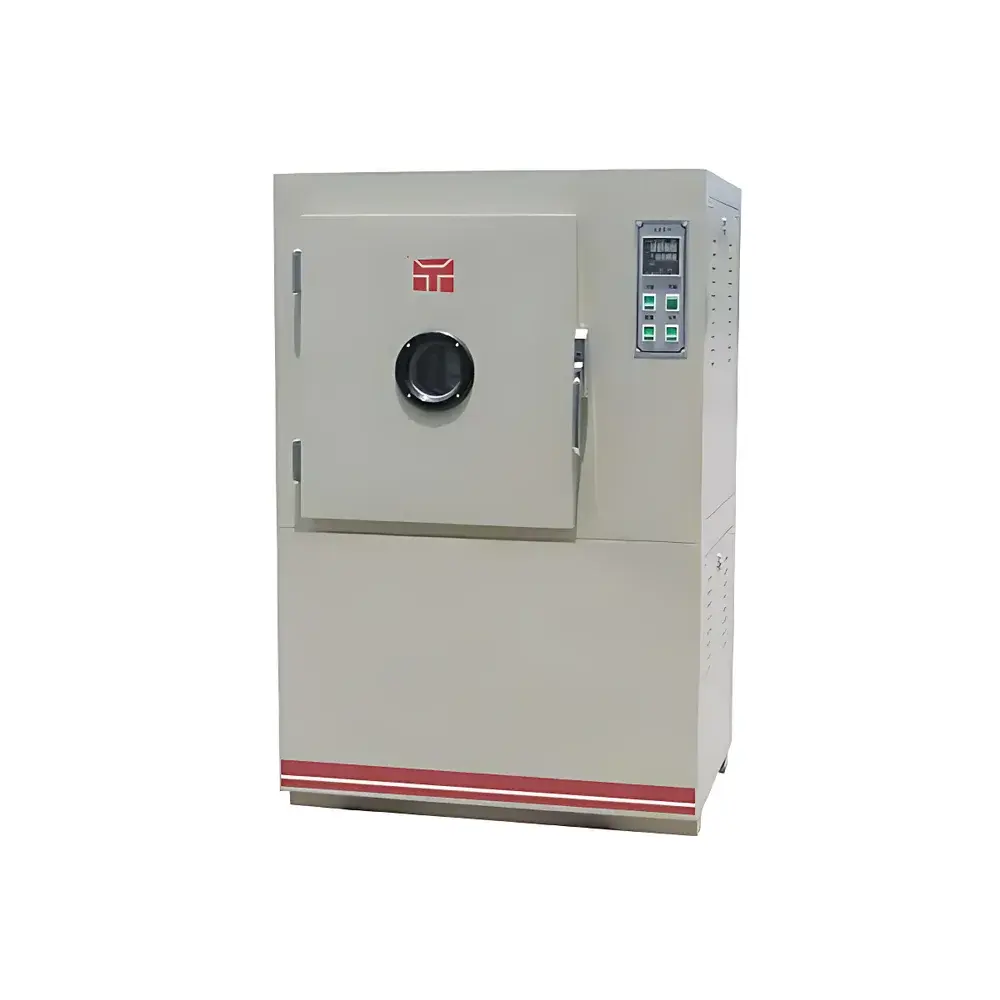
TianYuan TY-401A High-Temperature Thermal Aging Test Chamber
| Brand | TianYuan |
|---|---|
| Origin | Jiangsu, China |
| Manufacturer Type | Direct Manufacturer |
| Product Category | Domestic |
| Model | TY-401A |
| Price Range | USD 700–1,400 (FOB) |
| Max Operating Temperature | 300 °C |
| Temperature Range | Ambient to 300 °C |
| Temperature Uniformity | ≤ ±1 °C |
| Temperature Stability | ≤ ±0.5 °C |
| Air Exchange Rate | 3–10 air changes/hour |
| Internal Chamber Dimensions (W×H×D) | 450 × 450 × 500 mm |
| Rotating Sample Tray Speed | 11–12 rpm |
| Airflow Velocity | 0.5–1.5 m/s |
| Power Consumption | 2.2–4.0 kW |
| Supply Voltage | AC 220 V, 50 Hz |
| Chamber Material | Stainless Steel Interior |
Overview
The TianYuan TY-401A High-Temperature Thermal Aging Test Chamber is an engineered environmental test system designed for accelerated thermal aging evaluation of polymeric, elastomeric, and electrically insulating materials under controlled, reproducible conditions. It operates on the principle of forced-air convection heating within a thermally insulated stainless steel chamber, enabling precise simulation of long-term thermal exposure effects—such as oxidation, crosslinking, chain scission, and embrittlement—over defined time intervals. The chamber complies with the fundamental thermal aging methodology outlined in GB/T 3512–2014 (“Rubber—Determination of ageing characteristics in hot air ovens”), and its performance parameters align with internationally recognized practices for material stability assessment referenced in ASTM D573, ISO 188, and IEC 60811-2-1. Unlike ambient storage or uncontrolled oven environments, the TY-401A delivers traceable, repeatable thermal stress profiles essential for comparative aging studies, shelf-life prediction, and qualification testing in R&D, quality assurance, and regulatory submission workflows.
Key Features
- Stainless steel interior chamber (SUS304) ensures corrosion resistance, thermal stability, and ease of cleaning—critical for long-duration tests and repeated use across diverse material classes.
- Digital PID temperature controller with real-time display enables setpoint programming from ambient to 300 °C in 1 °C increments; auto-tuning minimizes overshoot and stabilizes temperature within ≤ ±0.5 °C over time.
- Uniform thermal distribution (≤ ±1 °C across working volume) achieved via optimized axial fan placement, baffle-guided airflow, and symmetrical heater arrangement—validated per ISO 16750-4 Annex C procedures.
- Motor-driven rotating sample tray (11–12 rpm) eliminates positional bias by continuously reorienting specimens, ensuring homogeneous thermal exposure across all test samples—particularly critical for multi-sample comparative studies.
- Adjustable ventilation system supports programmable air exchange rates between 3 and 10 times per hour, allowing users to emulate varying oxidative environments—from low-oxygen inert-like conditions to high-oxidation accelerated aging scenarios.
- Pre-set digital timer (0–999 hours) with audible end-of-test alert supports unattended operation while maintaining full traceability of exposure duration—essential for GLP-compliant documentation.
Sample Compatibility & Compliance
The TY-401A accommodates standard test specimens including rubber dumbbells (ASTM D412), plastic tensile bars (ISO 527), wire insulation strips (IEC 60811), and encapsulated electronic components. Its internal dimensions (450 × 450 × 500 mm) support up to 12–16 standardized samples per run when mounted on the rotating tray. All operational parameters—including temperature uniformity, stability, airflow velocity (0.5–1.5 m/s), and air exchange rate—are validated against national and international standards applicable to thermal aging test chambers: GB/T 3512–2014, ASTM D573–22, ISO 188:2011, and IEC 60068-2-1. While not certified to UL or CE as a standalone safety appliance, the unit incorporates dual overtemperature protection (mechanical cut-off + electronic limiter), grounded chassis, and thermal-insulated outer casing meeting IP20 enclosure requirements for laboratory use.
Software & Data Management
The TY-401A operates via embedded microcontroller firmware with no external PC dependency. Temperature setpoints, runtime, and alarm thresholds are configured directly on the front-panel interface. Real-time temperature readings are logged internally at 10-second intervals and retained for the duration of the active test cycle. Data export is not supported natively; however, optional RS-485 serial output (available upon request) enables integration with third-party SCADA systems or custom LabVIEW/Python acquisition scripts for automated logging. For regulated environments requiring audit trails, users may supplement operation with external calibrated data loggers (e.g., Omega OM-DAQPRO-5300) compliant with FDA 21 CFR Part 11 when paired with appropriate validation protocols.
Applications
- Accelerated aging of automotive rubber seals, hoses, and under-hood polymer components per SAE J2236 and GMW15635.
- Thermal endurance evaluation of cable insulation (PVC, XLPE, ETFE) in accordance with IEC 60811-2-1 and UL 1581.
- Stability screening of adhesives, conformal coatings, and potting compounds during formulation development.
- Pre-qualification testing of printed circuit board (PCB) laminates and solder mask materials under elevated temperature stress.
- Supporting ISO 14644-1 cleanroom material certification where thermal outgassing and dimensional stability at elevated temperatures must be verified.
- Academic research on polymer degradation kinetics, Arrhenius modeling, and activation energy estimation using multi-temperature aging datasets.
FAQ
What standards does the TY-401A comply with for thermal aging testing?
It meets the core performance and procedural requirements of GB/T 3512–2014, ASTM D573–22, and ISO 188:2011 for hot-air oven aging of elastomers and plastics.
Can the chamber operate continuously for 1000+ hours?
Yes—designed for extended unattended operation with redundant overtemperature safeguards and industrial-grade heating elements rated for >10,000 hours MTBF.
Is the rotating tray mandatory for all tests?
While optional for single-specimen runs, rotation is strongly recommended for multi-sample consistency and is required to meet uniformity clauses in ISO 188 and GB/T 3512.
Does the unit include calibration documentation?
Factory calibration certificates (temperature sensor & controller) are provided; users must perform periodic verification using NIST-traceable reference thermometers per ISO/IEC 17025 guidelines.
What maintenance is required to sustain accuracy?
Quarterly inspection of door gasket integrity, annual verification of airflow velocity and air exchange rate, and biannual recalibration of the control sensor are advised for GMP-aligned operations.



