
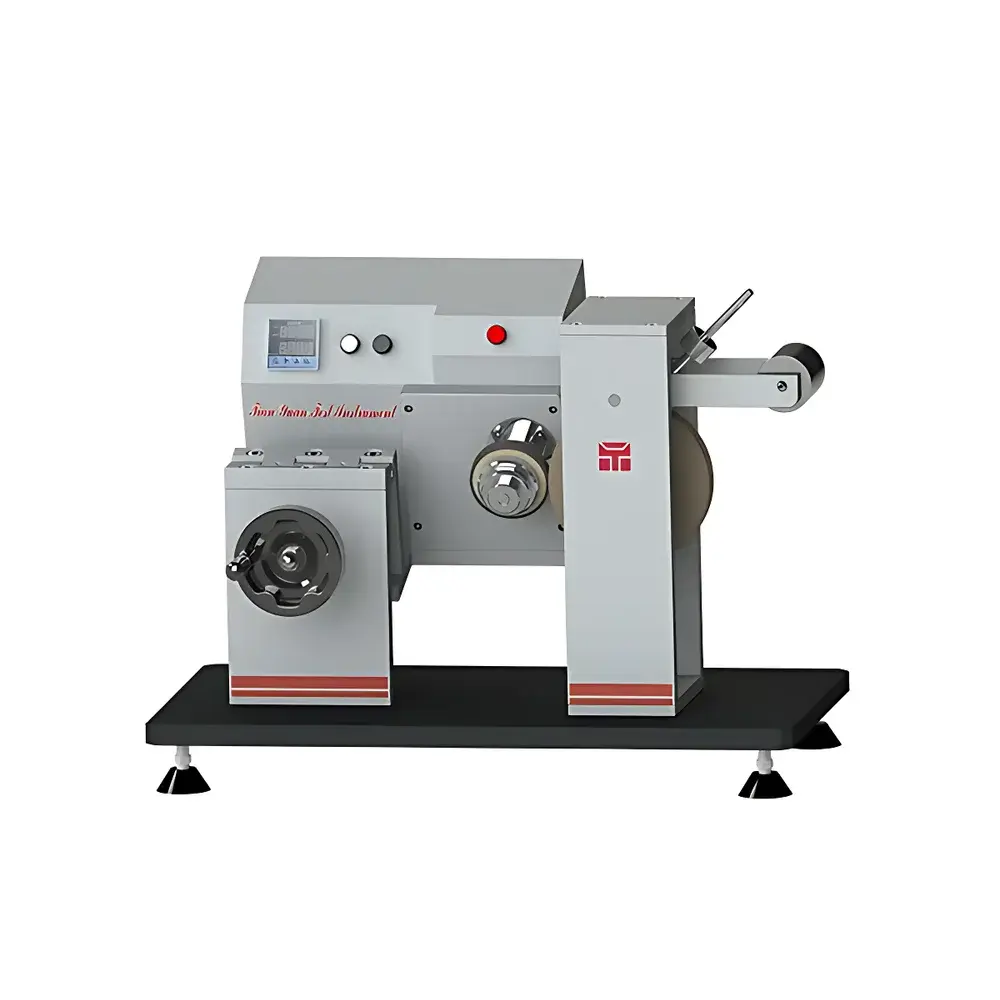
TianYuan TY-4069 Akron Abrasion Tester
| Key | Brand: TianYuan |
|---|---|
| Origin | Jiangsu, China |
| Manufacturer Type | Direct Manufacturer |
| Model | TY-4069 |
| Load on Rubber Wheel | 26.7 N |
| Rubber Wheel Rotational Speed | 76 ± 2 rpm |
| Abrasive Wheel Rotational Speed | 33–35 rpm |
| Angle Between Wheel Axes | 0°–45° |
| Power Supply | AC 220 V ± 10% |
| Dimensions (L×W×H) | 600 × 480 × 400 mm |
| Weight | 60 kg |
Overview
The TianYuan TY-4069 Akron Abrasion Tester is a precision-engineered instrument designed to quantify the abrasive wear resistance of vulcanized rubber compounds under controlled mechanical conditions. Based on the classical Akron abrasion test principle—defined by ASTM D1630 and harmonized with GB/T 1689—the device subjects a rotating rubber wheel specimen to tangential friction against a standardized abrasive grinding wheel. The test simulates real-world abrasive contact scenarios, such as tire tread wear on rough pavement, enabling quantitative assessment of material durability through volumetric loss measurement after a defined travel distance (typically 1.6 km or equivalent revolutions). The tester operates via a dual-axis rotational architecture: the rubber wheel rotates at a tightly regulated 76 ± 2 rpm under a constant vertical load of 26.7 N, while the abrasive wheel rotates counter-directionally at 33–35 rpm. The adjustable inter-axis angle (0°–45°) allows systematic investigation of shear stress dependence on contact geometry—a critical parameter for optimizing compound formulation and predicting service life in dynamic elastomeric applications.
Key Features
- Robust cast-iron frame with vibration-damped base ensures mechanical stability during extended testing cycles.
- Precision-machined wheel arbors with high-tolerance bearings maintain consistent rotational alignment and minimize torque-induced drift.
- Calibrated spring-loaded loading mechanism delivers repeatable 26.7 N force on the rubber wheel, traceable to national metrological standards.
- Dual independent speed control system enables synchronized yet adjustable rotation of both wheels—critical for method compliance and inter-laboratory reproducibility.
- Angle-adjustable wheel mounting assembly permits precise setting and locking of the inter-axis inclination from 0° to 45° in 1° increments, facilitating parametric wear studies.
- Integrated digital timer with auto-stop functionality supports standardized test durations and eliminates operator-dependent termination errors.
Sample Compatibility & Compliance
The TY-4069 accommodates standard cylindrical rubber test specimens (diameter 15.9 mm, thickness ≥ 6 mm) prepared per GB/T 1689 and ASTM D1630 requirements. Specimen mounting fixtures ensure concentricity and axial rigidity during rotation. The instrument meets essential mechanical and electrical safety provisions of GB/T 5226.1 (IEC 60204-1) and is compatible with GLP-compliant laboratory environments. While not certified to ISO/IEC 17025 as a standalone unit, its design enables full traceability when used within accredited testing workflows—including documented calibration of load cells, tachometers, and angular positioning systems. Test reports generated using this instrument satisfy technical documentation requirements for rubber quality assurance in automotive, conveyor belt, and footwear manufacturing sectors.
Software & Data Management
The TY-4069 is a manually operated benchtop instrument without embedded microprocessor control or native data logging. However, it is fully compatible with third-party laboratory information management systems (LIMS) and digital documentation protocols. Users routinely integrate it with calibrated digital calipers (e.g., Mitutoyo 500-196-30), analytical balances (0.1 mg resolution), and volumetric calculation software compliant with ASTM D1630 Annex A1. All operational parameters—including applied load, rotational speeds, angle setting, and elapsed time—are recorded manually in audit-ready test logs. For regulated environments requiring electronic records, the instrument supports 21 CFR Part 11–compliant data capture when paired with validated spreadsheet templates or LIMS modules that enforce user authentication, change tracking, and electronic signatures.
Applications
- Quality control of raw rubber compounds and masterbatches in tire and industrial rubber production.
- Comparative wear ranking of carbon black-, silica-, or hybrid-filled elastomer formulations.
- Development validation of anti-abrasion additives (e.g., protective waxes, hindered amine light stabilizers).
- Failure analysis of field-failed rubber components where abrasive wear is suspected as a primary degradation mode.
- Supporting technical submissions for ISO/TS 16949 or IATF 16949 process capability assessments in Tier-1 automotive supply chains.
FAQ
What international standards does the TY-4069 comply with?
The instrument is engineered to execute tests per GB/T 1689 and ASTM D1630. Its mechanical specifications—including load application, speed tolerances, and angular adjustability—align with the apparatus requirements specified in both standards.
Is the abrasive wheel included with the instrument?
Yes, one standard 60-grit aluminum oxide abrasive wheel conforming to ASTM D1630 specifications is supplied. Replacement wheels must meet ANSI B74.17 grading and dimensional tolerances.
Can the TY-4069 be used for non-rubber elastomers such as TPU or TPE?
While primarily validated for vulcanized rubbers, the instrument may be adapted for thermoplastic elastomers with appropriate specimen conditioning and pre-test verification of dimensional stability under load and temperature.
What maintenance is required to ensure long-term accuracy?
Monthly verification of wheel runout (≤ 0.05 mm), annual recalibration of the load application system, and routine cleaning of abrasive debris from the wheel housings are recommended per the manufacturer’s maintenance log.
Does the instrument support automated data export?
No—it operates without onboard electronics. Data acquisition relies on external instrumentation and manual entry into validated reporting systems.



