
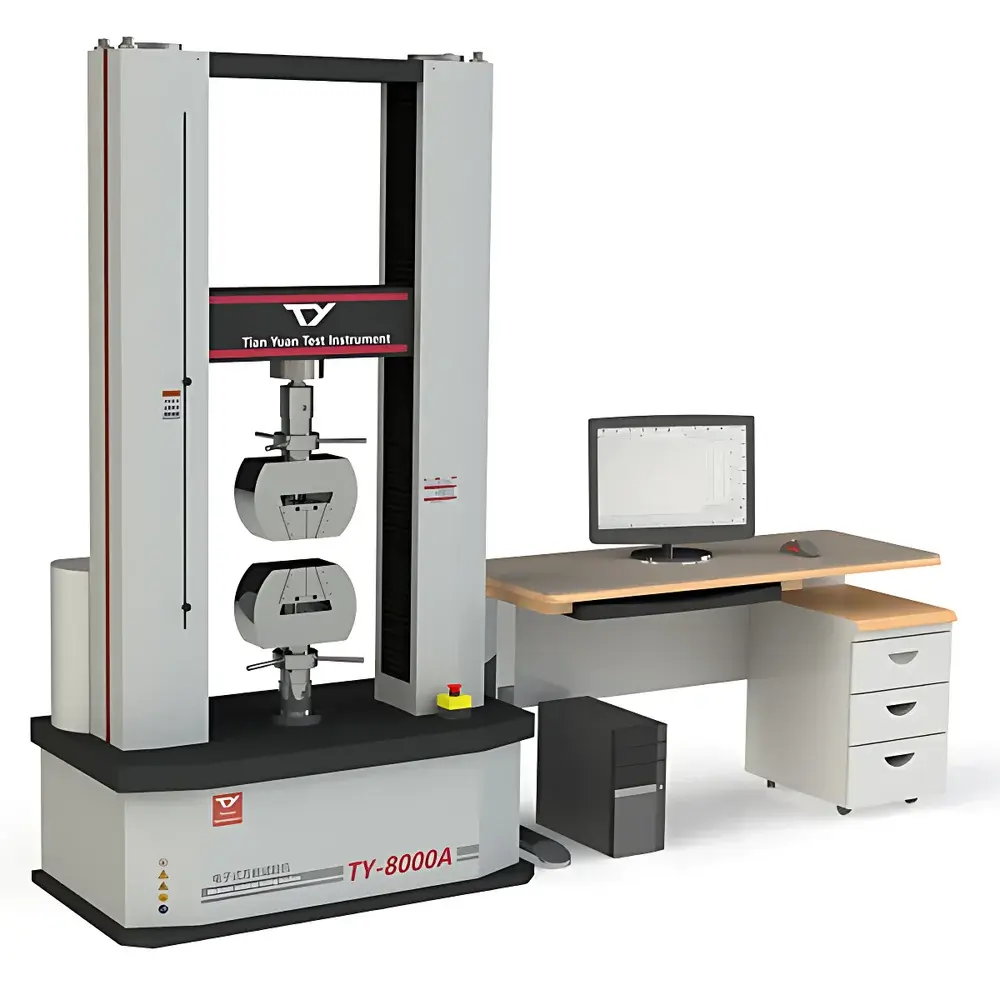
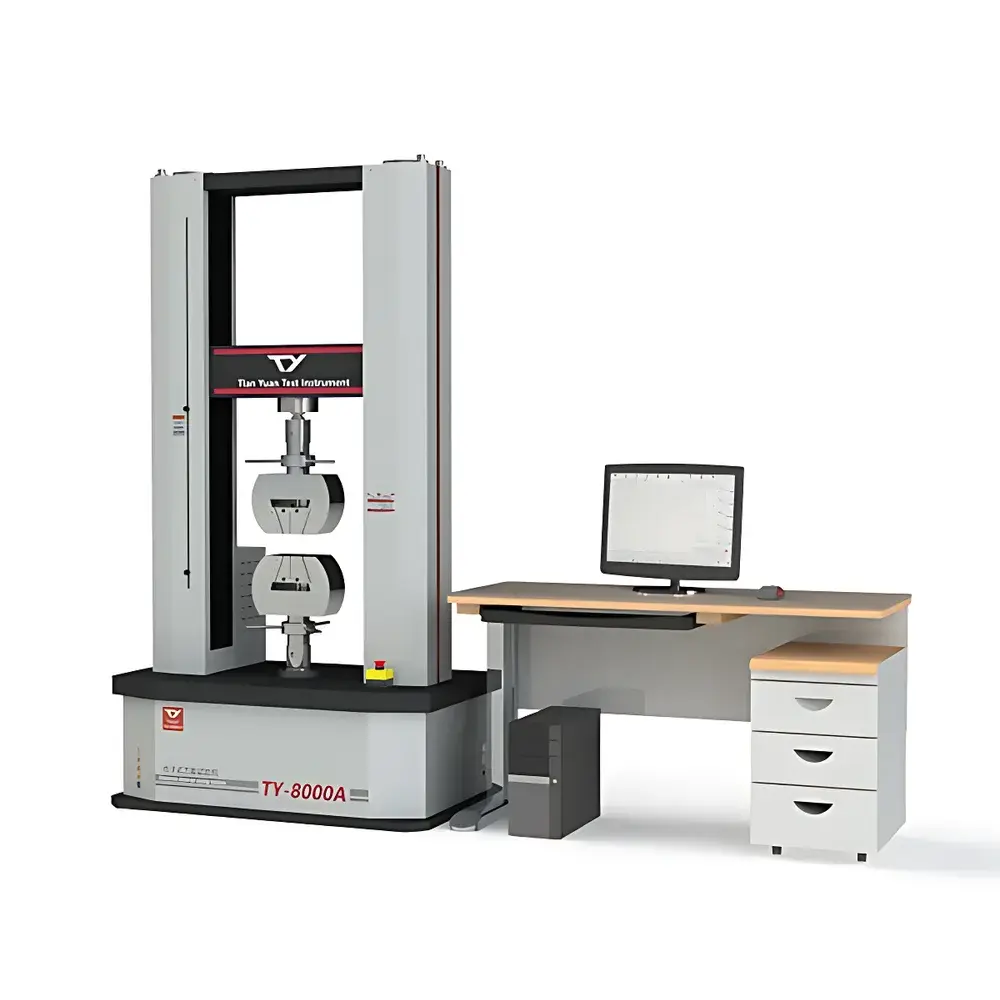
TianYuan TY8000-A300KN Electromechanical Universal Testing Machine
| Brand | TianYuan |
|---|---|
| Origin | Jiangsu, China |
| Manufacturer Type | Direct Manufacturer |
| Model | TY8000-A300KN |
| Maximum Test Load | 300 kN |
| Force Measurement Range | 0.4–100% FS |
| Force Accuracy | ≤ ±0.5% |
| Crosshead Travel | 900 mm |
| Displacement Resolution | 0.001 mm |
| Load Cell Resolution | 1/500,000 |
| Force Control Rate Range | 0.01–5% FS/s |
| Deformation Control Rate Range | 0.02–5% FS/s |
| Crosshead Speed Range | 0.001–500 mm/min |
| Speed Accuracy | ≤ ±0.3% |
| Effective Test Width | 600 mm |
| Dimensions (W×D×H) | 1200 × 660 × 2250 mm |
| Weight | 1500 kg |
| Power Supply | 380 V, 5.1 kW |
Overview
The TianYuan TY8000-A300KN is a high-capacity electromechanical universal testing machine engineered for precision mechanical property evaluation of metallic and non-metallic materials under static and quasi-static loading conditions. Based on servo-controlled electromechanical actuation, it operates according to the principles of uniaxial force-displacement transduction, enabling accurate measurement of tensile strength, yield strength, elongation at break, Young’s modulus, flexural modulus, compressive strength, shear resistance, peel adhesion, tear propagation, and puncture resistance. Designed for compliance with international standard test methodologies—including ASTM E8/E21, ISO 6892-1, ISO 7500-1, EN 10002-1, GB/T 228.1, and GB/T 16491—the system delivers traceable, repeatable, and auditable results suitable for R&D laboratories, quality control departments, and third-party certification facilities operating under GLP or ISO/IEC 17025 frameworks.
Key Features
- Servo-driven actuation system featuring Panasonic AC servo motor coupled with high-rigidity planetary gearbox (LIMIN, Taiwan) and preloaded TBI ball screw assembly—ensuring minimal backlash (< 1 arcmin), high positioning repeatability (±0.005 mm), and long-term mechanical stability.
- Full-digital closed-loop control architecture integrating DSP + MCU real-time processing engine for synchronized force, displacement, and strain regulation with independent PID tuning per control mode (force, displacement, strain).
- High-resolution load measurement using IMG (USA) precision load cells calibrated to Class 0.5 accuracy per ISO 376 and GB/T 16825, with resolution up to 1/500,000 of full scale.
- Integrated optical encoder-based displacement feedback (Panasonic) with 0.001 mm resolution and ≤ ±0.3% speed fidelity across the full 0.001–500 mm/min range.
- Modular software platform supporting multi-channel real-time acquisition (up to 10 kHz sampling), dynamic curve overlay, and post-test reanalysis including derivative-based modulus calculation, hysteresis loop integration, and cyclic loading sequence scripting.
- Robust structural frame with 600 mm effective test width and 900 mm vertical travel accommodates standardized specimen fixtures, hydraulic wedge grips, pneumatic clamps, and extensometer interfaces (compliant with GB/T 12160 Class 1).
Sample Compatibility & Compliance
The TY8000-A300KN supports standardized test specimens per ASTM E8 (tensile bars), ASTM D638 (plastics), ISO 527 (polymer sheets), ISO 178 (flexural), ISO 1413 (tear), and ISO 8510 (peel). It accepts flat, round, rectangular, and custom-profile specimens up to 300 mm gauge length and 60 mm thickness. The system is fully compliant with GB/T 2611 (General Technical Requirements for Testing Machines), GB/T 16491 (Electronic Universal Testing Machines), and verified per ISO 7500-1 Class 1 calibration protocols. Optional extensometers enable strain-controlled testing meeting ASTM E83 Class B-1 requirements. All hardware and firmware configurations support audit-ready documentation per FDA 21 CFR Part 11 when deployed with validated software modules.
Software & Data Management
The TianYuan proprietary testing software provides ISO/IEC 17025-aligned data handling: user-level access control, electronic signatures, full audit trail logging (including parameter changes, calibration events, and report generation timestamps), and encrypted raw data storage in binary + CSV formats. Real-time visualization includes synchronized dual-axis plots (e.g., stress–strain, load–displacement, load–time) with customizable scaling, grid overlays, and annotation tools. Post-processing features include automatic yield point detection (0.2% offset method), tangent/ secant modulus derivation, energy absorption quantification (area under curve), and cyclic fatigue analysis (hysteresis loop counting, stiffness degradation tracking). Export options include PDF reports with embedded metadata, Excel-compatible .xlsx files, and XML for LIMS integration.
Applications
This system serves critical roles in material qualification for aerospace alloys (Ti-6Al-4V, 7075-T6), automotive composites (CFRP laminates, thermoplastic elastomers), biomedical polymers (PEEK, UHMWPE), civil engineering materials (rebar, geotextiles), packaging films (BOPP, PET), and rubber compounds (vulcanized elastomers, silicone gels). It supports routine QC testing per incoming inspection protocols, failure analysis investigations, comparative benchmarking against supplier specifications, and regulatory submission packages for CE marking, UL recognition, or FDA 510(k) dossiers. Its capacity and control fidelity make it suitable for both single-point certification tests and extended durability studies involving low-cycle fatigue (LCF) and creep rupture profiling.
FAQ
What standards does the TY8000-A300KN comply with for calibration and verification?
It conforms to ISO 7500-1 Class 1 for load cell verification, GB/T 16825 for machine verification, and ISO 9513 for extensometer calibration when equipped.
Can the system perform closed-loop strain control using an external extensometer?
Yes—integrated analog/digital extensometer inputs support real-time strain feedback for ASTM E83-compliant modulus and yield measurements.
Is the software compliant with FDA 21 CFR Part 11 for regulated environments?
When deployed with validated configuration, role-based authentication, electronic signature workflows, and immutable audit trails enabled, it meets core Part 11 requirements for electronic records and signatures.
What is the maximum specimen height accommodated within the test zone?
With standard crosshead configuration, usable vertical space between grips is 900 mm; optional height extensions are available upon request.
Does the system support automated test sequencing for batch processing?
Yes—the software allows programmable test sequences with conditional logic, pass/fail criteria, and auto-generated summary reports per batch ID or lot number.



