
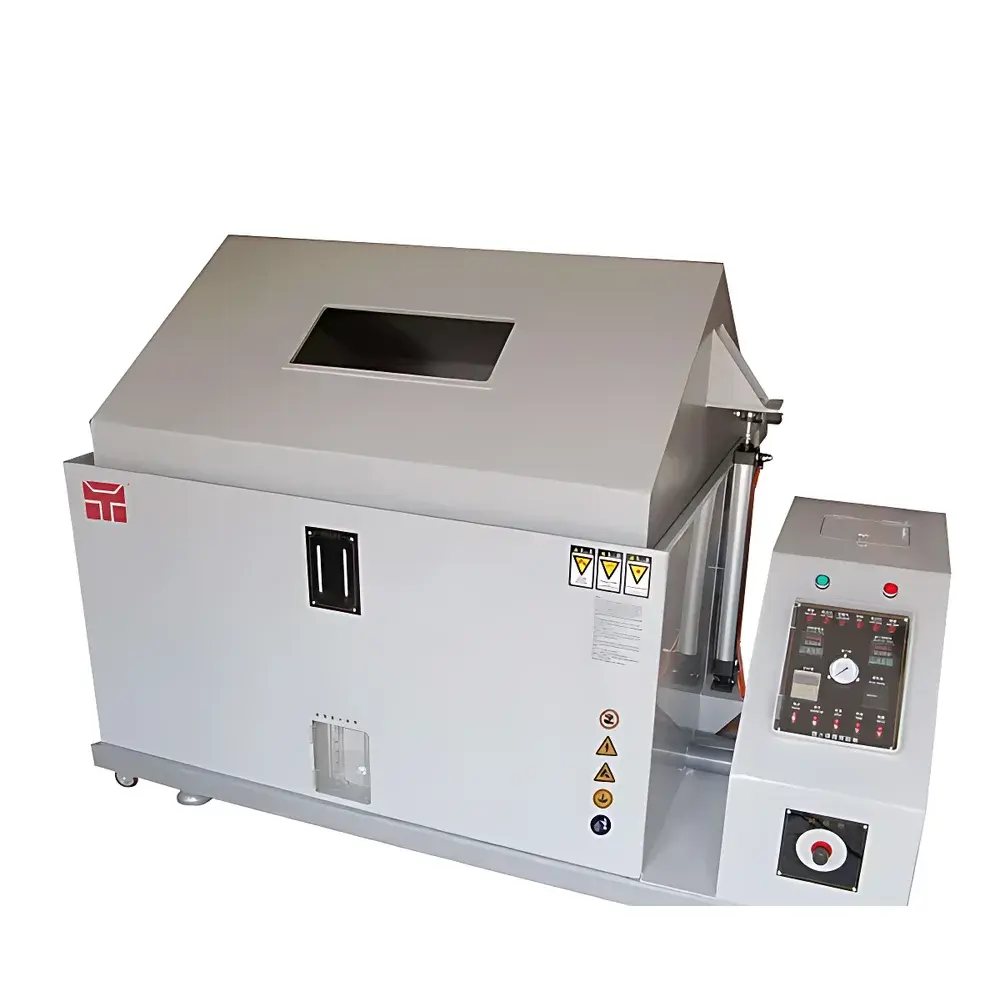
TianYuan TY-9015 Advanced Salt Spray Test Chamber
| Brand | TianYuan |
|---|---|
| Origin | Jiangsu, China |
| Manufacturer Type | Direct Manufacturer |
| Country of Origin | China |
| Model | TY-9015 |
| Price Range | USD 7,000–14,000 (FOB) |
| Salt Spray Deposition Rate | 1–2 mL/h·80 cm² |
| Test Chamber Temperature Range | 35–55 °C |
| Compliance Standards | GB/T 2423.17–2008, ASTM B117, JIS Z2371, ISO 9227, CNS 14103 |
Overview
The TianYuan TY-9015 Advanced Salt Spray Test Chamber is an engineered environmental test system designed for accelerated corrosion evaluation of metallic and coated materials under controlled saline fog conditions. It operates on the principle of continuous or cyclic salt mist generation via pneumatic atomization—leveraging Bernoulli-effect suction and precision PYREX® glass nozzles—to produce a stable, uniformly distributed aerosol within a sealed, chemically inert test chamber. The chamber’s thermally regulated environment ensures strict adherence to international corrosion testing protocols, including neutral salt spray (NSS), acetic acid salt spray (AASS), and copper-accelerated acetic acid salt spray (CASS) methods. Its dual-stage air pressure regulation, saturated air humidification via titanium alloy heating elements, and PTFE-free PVC construction eliminate cross-contamination risks while maintaining long-term operational stability in high-chloride exposure environments.
Key Features
- Chemically inert chamber construction: 5–8 mm thick A-grade UV-stabilized opaque and transparent PVC panels (max. service temperature: 60 °C), fully welded seams, and conical 120° lid geometry to prevent condensate drip onto specimens.
- Dual-stage compressed air regulation: Primary filtration (2.0–2.5 kg/cm²) with automatic moisture drainage; secondary precision pressure control (1.0 ± 0.1 kg/cm²) monitored by calibrated analog gauge and digital PID controller.
- Uniform雾化 delivery: Precision-machined PYREX® borosilicate glass nozzles (rated for >4,000 h operation without crystallization), coupled with conical dispersion towers enabling adjustable spray intensity and directional consistency across chamber volume.
- Thermal management system: Water-jacketed inner chamber heating with liquid-expansion safety thermostat (0–120 °C, EGO Italy); independent saturation tank temperature control (47–70 °C, ±1 °C accuracy) using VT4810 PID algorithm.
- Intelligent operational safeguards: Dual overtemperature cutoffs, auto-refill water level detection with audible/visual alert, leakage current protection, and power-loss memory function preserving elapsed test time upon restoration.
- Modular specimen support: Standard V- and O-type PVC racks (15° and 30° inclination per GB/T 2423.17), plus optional hook-based mounting for irregular geometries; internal salt solution reservoir pre-heated in situ to minimize thermal shock during spraying.
Sample Compatibility & Compliance
The TY-9015 accommodates specimens up to 200 × 100 × 60 cm (model TY-9015-016), supporting flat panels, fasteners, electronic enclosures, automotive components, and coated substrates. All internal wetted surfaces—including nozzles, tubing, reservoirs, and mist collectors—are constructed from non-metallic, chloride-resistant polymers to prevent catalytic corrosion artifacts. The system meets full technical requirements of ASTM B117 (Neutral Salt Spray), ISO 9227 (Corrosion tests in artificial atmospheres), JIS Z2371, GB/T 2423.17–2008, and CNS 14103. Optional CASS mode operation complies with ASTM G85 Annex A5, requiring precise temperature control at 50 ± 2 °C and pH-adjusted acidic salt solution. Chamber design supports GLP-compliant validation—traceable calibration records for temperature sensors (±0.1 °C), deposition rate verification (via calibrated漏斗 collector per ISO 9227 Annex B), and audit-ready event logging.
Software & Data Management
While the base TY-9015 model features standalone analog/digital instrumentation (VT4810 PID controllers, OMRON timers, dual-display temperature readouts), optional RS485/Modbus RTU interface enables integration with centralized laboratory data acquisition systems. Real-time parameters—including chamber temperature, saturation tank temperature, total elapsed time, and cycle count—are logged at user-defined intervals (1–60 min). Event-triggered alerts (e.g., low water level, overtemperature, pressure deviation >±0.05 kg/cm²) generate timestamped entries compliant with FDA 21 CFR Part 11 requirements when paired with validated third-party SCADA software. All firmware adheres to IEC 61508 functional safety principles for industrial control systems.
Applications
This chamber is routinely deployed in quality assurance laboratories for evaluating corrosion resistance of electroplated zinc/nickel coatings, anodized aluminum alloys, stainless steel passivation layers, marine-grade fasteners, printed circuit board conformal coatings, and automotive under-hood components. It serves as a primary qualification tool for suppliers to Tier-1 OEMs in aerospace (per AMS 2700), automotive (VW TL 226, GMW 14872), and defense sectors (MIL-STD-810H Method 509.6). In R&D settings, it supports comparative studies of inhibitor efficacy, coating thickness optimization, and galvanic coupling behavior under simulated coastal or de-icing salt exposure. Validated use cases include accelerated life prediction modeling per ISO 16701 and failure mode correlation with field performance data.
FAQ
What standards does the TY-9015 comply with?
It fully conforms to ASTM B117, ISO 9227, JIS Z2371, GB/T 2423.17–2008, and CNS 14103 for NSS, AASS, and CASS testing.
Can the chamber operate in cyclic corrosion modes?
Yes—optional programmable timer modules enable automated transitions between salt spray, dry-off, and high-humidity phases per ASTM G85 Annexes A1–A5.
Is the PYREX® nozzle truly maintenance-free for 4,000 hours?
Under standard NSS conditions (5 wt% NaCl, pH 6.5–7.2, distilled water feed), crystallization resistance is verified per manufacturer’s accelerated aging protocol; periodic inspection is recommended per ISO 9227 Clause 7.3.
How is temperature uniformity validated?
Per ISO 9227 Section 6.2, nine-point mapping (center + eight corners) confirms ≤±0.5 °C spatial deviation at setpoint; calibration certificates available upon request.
Does the system support remote monitoring?
RS485 Modbus RTU output allows connection to PLCs or LabVIEW-based DAQ systems; Ethernet/WiFi gateway add-ons are available for cloud-enabled telemetry.



