
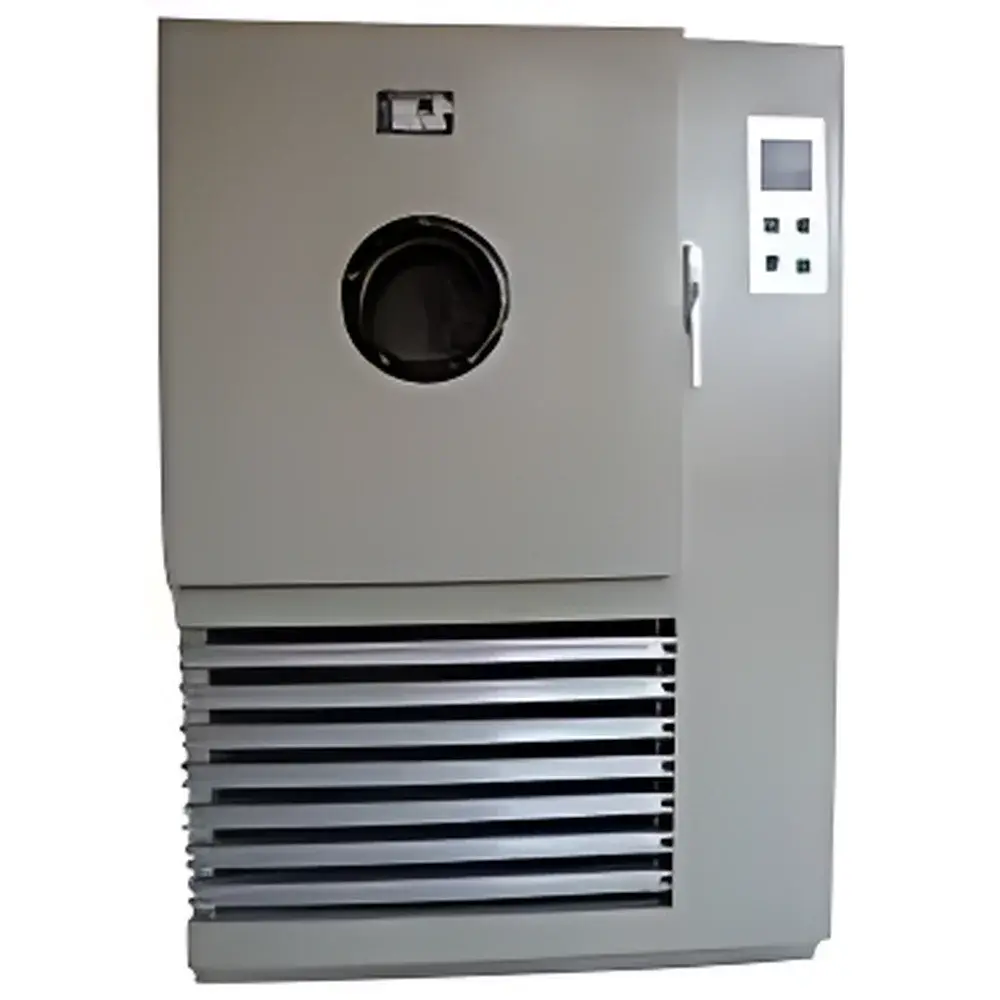
TianYuan TY-401B High-Temperature Air Aging Test Chamber for Rubber and Polymer Materials
| Brand | TianYuan |
|---|---|
| Origin | Jiangsu, China |
| Manufacturer Type | Direct Manufacturer |
| Country of Origin | China |
| Model | TY-401B |
| Price Range | USD 1,400 – 7,000 (FOB) |
| Max Operating Temperature | 300 °C |
| Temperature Range | Ambient to 300 °C |
| Temperature Uniformity | ≤ ±1 °C |
| Temperature Fluctuation | ≤ ±0.5 °C |
| Temperature Deviation | ≤ ±1 °C |
| Heating Time (RT to 300 °C) | ≤ 60 min |
| Air Exchange Rate | 0–100 cycles/h |
| Internal Chamber Dimensions (W×H×D) | 500 × 500 × 500 mm |
| Forced Air Velocity | 0.5 m/s |
| Power Rating | 2–4 kW |
| Supply Voltage | AC 220 V, 50 Hz |
| Internal Construction | Stainless Steel (SUS304) |
Overview
The TianYuan TY-401B High-Temperature Air Aging Test Chamber is a precision-engineered environmental test system designed specifically for accelerated thermal oxidation aging of elastomers, thermoplastics, electrical insulating materials, and other organic polymers. It operates on the principle of forced-convection air circulation under controlled elevated temperature conditions, simulating long-term exposure to ambient thermal stress in a compressed timeframe. The chamber maintains a stable, uniform thermal environment across its stainless steel (SUS304) interior, enabling reproducible degradation studies critical for material lifetime prediction, formulation optimization, and quality assurance in rubber compounding and polymer manufacturing. Its design complies with key international standards governing thermal aging methodology—including JB/T 7444 (Chinese national standard for air-aging test chambers) and IEC 60540 (formerly IEC 540), which specify requirements for temperature control accuracy, airflow homogeneity, and chamber construction integrity.
Key Features
- Stainless steel (SUS304) inner chamber ensures corrosion resistance, thermal stability, and long-term dimensional integrity during repeated high-temperature cycling.
- Digital PID temperature controller with real-time display enables precise setpoint programming from ambient to 300 °C, with automatic ramp-hold functionality and programmable timer-based operation.
- Forced-air circulation system driven by a dedicated blower motor delivers consistent airflow at 0.5 m/s, promoting uniform heat transfer and minimizing thermal gradients across test specimens.
- Adjustable air exchange rate (0–100 cycles per hour) allows users to modulate oxidative intensity—critical for simulating varying atmospheric exposure conditions in service environments.
- High-reproducibility thermal performance: temperature fluctuation ≤ ±0.5 °C; uniformity ≤ ±1 °C; deviation ≤ ±1 °C—validated per JB/T 7444 calibration protocols.
- Robust thermal insulation and dual-layer door sealing minimize energy consumption and external surface temperature rise during extended 300 °C operation.
Sample Compatibility & Compliance
The TY-401B accommodates standardized test specimens per ASTM D573, ISO 188, and GB/T 3512—commonly used for rubber vulcanizate aging evaluation. Its 500 × 500 × 500 mm working volume supports multiple parallel samples (e.g., dumbbell tensile strips, O-rings, or die-cut discs) while maintaining required airflow clearance. All operational parameters—including temperature profile, dwell time, and air exchange rate—are documented in accordance with GLP-compliant laboratory practice. While the unit itself does not embed electronic audit trails, its analog/digital hybrid control interface permits integration into facility-wide data logging systems compliant with FDA 21 CFR Part 11 when paired with validated external recorders.
Software & Data Management
The TY-401B features an embedded digital controller with non-volatile memory for storing up to 10 user-defined test programs, including multi-step ramp-soak sequences. Temperature data is output via analog 4–20 mA signal or RS485 Modbus RTU interface (optional), enabling connection to SCADA platforms, LIMS, or centralized environmental monitoring systems. Optional PC-based software (sold separately) provides real-time graphing, alarm logging, and CSV export of time-stamped temperature readings—supporting traceability for internal QA audits and third-party certification submissions (e.g., ISO 9001, IATF 16949).
Applications
- Evaluation of thermal oxidative stability in natural rubber (NR), styrene-butadiene rubber (SBR), nitrile rubber (NBR), EPDM, and silicone elastomers.
- Accelerated aging of polymer-based cable insulation, gaskets, seals, and automotive under-hood components.
- Pre-screening of antioxidant package efficacy in rubber formulations prior to field validation.
- Compliance testing per ASTM D573 (rubber—deterioration in an air oven), ISO 188 (vulcanized rubber—accelerated ageing), and GB/T 3512 (rubber—thermal ageing test).
- Supporting R&D activities in tire manufacturing, aerospace sealing, medical device polymer qualification, and electrical insulation system development.
FAQ
What standards does the TY-401B meet for thermal aging testing?
It conforms to JB/T 7444 (People’s Republic of China mechanical industry standard) and IEC 60540 for air-aging test chamber performance, and supports test execution per ASTM D573, ISO 188, and GB/T 3512.
Can the chamber operate continuously at 300 °C?
Yes—the SUS304 chamber and heating system are rated for uninterrupted operation at 300 °C, with thermal protection cutoffs and overtemperature alarms as safety redundancies.
Is the air exchange rate calibrated and traceable?
The mechanical flow control valve is factory-adjusted and verified against volumetric airflow measurement; users may validate in situ using an anemometer or calibrated rotameter per ISO 5167 guidelines.
Does the unit support remote monitoring or network connectivity?
Standard configuration includes RS485 Modbus RTU; Ethernet or Wi-Fi modules are available as OEM add-ons for integration into Industry 4.0-capable lab infrastructures.
What maintenance is required for long-term reliability?
Biannual inspection of heater elements, blower bearings, and door gasket integrity is recommended; calibration of the temperature sensor should be performed annually using NIST-traceable reference standards.



