
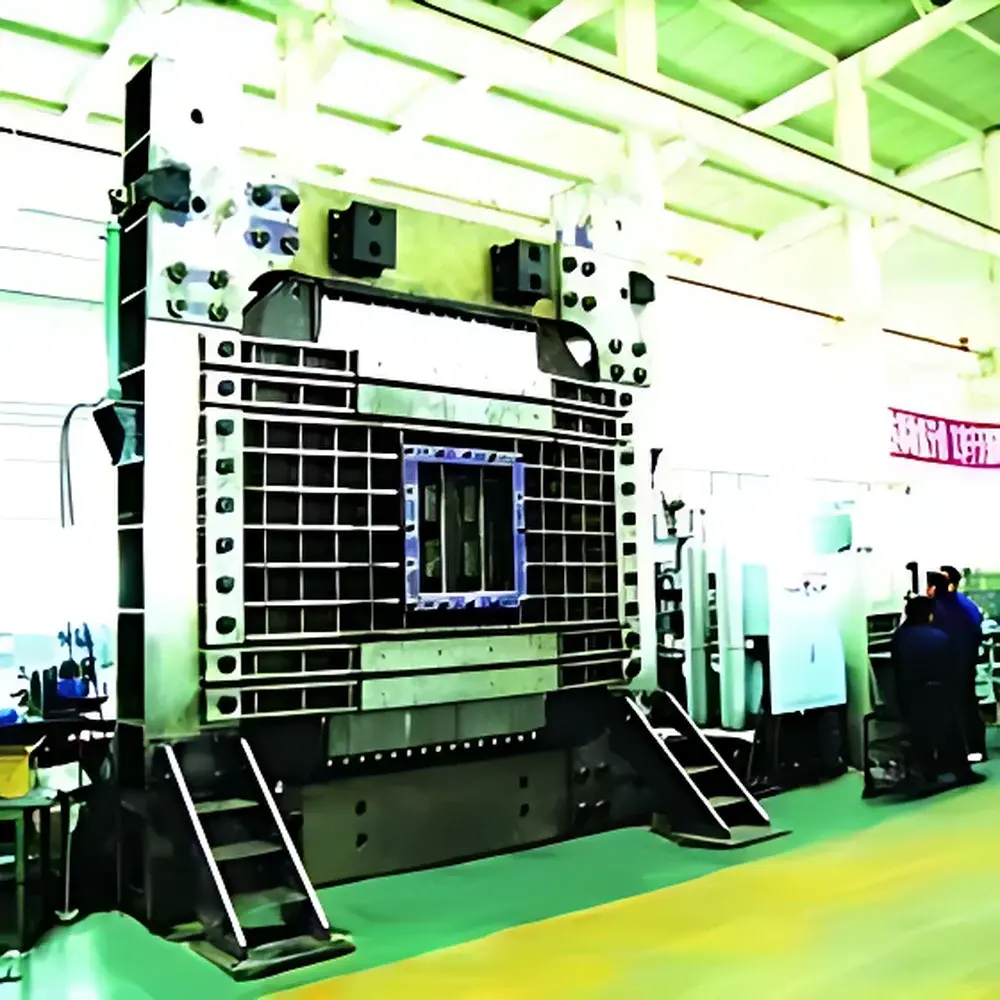
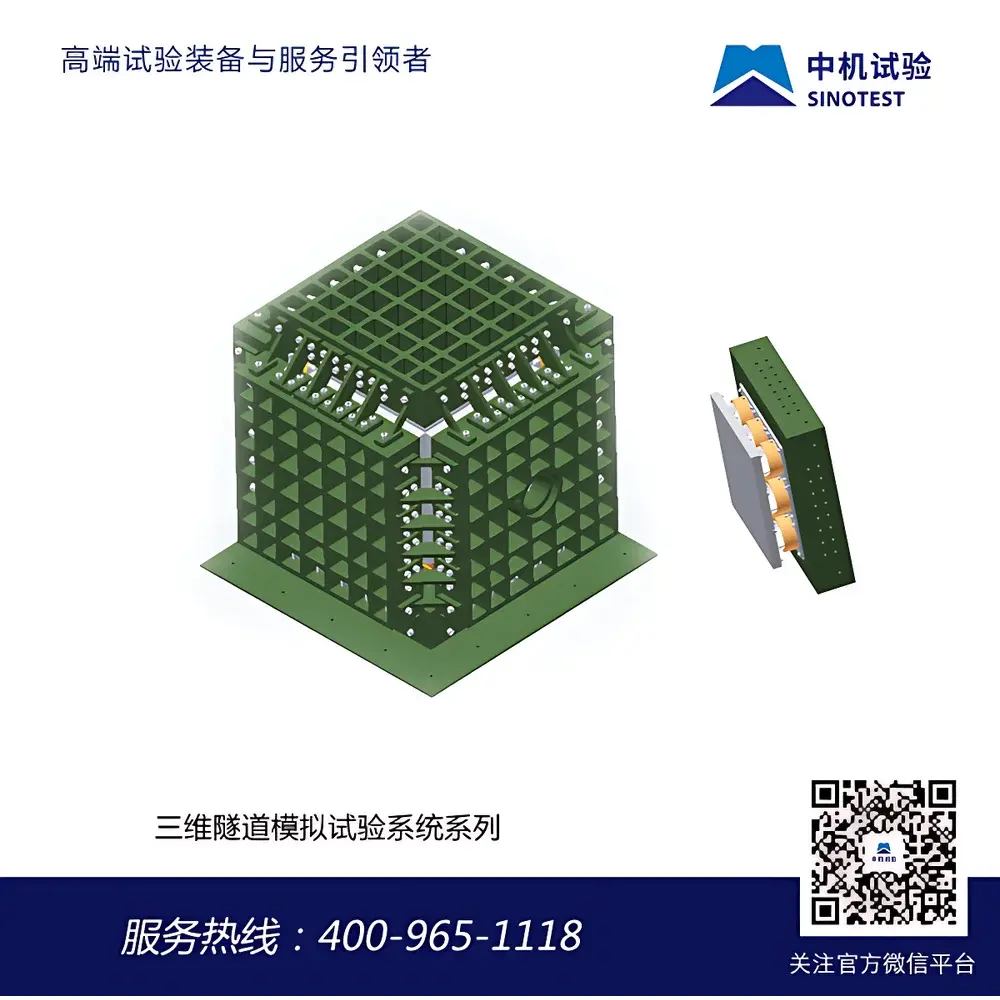
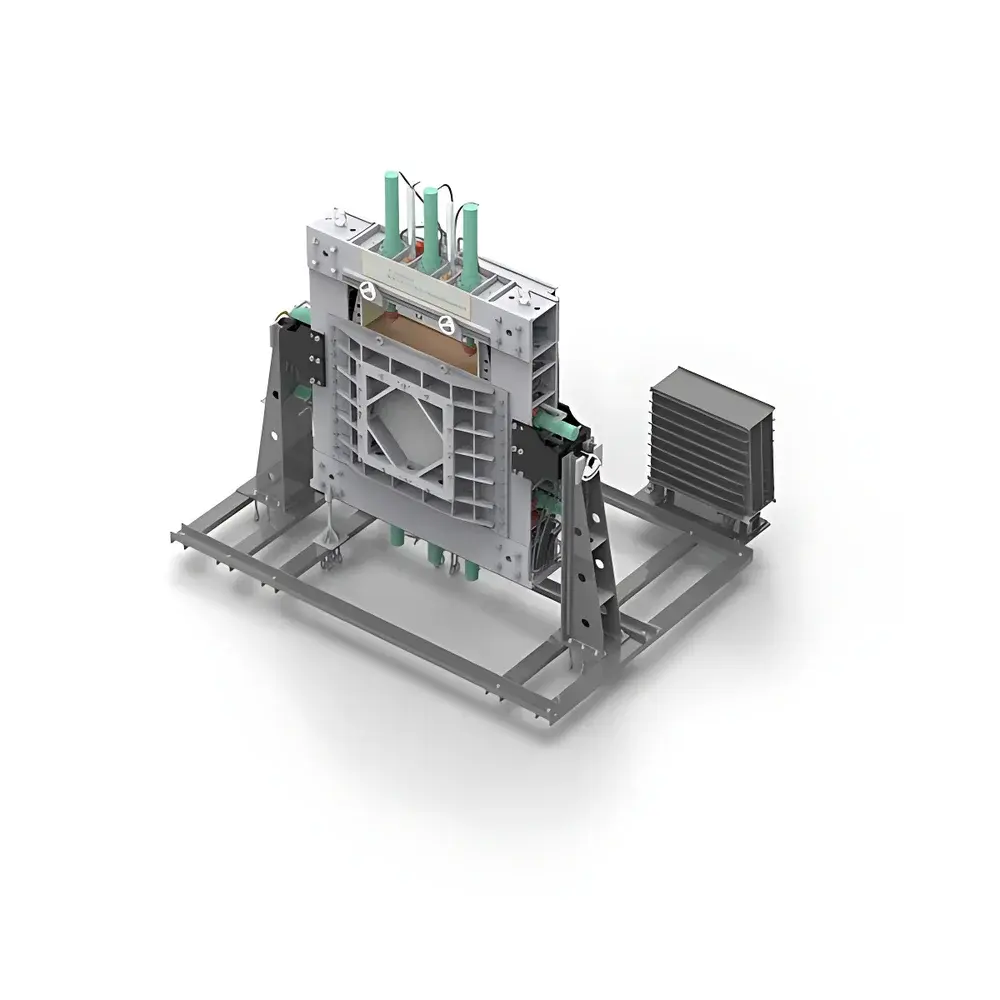
SINOTEST ZYDL-YS120100 & ZSDM800400 Planar Rock-Mass Similarity Model Testing System
| Brand | SINOTEST |
|---|---|
| Origin | Jilin, China |
| Manufacturer Type | Direct Manufacturer |
| Country of Origin | China |
| Model | ZYDL-YS120100 / ZSDM800400 |
| Max Specimen Dimensions (ZYDL-YS) | 2000 mm × 300 mm × 1200 mm (L×W×H) |
| Max Vertical Load | 120 kN (4 × 30 kN), max stress 0.2 MPa |
| Max Horizontal Load | 100 kN (3 × 33.3 kN), max stress 0.25 MPa |
| Max Vertical Load (ZSDM800400) | 800 kN |
| Max Horizontal Load (ZSDM800400) | 2 × 400 kN (orthogonal directions) |
| Hydraulic Control Channels | 1 horizontal (proportional servo), 1 vertical top surface (proportional servo) |
| Loading Accuracy | ±2% of indicated value |
| Deformation Measurement Range | 5–80 mm |
| Jack Stroke | ≤150 mm (ZYDL-YS) |
| Test Duration Capability | Up to 28 days under sustained load with ±2% load control stability |
| Structural Clearance (ZSDM800400) | 1386 mm × 1386 mm × 800 mm (L×W×H) |
| Actuator Speed | 0.01 m/s (vertical and horizontal) |
| Protection Functions | Overload, limit switch, overcurrent, overvoltage |
| Acoustic Noise Level | <65 dB(A) |
| Accuracy Class | Grade 2 per GB/T 16825.1 / ISO 7500-1 |
Overview
The SINOTEST ZYDL-YS120100 and ZSDM800400 Planar Rock-Mass Similarity Model Testing Systems are engineered for high-fidelity physical simulation of geomechanical behavior in large-scale underground structures. Based on the principles of dimensional similarity and mechanical equivalence, these systems replicate in-situ stress states—including vertical overburden pressure and lateral tectonic constraints—within planar physical models constructed from scaled-down rock analog materials (e.g., cemented sand, gypsum composites, or polymer-based simulants). The ZYDL-YS variant supports medium-scale investigations (up to 2 m length), while the ZSDM800400 provides heavy-duty capability for full-section tunnel or cavern modeling with dual orthogonal horizontal actuation and 800 kN vertical capacity. Both configurations employ closed-loop proportional servo-hydraulic control to maintain static and quasi-static loading profiles with traceable fidelity, enabling quantitative validation of numerical models (e.g., FLAC2D, Phase2, or UDEC) used in feasibility studies and safety assessments.
Key Features
- Modular dual-system architecture: ZYDL-YS120100 optimized for educational labs and preliminary research; ZSDM800400 designed for advanced geotechnical R&D with 800 kN vertical and 400 kN × 2 orthogonal horizontal loading capacity
- Independent proportional servo-hydraulic control of vertical and horizontal load paths ensures decoupled stress application, critical for simulating anisotropic in-situ stress fields
- High-stiffness steel frame and precision-machined loading platens minimize parasitic deformation, supporting test accuracy compliant with Grade 2 requirements per GB/T 16825.1 and ISO 7500-1
- Sustained-load capability up to 28 days with continuous ±2% load regulation—validated for long-term creep and time-dependent deformation analysis in salt caverns, nuclear waste repositories, and deep mining pillars
- Integrated safety architecture including hardware-limit switches, pressure relief valves, current/voltage monitoring, and software-enforced operational boundaries
- Low-noise hydraulic power unit (<65 dB(A)) suitable for university laboratories and shared research facilities without acoustic isolation requirements
Sample Compatibility & Compliance
The system accommodates planar rock-mass analog specimens fabricated from standardized simulant materials defined in ASTM D4543 (Standard Practices for Preparing Rock Core Specimens) and adapted for similarity modeling per ISRM Suggested Methods for Physical Modeling. Specimen dimensions conform to established scaling laws (e.g., 1:50 to 1:200) for hydroelectric tunnels, subsea transit corridors, and deep-buried energy infrastructure. All structural components meet GB 50017 (Chinese Code for Design of Steel Structures) and incorporate fatigue-rated welds per EN 1993-1-9. Data acquisition modules comply with IEEE 1057 for digitizer performance, and system calibration certificates reference national metrology standards traceable to CNAS-accredited laboratories.
Software & Data Management
A dedicated Windows-based control and analysis suite provides real-time load-displacement monitoring, multi-channel synchronized data logging (up to 10 kHz sampling), and automated report generation in PDF and CSV formats. Software architecture supports audit-trail logging per GLP/GMP guidelines, including user authentication, timestamped parameter changes, and immutable raw-data archiving. Export functions enable direct integration with MATLAB, Python (via HDF5), and commercial FEA post-processors. Calibration parameters are stored in encrypted configuration files with version control; all test sequences can be replayed or reprocessed using original acquisition metadata.
Applications
- Stability analysis of horseshoe-shaped hydropower diversion tunnels under asymmetric lateral confinement
- Failure mechanism mapping in layered rock masses surrounding underground powerhouse caverns
- Time-dependent convergence assessment of deep-buried petroleum storage caverns in bedded salt formations
- Support interaction evaluation between segmental linings and fractured host rock in subsea shield tunneling
- Validation of discrete element method (DEM) simulations for blocky rock slope kinematics
- Educational demonstration of stress redistribution around excavation boundaries in undergraduate geomechanics laboratories
FAQ
What is the maximum specimen thickness supported by the ZYDL-YS120100 system?
The system accepts specimens up to 300 mm thick (width dimension), with total model envelope constrained to 2000 mm × 300 mm × 1200 mm (L×W×H).
Can the ZSDM800400 apply independent horizontal loads in two perpendicular directions simultaneously?
Yes—two independently controlled servo actuators provide orthogonal horizontal loading (X and Y axes), each rated at 400 kN, enabling biaxial stress path testing.
Is the system compatible with third-party displacement sensors (e.g., LVDTs or digital image correlation)?
All analog input channels support standard ±10 V DC signals; digital I/O ports allow TTL-level triggering for external optical measurement systems.
Does the software support compliance with FDA 21 CFR Part 11 for regulated research environments?
While not certified for pharmaceutical GxP use, the audit-trail, electronic signature, and data-integrity features align with foundational Part 11 expectations for non-clinical laboratory applications.
What maintenance intervals are recommended for the hydraulic power unit?
Oil filtration and viscosity verification every 500 operational hours; full fluid replacement and seal inspection every 2,000 hours or biannually—whichever occurs first.



