
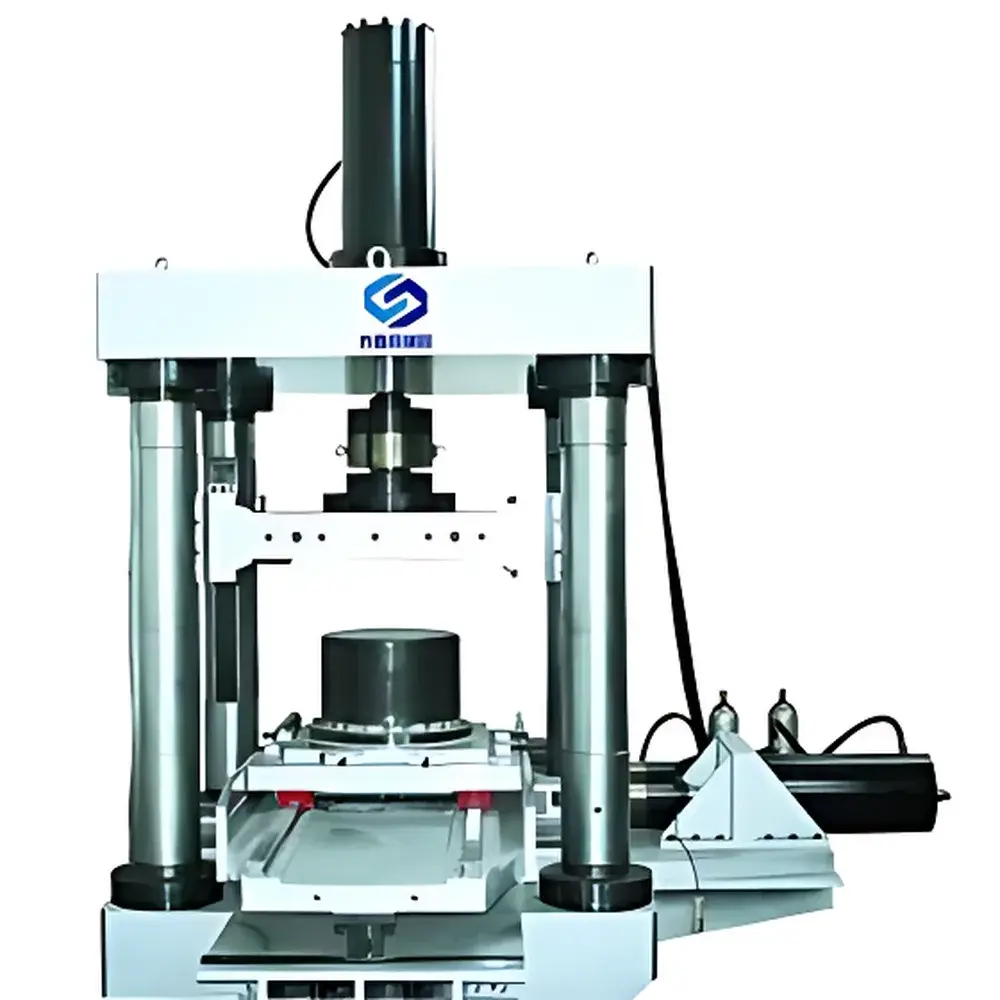
SINOTEST ZSDM Large-Scale 3D Multifunctional Interface Testing System
| Brand | SINOTEST |
|---|---|
| Origin | Jilin, China |
| Manufacturer Type | Direct Manufacturer |
| Region of Origin | Domestic (China) |
| Model | ZSDM |
| Pricing | Upon Request |
Overview
The SINOTEST ZSDM Large-Scale 3D Multifunctional Interface Testing System is an advanced geotechnical and geosynthetic interface characterization platform engineered for high-fidelity mechanical testing of soil–structure, soil–soil, and soil–geotextile interfaces under controlled multiaxial stress and displacement boundary conditions. It operates on the principle of servo-hydraulic closed-loop control to apply independent, synchronized, or path-defined loading in three orthogonal axes—two horizontal (X and Y) and one vertical (Z)—enabling precise simulation of complex in-situ interaction mechanics. Unlike conventional shear or consolidation apparatuses, the ZSDM system integrates force-controlled, displacement-controlled, and hybrid stress–strain coupling modes within a single unified framework, supporting both static monotonic and dynamic cyclic loading protocols. Its structural architecture accommodates large-scale specimens (up to 600 mm × 600 mm planar dimensions and 400 mm height), ensuring representative volume element (RVE) testing while maintaining measurement integrity across heterogeneous material systems.
Key Features
- Triaxial independent loading capability with real-time force and displacement feedback in all three axes (X, Y, Z), enabling coordinated multiaxial control with sub-millimeter positioning resolution and ±0.5% full-scale load accuracy.
- Programmable stress-path generation—including circular, elliptical, and cruciform trajectories—calculated from applied normal and shear forces normalized by specimen cross-sectional area per ASTM D5321 and ISO 17892-10 conventions.
- Displacement-trajectory control mode, where user-defined paths are executed via spatial interpolation of nodal displacements measured at predefined points on the specimen surface.
- Hybrid control architecture supporting simultaneous stress–displacement coupling, including constant-normal-stress (CNS), constant-normal-stiffness (CNSK), and incremental stiffness-based protocols.
- Integrated calibration workflow with guided GUI-based procedures for load cell zeroing, LVDT alignment verification, and hydraulic pressure compensation—fully traceable and audit-ready for GLP-compliant laboratories.
- Overload protection system with dual-stage safety logic: hardware-limited pressure cutoff and software-enforced force/displacement envelope monitoring, compliant with ISO 12100 mechanical safety standards.
Sample Compatibility & Compliance
The ZSDM system accommodates a broad range of geomaterial configurations: cohesive and cohesionless soils (sand, silt, clay), reinforced soil masses, geotextiles (woven/nonwoven), geogrids, geomembranes, and concrete–soil interfaces. Two interchangeable consolidation cells support both standard oedometer-style compression and flexible-wall triaxial-compatible setups per ASTM D2435 and ISO 17892-5. All test procedures align with international geotechnical testing standards, including but not limited to ASTM D3080 (direct shear), ASTM D5321 (pullout), and ISO 17892-10 (interface shear). The system’s mechanical design conforms to CE machinery directive 2006/42/EC, and its data acquisition firmware supports audit trails required under FDA 21 CFR Part 11 when configured with optional electronic signature modules.
Software & Data Management
The proprietary ZSDM Control Suite provides a Windows-based graphical interface with role-based access control, intuitive test sequence scripting, and real-time multi-channel visualization (force vs. time, displacement loops, stress–strain hysteresis, and trajectory overlays). All raw sensor data—including load cell outputs (kN), LVDT displacements (mm), and hydraulic pressures (MPa)—are timestamped and stored in HDF5 format for long-term archival and third-party analysis compatibility (MATLAB, Python, Origin). Built-in reporting tools generate PDF test summaries with metadata embedding (operator ID, calibration dates, environmental conditions), and optional integration with LIMS platforms via OPC UA or RESTful API enables automated data ingestion into enterprise QA/QC workflows.
Applications
- Interface shear behavior characterization for buried pipelines, retaining wall backfills, and foundation–soil systems.
- Geosynthetic pullout resistance quantification under varying normal stress and displacement rate conditions.
- Multiaxial consolidation and creep response analysis of soft clays and municipal landfill cover soils.
- Validation of constitutive models (e.g., hypoplasticity, critical state frameworks) requiring full stress–strain path data.
- Dynamic interface degradation assessment under cyclic loading simulating seismic or traffic-induced stresses.
- Calibration of discrete element method (DEM) contact laws using experimentally derived interface friction, dilation, and stiffness parameters.
FAQ
What types of soil–structure interfaces can be tested on the ZSDM system?
The system supports direct shear, simple shear, and pullout configurations for interfaces between soil and rigid structures (e.g., steel, concrete), flexible membranes, and geosynthetic reinforcements.
Does the ZSDM support automated test sequence execution?
Yes—users can define and save multi-step protocols with conditional triggers (e.g., “hold at 50 kPa normal stress for 30 minutes, then ramp shear displacement at 0.02 mm/min until peak resistance”).
Is third-party software integration possible?
The system provides documented APIs and export formats (CSV, HDF5, XML) compatible with MATLAB, Python (NumPy/Pandas), and commercial FE preprocessors.
What calibration documentation is provided?
Each unit ships with NIST-traceable calibration certificates for all transducers, along with internal verification procedures aligned with ISO/IEC 17025 requirements.
Can the system perform long-term creep or relaxation tests?
Yes—the closed-loop controller maintains target load or displacement for durations exceeding 72 hours with thermal drift compensation and automatic gain adjustment.



