
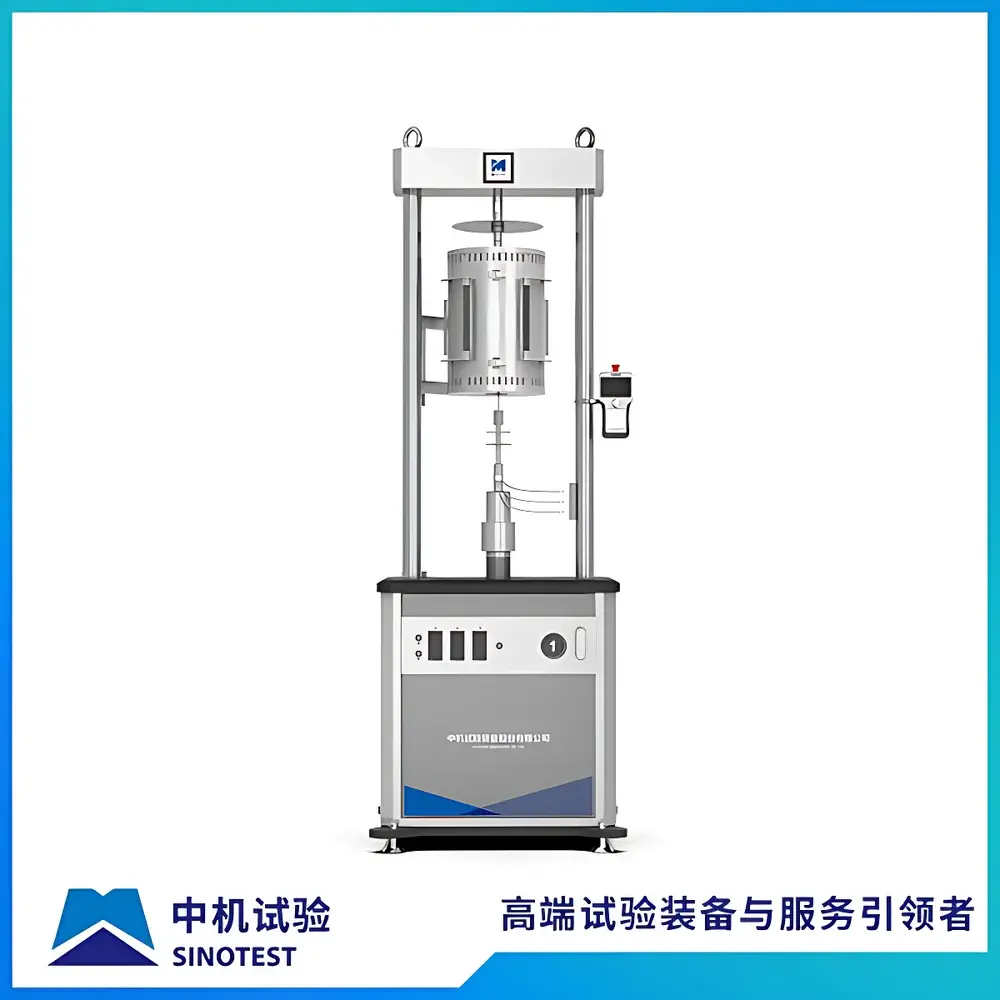
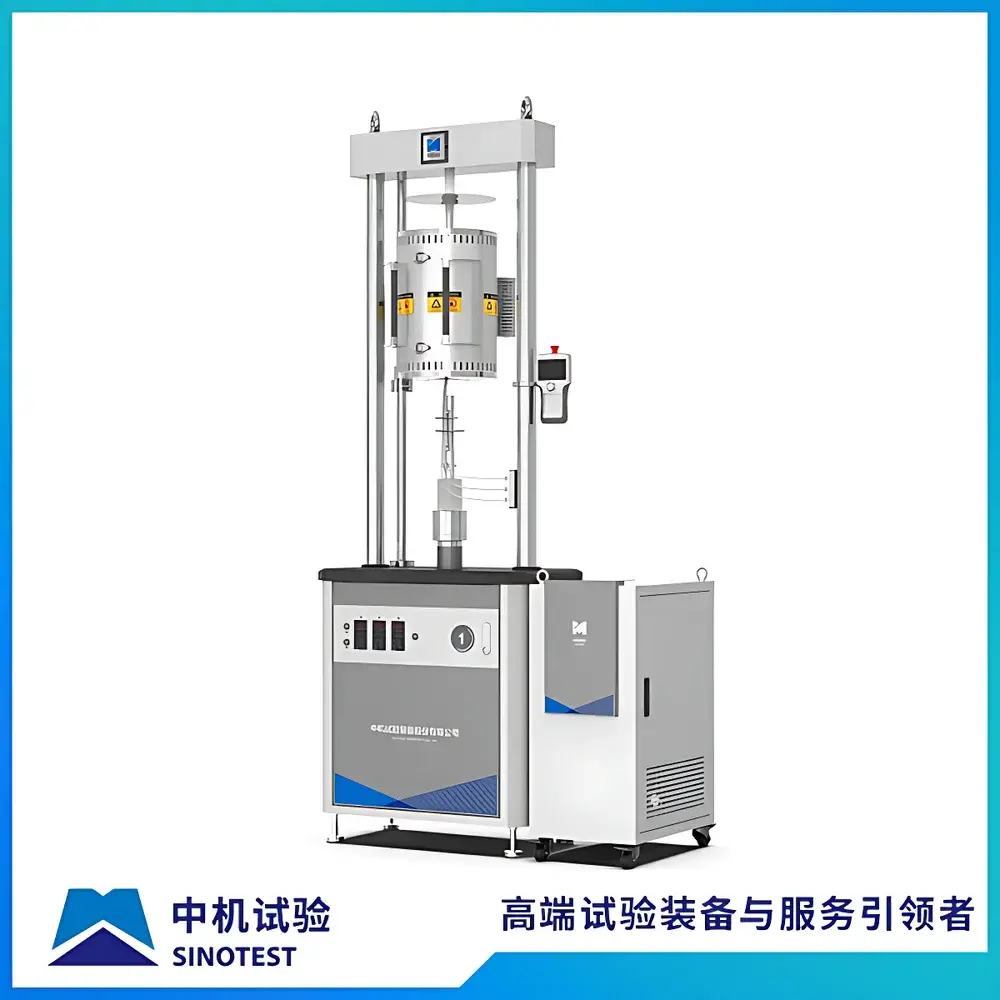
SINOTEST R-Series Electronic Creep and Stress Rupture Testing Machine
| Brand | SINOTEST |
|---|---|
| Origin | Jilin, China |
| Manufacturer Type | Direct Manufacturer |
| Country of Origin | China |
| Model Series | RDL, RWS |
| Instrument Type | Electromechanical |
| Maximum Test Load | 600 kN |
| Maximum Crosshead Travel | >200 mm |
| Overall Dimensions (W × D) | 2300 × 950 mm |
| Machine Weight | 500–1200 kg |
Overview
The SINOTEST R-Series Electronic Creep and Stress Rupture Testing Machine is a precision-engineered electromechanical system designed for long-term, high-stability mechanical property evaluation under sustained load and elevated temperature conditions. Rooted in over four decades of continuous development since its debut in the 1980s — recognized as China’s first domestically developed long-duration mechanical testing platform — the R-Series implements fundamental creep mechanics principles based on time-dependent viscoelastic and viscoplastic deformation theory. It operates under controlled uniaxial tensile or compressive loading while maintaining specimen temperature within calibrated furnace environments (compatible with external high-temperature furnaces up to 1200 °C, sold separately). The system is engineered for compliance with ISO 204, ASTM E139, ASTM E2714, ASTM E328, GB/T 2039, GB/T 10120, and JJG 276 metrological verification requirements, supporting traceable, audit-ready data acquisition essential for materials qualification in aerospace, power generation, nuclear engineering, and heavy industrial applications.
Key Features
- Electromechanical actuation architecture delivering precise, low-drift force control over durations exceeding 10,000 hours — optimized for creep strain rates down to 10−8 s−1
- Integrated controller and thermal management subsystem housed within the main frame — minimizing footprint and eliminating external cabinet dependencies
- RDL Series: Equipped with DOLi EDC digital controller (custom firmware for creep-specific PID tuning and load hold stability), paired with dual-software environment — CreepTest (jointly developed with DOLi) and Creep Test Expert v2.0 (SINOTEST proprietary)
- RWS Series: Powered by SINOTEST’s TMC-series digital controller, supporting real-time closed-loop control of load, displacement, and thermal ramp profiles
- Multi-unit synchronization capability: Enables seamless parallel operation of multiple R-Series frames with synchronized data timestamps and centralized monitoring via Ethernet
- Fully recoverable offline test mode: All active channels (load, extensometer displacement, furnace thermocouple signals, crosshead position) persist in non-volatile memory during power interruption; resume functionality restores full experimental continuity without data loss
Sample Compatibility & Compliance
The R-Series accommodates standardized cylindrical and flat-sheet specimens per ASTM E139, ISO 204, and GB/T 2039 geometries (e.g., gauge lengths from 25 mm to 100 mm, diameters from 3 mm to 12 mm). Optional high-temperature extensometers (capable of operation up to 1100 °C) and vacuum-compatible furnace interfaces are available for specialized applications including stress corrosion cracking (SCC) and creep-fatigue interaction studies. The system conforms to GLP and GMP-aligned documentation practices, with software supporting 21 CFR Part 11-compliant electronic signatures, audit trails, and user access level management. Calibration certificates follow ISO/IEC 17025 guidelines, and periodic verification aligns with JJG 276–2009 national verification procedures for high-temperature creep testing machines.
Software & Data Management
Creep Test Expert v2.0 provides a deterministic, deterministic real-time operating environment with sub-millisecond sampling resolution across all analog input channels. The software supports automated test sequencing (e.g., step-load creep, ramp-hold relaxation, cyclic creep-fatigue protocols), live curve superposition, and export of raw time-series datasets in CSV, XML, and universal HDF5 formats. Built-in reporting modules generate ISO/ASTM-compliant test reports with embedded metadata (operator ID, calibration status, environmental logs, uncertainty budgets). Data archiving complies with long-term retention requirements for regulatory submissions, with optional integration into LIMS platforms via OPC UA or RESTful API interfaces.
Applications
- High-temperature creep rupture life prediction for turbine disk alloys (e.g., Inconel 718, GH4169) per ASTM E139
- Stress relaxation behavior of welded joints in pressure vessel steels (ASME Section II, Part D)
- Low-cycle fatigue–creep interaction analysis in steam generator tubing materials (ASTM E2714)
- Long-term dimensional stability assessment of polymer composites and ceramic matrix composites (CMCs)
- Time-dependent mechanical characterization for nuclear fuel cladding materials (e.g., Zircaloy-4, M5®) under simulated reactor conditions
- Validation of constitutive models (e.g., Norton-Bailey, Garofalo, Kachanov-Rabotnov) used in finite element life prediction tools
FAQ
What temperature ranges are supported with the R-Series?
The base system supports ambient-to-300 °C using integrated heating elements; extended high-temperature capability (up to 1200 °C) requires externally mounted furnaces compatible with DIN 51859 or ASTM E1113 standards.
Is the system compliant with FDA 21 CFR Part 11?
Yes — Creep Test Expert v2.0 includes role-based authentication, electronic signature workflows, immutable audit trails, and data integrity safeguards meeting Part 11 technical and procedural requirements.
Can the RDL and RWS controllers be interchanged between frames?
No — RDL frames require DOLi EDC hardware and associated firmware licensing; RWS frames utilize SINOTEST TMC-series controllers with distinct I/O architecture and calibration mapping.
What extensometer options are certified for use with this system?
SINOTEST-certified LVDT and clip-on extensometers (including high-temperature variants with ceramic housings and mineral-insulated thermocouples) are qualified per ISO 9513 Class 0.5 and ASTM E83 specifications.
Does the system support automated multi-step creep tests?
Yes — programmable test sequences include load ramping, dwell periods, temperature ramps, and conditional transitions triggered by strain rate thresholds or elapsed time.



