
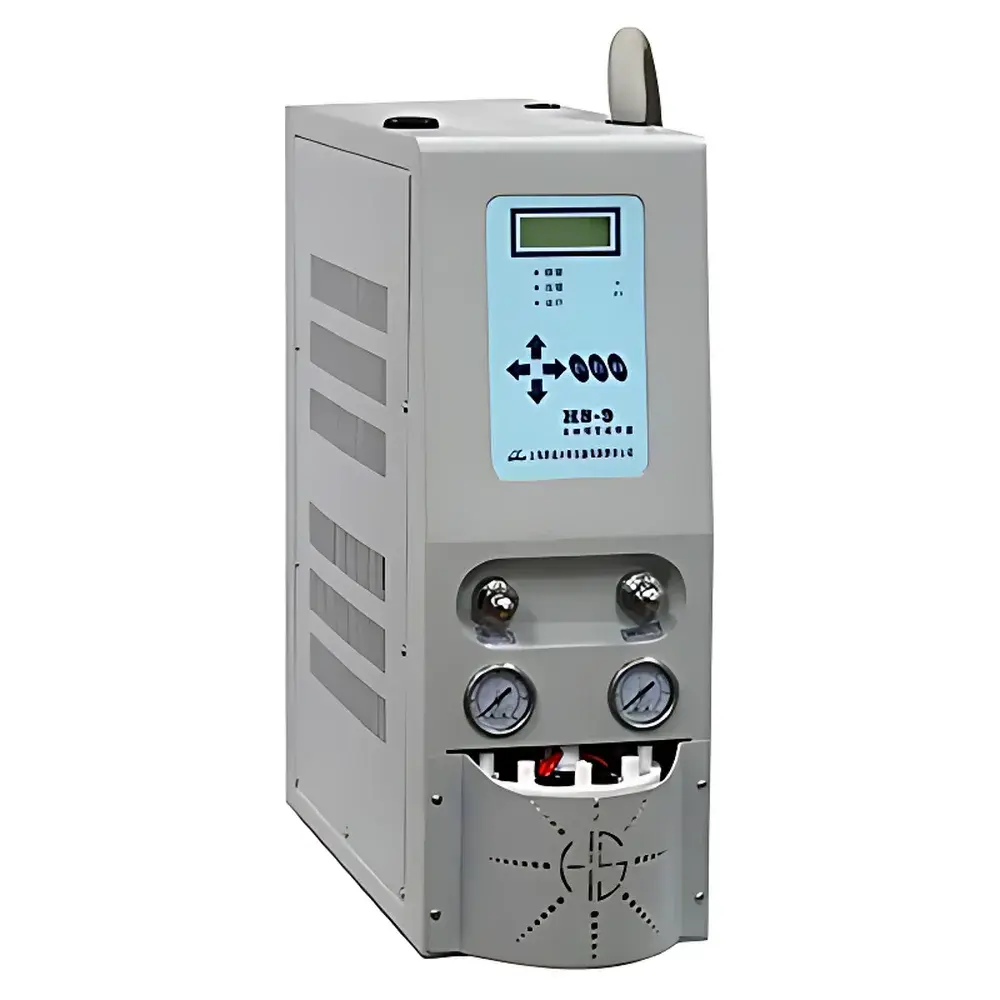
Sida HS-9 Static Headspace Sampler
| Brand | Sida |
|---|---|
| Origin | Shanghai, China |
| Manufacturer Type | OEM Manufacturer |
| Regional Classification | Domestic (China) |
| Model | HS-9 |
| Price Range | USD 4,200 – 5,600 |
| Instrument Type | Static Headspace Sampler |
| Automation Level | Semi-Automatic |
| Sample Vial Capacity | 9 positions |
| Vial Sizes Supported | 10 mL and 20 mL |
Overview
The Sida HS-9 Static Headspace Sampler is an engineered solution for routine and method-developed volatile organic compound (VOC) analysis in gas chromatography (GC) workflows. Designed on the principle of static headspace equilibrium—where analytes partition between a liquid/solid sample matrix and its overlying vapor phase at controlled temperature—the HS-9 enables reproducible extraction of headspace gases without mechanical agitation or pressurized transfer. Its compact, integrated architecture reflects deliberate optimization for laboratory environments with limited bench space, particularly QC labs, environmental testing facilities, and pharmaceutical stability studies where cost-effective, reliable VOC screening is required. The system operates under precise thermal control of both sample vials and transfer lines to minimize condensation and adsorption losses—critical for trace-level analysis of low-boiling compounds such as residual solvents (e.g., methanol, acetone, dichloromethane) per ICH Q3C guidelines.
Key Features
- Compact footprint: Engineered as one of the smallest static headspace samplers available in the domestic Chinese instrumentation market, facilitating deployment in high-density lab layouts.
- Semi-automated operation: Combines manual vial loading with programmable thermal equilibration, pressurization, loop fill, and GC injection sequencing—reducing operator dependency while maintaining method flexibility.
- Dual vial compatibility: Supports standard 10 mL and 20 mL crimp-top headspace vials, enabling method scalability from screening to validation without hardware modification.
- Inert flow path: All wetted surfaces—including vial septum piercer, sampling loop, and transfer lines—are constructed from chemically resistant materials (e.g., fused silica, electropolished stainless steel, and fluoropolymer coatings) to suppress analyte adsorption and carryover.
- Active thermal management: Independent heating zones for vial block (ambient to 200 °C, ±0.1 °C stability) and transfer line (up to 220 °C), preventing cold spots and ensuring quantitative vapor-phase transfer.
- Robust mechanical design: Built with industrial-grade stepper motors and sealed solenoid valves rated for >500,000 cycles, supporting long-term operation under GLP-compliant routine use.
Sample Compatibility & Compliance
The HS-9 accommodates aqueous solutions, polymers, soils, biological tissues, and pharmaceutical formulations—provided samples remain thermally stable within the defined equilibration range. It complies with core requirements for static headspace methods referenced in ASTM D7217 (standard practice for VOC analysis in water), USP (residual solvents), and ISO 11843-7 (detection limits in headspace-GC). While the instrument itself does not include built-in audit trail or electronic signature functionality, its operational parameters (equilibration time, temperature, pressurization duration) are fully configurable via front-panel interface and can be documented manually or synchronized with external LIMS systems for 21 CFR Part 11–aligned workflows when paired with compliant GC data systems.
Software & Data Management
The HS-9 operates via an embedded microcontroller with intuitive membrane keypad navigation and LCD status display. Method parameters—including vial incubation time (0–999 min), oven temperature (30–200 °C), pressurization time (0–99.9 s), and loop fill time (0–99.9 s)—are stored in non-volatile memory across up to 10 user-defined methods. No proprietary PC software is required; however, ASCII-formatted run logs (timestamp, method ID, vial position, error codes) can be exported via RS-232 serial output for integration into laboratory informatics platforms. For laboratories requiring full electronic records, the HS-9 is compatible with third-party chromatography data systems (CDS) such as Thermo Fisher Chromeleon, Agilent OpenLab CDS, or Shimadzu GC Solutions—supporting trigger-based synchronization and automated sequence initiation.
Applications
- Residual solvent quantification in active pharmaceutical ingredients (APIs) and excipients per ICH Q3C classification.
- VOC profiling in drinking water, wastewater, and soil extracts using EPA Methods 502.2, 524.4, and 8260D.
- Flavor and fragrance compound analysis in food matrices (e.g., ethanol in beverages, limonene in citrus oils).
- Quality control of polymer additives (e.g., plasticizers, monomers) via headspace screening prior to extrusion or molding.
- Stability-indicating assays tracking degradation volatiles (e.g., acetaldehyde in PET packaging, formaldehyde release from resins).
FAQ
Is the HS-9 compatible with all gas chromatographs?
Yes—it features universal pneumatic interfaces (6 mm OD tubing, standard GC septum-pierce inlet) and TTL/relay trigger outputs compatible with major GC manufacturers including Agilent, Thermo Fisher, Shimadzu, and PerkinElmer.
What maintenance is required for long-term reliability?
Routine maintenance includes quarterly inspection of septa, annual calibration of temperature sensors against NIST-traceable references, and biannual replacement of O-rings in the vial pressurization manifold.
Can the HS-9 perform dynamic headspace or purge-and-trap sampling?
No—the HS-9 is strictly a static headspace sampler. It does not incorporate gas flow control, trapping cartridges, or cryofocusing capabilities required for dynamic applications.
Does it support barcode scanning or RFID vial identification?
Not natively. Vial positioning is manually indexed; however, optional GPIO expansion modules may be integrated for third-party barcode reader interfacing.
How is carryover minimized between injections?
Through heated transfer lines (preventing condensate formation), inert surface passivation, and programmable post-injection bake-out cycles (up to 220 °C for 5 minutes) that thermally desorb residual analytes from internal pathways.






