
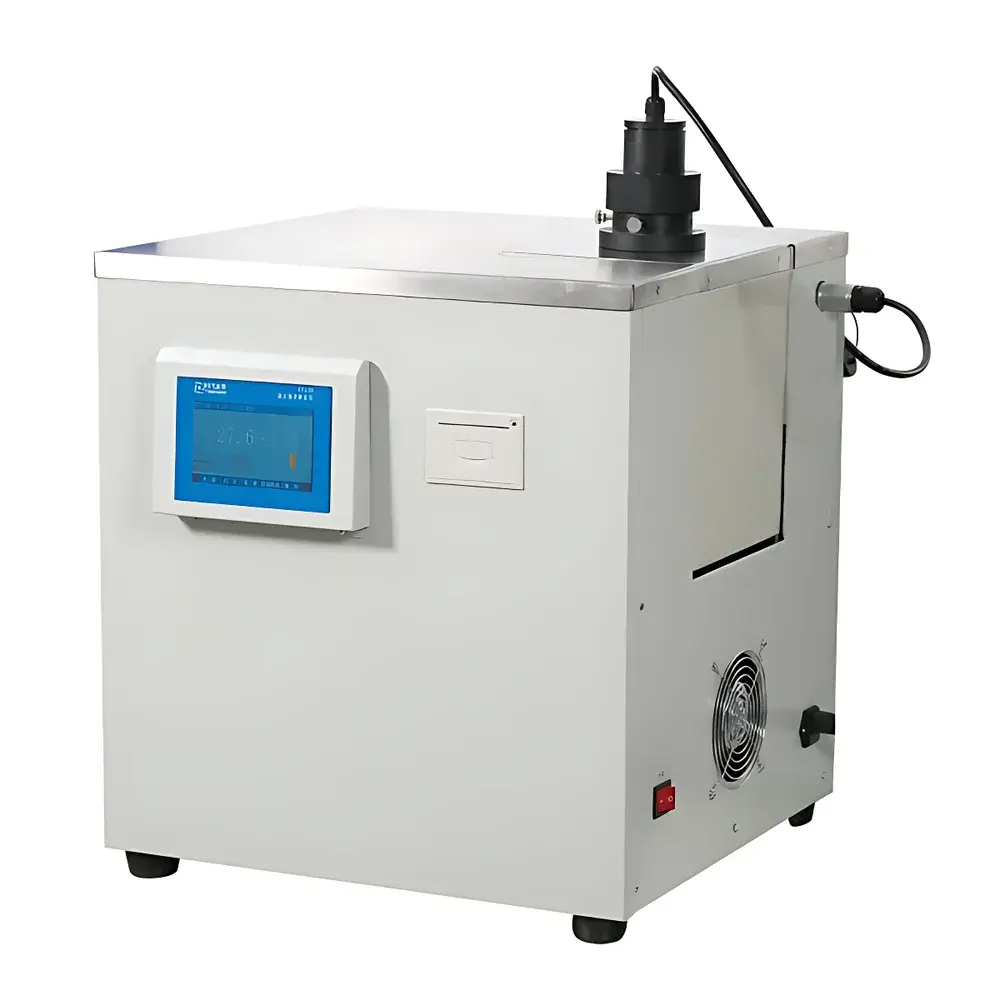
TimePower TP526 Automated Cloud Point and Pour Point Tester
| Brand | TimePower |
|---|---|
| Model | TP526 |
| Temperature Control Range | −70 °C to +35 °C |
| Accuracy | ±1 °C |
| Resolution | 0.1 °C |
| Cooling System | High-efficiency compressor-based |
| Heating Capability | Up to 35 °C |
| Sample Tilt Mechanism | Motorized, standards-compliant |
| Test Modes | Standard and accelerated protocols |
| Display | LCD touchscreen interface |
| Printer | Thermal, 36-character Chinese/English output |
| Power Supply | AC 220 V ±10%, 50 Hz ±10% |
| Power Consumption | <900 W |
| Dimensions | 460 × 310 × 480 mm |
| Weight | 55 kg |
| Compliance | GB/T 510, GB/T 3535, ASTM D2386, ASTM D97 |
Overview
The TimePower TP526 Automated Cloud Point and Pour Point Tester is a precision-engineered instrument designed for the standardized determination of cloud point (CP) and pour point (PP) in petroleum products—including lubricating oils, diesel fuels, residual fuels, and dark-colored hydrocarbon samples—according to internationally recognized test methods. It operates on the principle of controlled cooling with real-time optical detection of wax crystal formation (for cloud point) and cessation of flow under gravity (for pour point), followed by automated tilt verification per ASTM D97 and GB/T 3535 requirements. Unlike manual or semi-automated systems, the TP526 integrates thermoelectric stability, programmable cooling ramp profiles, and synchronized mechanical tilting to eliminate operator subjectivity and ensure method fidelity. Its dual-range temperature control (−70 °C to +35 °C) supports testing across a broad spectrum of distillate and residual fuels, including low-pour synthetic blends and biofuel-diluted formulations.
Key Features
- Compressor-based refrigeration system delivering stable, uniform cooling down to −70 °C with low thermal drift and extended service life
- Motor-driven sample tube tilting mechanism precisely synchronized with temperature descent, fully compliant with ASTM D97 and GB/T 510 tilt timing and angle specifications
- High-resolution digital temperature control (0.1 °C resolution, ±1 °C accuracy) with PID-regulated thermal management for reproducible ramping profiles
- Intuitive 7-inch LCD touchscreen interface supporting multilingual operation (English/Chinese), user-defined test protocols, and real-time graphical display of temperature vs. time curves
- Dual-mode operation: selectable standard cooling rate (1.0–1.5 °C/min) or accelerated protocol for rapid screening without compromising result validity
- Integrated self-diagnostic subsystem with on-screen fault codes, sensor validation alerts, and refrigerant pressure monitoring for proactive maintenance
- Thermal printer with 36-character line capacity enables direct hardcopy output of test ID, date/time stamp, final CP/PP values, and pass/fail status against specification limits
Sample Compatibility & Compliance
The TP526 accommodates standard ASTM D97 and ISO 3016 sample tubes (19 mm diameter × 150 mm length) and accepts viscous and opaque samples—including heavy fuel oils, bitumen emulsions, and additive-treated lubricants—without pre-dilution or filtration. Its optical detection algorithm is optimized to distinguish microcrystalline haze onset (cloud point) even in deeply colored matrices, while its tilt verification sequence meets the 3-second hold requirement at each 3 °C decrement below expected pour point. The instrument is validated for conformance with GB/T 510 (Petroleum Products—Determination of Pour Point), GB/T 3535 (Petroleum Products—Determination of Cloud Point), ASTM D2386 (Standard Test Method for Cloud Point of Petroleum Products), and ASTM D97 (Standard Test Method for Pour Point of Petroleum Products). All calibration and operational records are timestamped and stored internally to support GLP/GMP audit readiness.
Software & Data Management
The embedded firmware supports full traceability per FDA 21 CFR Part 11 requirements, including electronic signatures, audit trail logging (user login/logout, parameter changes, test initiation/abort), and immutable data archiving. Up to 1,000 test records can be retained onboard with metadata (operator ID, ambient conditions, calibration certificate reference). Data export is supported via USB 2.0 to CSV or PDF formats compatible with LIMS integration. Optional PC-based software (TP-LabSuite v3.2) provides advanced reporting tools—including trend analysis across batches, statistical process control (SPC) charts, and comparative overlay of multiple cooling curves—for quality assurance laboratories operating under ISO/IEC 17025 accreditation.
Applications
This instrument serves critical quality control and formulation development functions across upstream, midstream, and downstream petroleum operations. In refining laboratories, it verifies cold-flow properties of winter-grade diesel and jet fuel (Jet A-1) to ensure compliance with ASTM D976 and DEF STAN 91-91 specifications. Power generation facilities use it to monitor turbine oil integrity and prevent cold-start failures in northern climates. Independent testing labs employ the TP526 for third-party certification under API RP 1529 or EN 590. Research applications include evaluating wax inhibitors, cold flow improvers (CFIs), and bio-blend stability under simulated arctic storage conditions. Its robust architecture and wide temperature span make it suitable for both routine QC workflows and method development studies requiring high inter-laboratory reproducibility.
FAQ
What standards does the TP526 comply with?
It fully supports GB/T 510, GB/T 3535, ASTM D2386, and ASTM D97, with hardware and software features engineered to meet all procedural requirements—including tilt timing, cooling rate tolerances, and endpoint detection logic.
Can the TP526 test highly viscous or opaque samples?
Yes. Its optical detection system uses diffuse reflectance enhancement and adaptive thresholding to reliably identify cloud point in dark, viscous, or asphaltene-rich samples without dilution or pretreatment.
Is the cooling rate programmable?
Yes. Users may select between standard (1.0–1.5 °C/min) and accelerated modes; custom ramp profiles can be configured via PC software for method optimization.
Does the system support electronic record retention for regulatory audits?
Yes. Internal audit trails log all user actions and instrument events with timestamps and digital signatures, satisfying FDA 21 CFR Part 11 and ISO/IEC 17025 documentation requirements.
What maintenance is required for the compressor cooling system?
The sealed compressor requires no routine refrigerant servicing; periodic condenser coil cleaning and annual verification of thermal sensor calibration are recommended for optimal long-term performance.






