
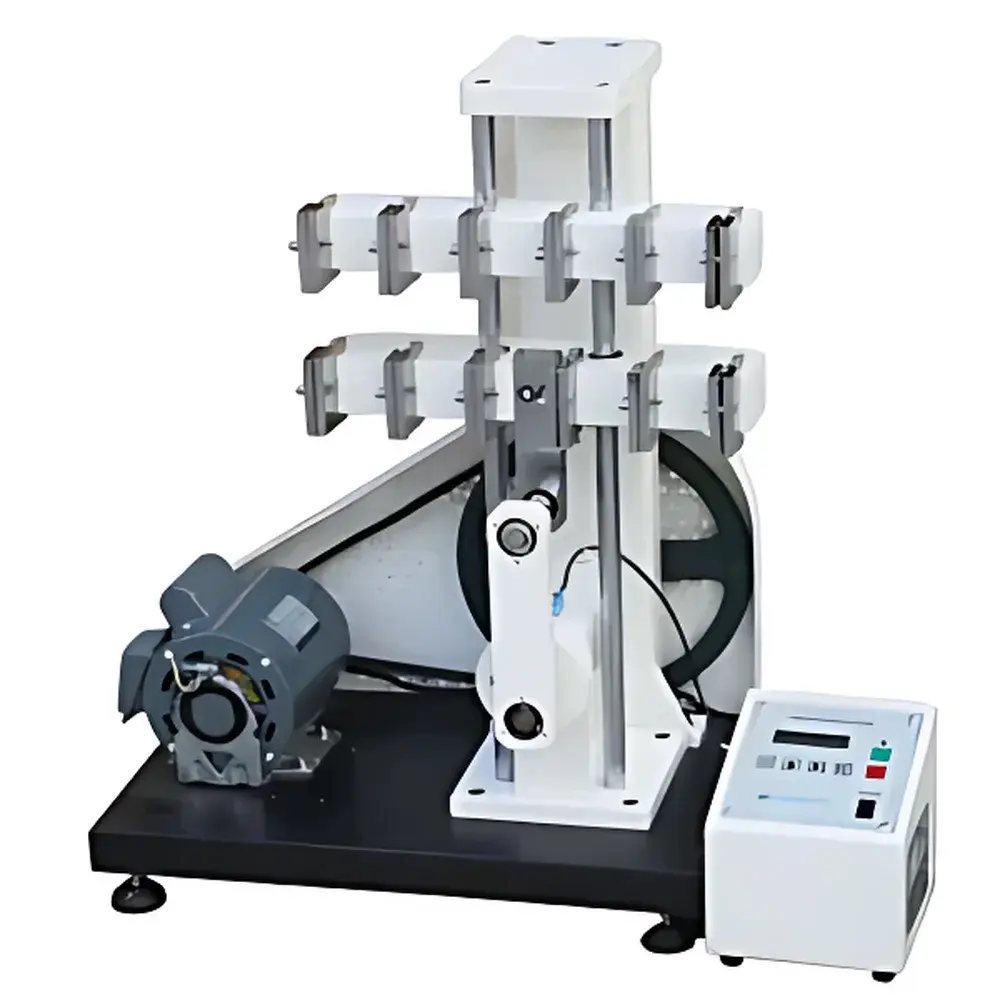
DeMoussy Flexing Tester HY-760
| Brand | HENGYU |
|---|---|
| Origin | Tianjin, China |
| Manufacturer Type | Authorized Distributor |
| Country of Origin | China |
| Model | HY-760 |
| Pricing | Available Upon Request |
| Specimen Dimensions | 140–155 × 20–25 × 6 mm |
| Clamp Spacing | 75 mm or 95 mm (customizable) |
| Stroke | 57 mm or 35 mm (customizable) |
| Test Frequency | 0–400 ±10 cycles/min |
| Cycle Counter | LCD display, 0–999,999 |
Overview
The DeMoussy Flexing Tester HY-760 is a precision-engineered mechanical property tester designed specifically for evaluating the dynamic flex resistance of vulcanized rubber compounds under controlled cyclic bending stress. Based on the classical DeMoussy principle—where a rectangular test specimen is clamped at fixed intervals and subjected to repeated sinusoidal bending at defined amplitude and frequency—the instrument quantifies material degradation through crack initiation and propagation behavior. This method replicates real-world service conditions experienced by footwear soles, conveyor belts, automotive rubber bushings, and other dynamically loaded elastomeric components. The HY-760 operates in accordance with internationally recognized fatigue testing protocols and serves as a critical tool in R&D laboratories, quality control departments, and certification testing facilities engaged in rubber formulation development and product validation.
Key Features
- Modular clamp assembly supporting dual standard spacing options (75 mm and 95 mm), with optional custom configurations to accommodate non-standard specimen geometries or industry-specific test requirements.
- Precision electromechanical drive system delivering stable, repeatable oscillation across the full frequency range (0–400 ±10 cycles/min), with digital speed regulation and real-time feedback control to ensure consistent stroke amplitude.
- High-resolution LCD cycle counter (0–999,999) with non-volatile memory retention, enabling uninterrupted long-duration tests and accurate tracking of cumulative flex cycles even after power interruption.
- Robust structural frame fabricated from anodized aluminum and stainless steel components, minimizing resonance effects and ensuring dimensional stability during extended operation.
- Included laser-cut die set conforms to ISO 20811 and ASTM D813 specimen preparation guidelines, guaranteeing uniform edge geometry and eliminating manual cutting variability that may influence crack nucleation onset.
- Comprehensive documentation package includes bilingual (English/Chinese) user manual, one-year limited warranty certificate, and an accredited calibration report issued by a CNAS-accredited laboratory (ISO/IEC 17025 compliant).
Sample Compatibility & Compliance
The HY-760 accommodates standard test specimens measuring 140–155 mm in length, 20–25 mm in width, and 6 mm in thickness—dimensions aligned with GB/T 13934, ASTM D813, JIS K6301, BS 903 Part A11, and HG/T 2873–2008. Its mechanical architecture permits direct implementation of multiple international test methods without hardware modification. The instrument supports compliance verification workflows required under GLP (Good Laboratory Practice) and pre-market regulatory submissions for footwear and industrial rubber goods. While not inherently FDA 21 CFR Part 11 compliant, data export functionality enables integration into validated LIMS environments where electronic record integrity and audit trail requirements are enforced externally.
Software & Data Management
The HY-760 operates as a standalone electromechanical tester with no embedded microprocessor or proprietary software interface. All operational parameters—including cycle count, frequency setting, and elapsed time—are monitored via front-panel LCD and manually recorded. For laboratories requiring digital traceability, optional RS-232 or USB-to-serial adapters (available separately) enable connection to third-party data acquisition systems. Raw cycle data can be exported to CSV format for statistical analysis using common platforms such as Excel, JMP, or Minitab. Calibration records follow ISO/IEC 17025 documentation standards and include measurement uncertainty estimates traceable to national metrology institutes.
Applications
- Evaluation of crack resistance in shoe sole compounds during ISO 20811-compliant footwear durability testing.
- Comparative assessment of carbon black vs. silica-reinforced EPDM formulations for automotive suspension bushings.
- Quality conformance testing of rubber hoses and diaphragms used in pneumatic control systems.
- Accelerated aging studies correlating flex life with crosslink density measured via equilibrium swelling or DSC.
- Supporting ASTM D412 tensile property correlation studies where elongation-at-break and flex endurance exhibit inverse trends.
- Validation of low-temperature flexibility retention in chloroprene (CR) and nitrile (NBR) compounds per SAE J2236.
FAQ
What standards does the HY-760 directly support?
The instrument meets mechanical and dimensional requirements of GB/T 13934, ASTM D813, JIS K6301, BS 903 Part A11, HG/T 2873–2008, and GB 24540–2009.
Is the test speed adjustable during operation?
Yes—frequency is continuously variable within the 0–400 ±10 cycles/min range using the front-panel potentiometer, with immediate mechanical response and no step-change latency.
Can the HY-760 be used for non-rubber materials?
While optimized for vulcanized elastomers, it may be applied to thermoplastic elastomers (TPEs) and certain flexible composites provided specimen dimensions and clamping force remain within mechanical limits; validation per relevant material-specific standards is required.
Does the CNAS calibration report cover all performance parameters?
The report verifies cycle counter accuracy, stroke amplitude repeatability, and frequency stability against reference standards; it does not assess crack detection sensitivity, which remains a visual inspection process per applicable test methods.
What maintenance is recommended for long-term reliability?
Monthly lubrication of pivot joints with silicone-based grease, biannual verification of clamp alignment using included gauge blocks, and annual recalibration by an accredited provider are advised per the maintenance schedule in Section 6 of the user manual.




