
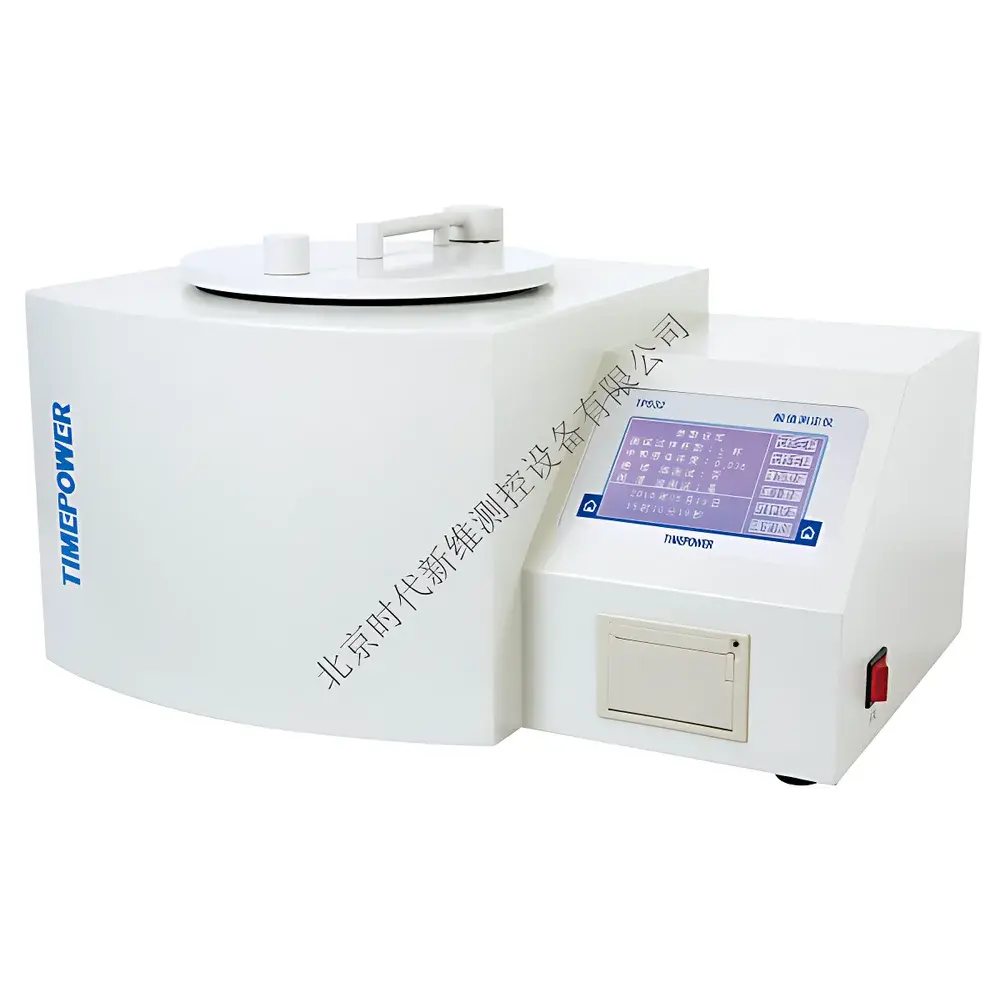
Timepower TP532 Acid Number Analyzer
| Brand | Timepower |
|---|---|
| Origin | Beijing, China |
| Manufacturer Type | Direct Manufacturer |
| Model | TP532 |
| Measurement Principle | Potentiometric-Optical Endpoint Detection via Laser Photometry |
| Standard Compliance | GB/T 4945–2002 (for insulating oils) |
| Measurement Method | Colorimetric Titration with KOH–Ethanol Standard Solution in Toluene–Isopropanol Extract |
| Detection System | Imported Laser Diode + Photodetector Array |
| Control Architecture | Dual-CPU Microcontroller |
| Automation Level | Fully Automated Extraction, Titration, Cup Rotation, Endpoint Recognition, and Thermal Printing |
| Display | LCD with Icon-Free Touch-Sensitive Keypad |
| Measurement Range | 0.0001–0.9999 mg KOH/g |
| Resolution | 0.0001 mg KOH/g |
| Accuracy | ±0.01 mg KOH/g (for values 0.0001–0.1) |
| Repeatability | 0.02 mg KOH/g (0.0–0.1), 0.05 mg KOH/g (0.0–0.5), 0.07 mg KOH/g (0.5–0.9999) |
| Sample Capacity | 6-position carousel |
| Power Consumption | ≤60 W (operational), ≤100 W (peak) |
| Ambient Operating Conditions | 5–35 °C, ≤80% RH |
| Dimensions (W×D×H) | 480 × 340 × 200 mm |
| Net Weight (main unit) | 12.5 kg |
| Power Supply | AC 220 V ±10%, 50 Hz ±10% |
Overview
The Timepower TP532 Acid Number Analyzer is an automated benchtop instrument engineered for precise, reproducible determination of acid number in insulating oils and related petroleum-based dielectric fluids. It implements the standardized colorimetric titration method specified in GB/T 4945–2002, which is harmonized with ASTM D974 and ISO 661 principles for acid value quantification in non-aqueous media. The system operates on a dual-phase analytical workflow: first, acidic components are selectively extracted from the sample using a toluene–isopropanol solvent mixture; second, the extract is titrated with a standardized potassium hydroxide (KOH) solution in ethanol. Endpoint detection is achieved not by subjective visual observation—but through high-stability laser photometry. A collimated 650 nm laser beam illuminates the reaction cuvette continuously; as the indicator (typically p-naphtholbenzein or similar) transitions from yellow to green at the neutralization endpoint, optical absorption increases measurably, triggering real-time photodiode signal analysis. This optoelectronic transduction eliminates observer bias and enhances inter-laboratory reproducibility—critical for power transformer maintenance, refinery QC, and academic research where trace acidity correlates directly with oxidation stability and equipment longevity.
Key Features
- Fully automated sequence control: solvent extraction, reagent delivery, magnetic stirring, cup indexing, endpoint recognition, and result printing—all executed without manual intervention.
- Dual-CPU architecture ensures deterministic timing, fault-tolerant operation, and independent monitoring of motor control, photometric acquisition, and titration logic.
- Imported low-power laser diode (Class 1, IEC 60825-1 compliant) with >50,000-hour operational lifetime—designed for stable beam intensity and minimal thermal drift across ambient temperature fluctuations.
- High-resolution photodetector array coupled with analog-to-digital conversion at 16-bit resolution enables sub-millivolt-level signal discrimination for robust endpoint identification.
- Six-position sample carousel supports unattended batch analysis—ideal for routine testing in power substations, lubricant blending plants, and university analytical labs.
- Non-mechanical keypad interface with icon-free tactile feedback reduces contamination risk and improves usability under glove-based operation in industrial environments.
Sample Compatibility & Compliance
The TP532 is validated exclusively for insulating oils per GB/T 4945–2002, including mineral oil-based transformer oils, silicone fluids, and synthetic ester dielectrics. It is not intended for aqueous samples, biodiesel blends (ASTM D664), or highly viscous residues (e.g., used engine oils). While its methodology aligns conceptually with ASTM D974 (color-indicator titration), formal ASTM or ISO certification requires third-party validation under specific laboratory accreditation (e.g., ISO/IEC 17025). The instrument meets electromagnetic compatibility requirements per GB/T 18268.1–2010 (equivalent to IEC 61326-1) and electrical safety standards per GB 4793.1–2007 (IEC 61010-1). Data integrity complies with basic ALCOA+ principles: attributable, legible, contemporaneous, original, accurate—and supports audit-ready record retention via built-in thermal printer output.
Software & Data Management
The TP532 operates firmware-based embedded software with no external PC dependency. All calibration parameters, user-defined method settings (e.g., titrant concentration, blank correction offset), and test logs are stored in non-volatile flash memory with write-cycle protection. Each printed report includes date/time stamp, sample ID (manually entered), operator code, measured acid number, endpoint volume, and system status flags (e.g., “Extraction OK”, “Photometric Stability Pass”). While the device lacks network connectivity or electronic data interchange (EDI), its printout satisfies GLP documentation requirements for paper-based QA workflows. For laboratories pursuing 21 CFR Part 11 compliance, integration with LIMS via RS-232 serial output (optional accessory) enables structured ASCII log export—though digital signature and audit trail functions must be implemented externally.
Applications
- Preventive maintenance of power transformers: trending acid number increase signals early-stage oil oxidation, guiding reclamation or replacement decisions per IEEE C57.106 guidelines.
- Quality release testing of new insulating oils prior to filling equipment—verifying conformance to IEC 60296 specifications (acid number ≤0.03 mg KOH/g for unused mineral oil).
- Research into antioxidant depletion kinetics under accelerated aging (e.g., ASTM D2112), where micro-acidity changes reflect inhibitor consumption rates.
- Educational laboratories teaching fundamental titrimetric analysis, solvent extraction theory, and optical sensor design principles in chemical engineering and materials science curricula.
- Field-deployable verification in substation mobile labs—its compact footprint, low power draw, and vibration-resistant optical path support operation outside climate-controlled labs.
FAQ
Does the TP532 support ASTM D664 (potentiometric titration) for biodiesel or crude oil?
No. It implements only the colorimetric endpoint method per GB/T 4945–2002, optimized for low-acidity insulating oils. ASTM D664 requires pH electrode-based detection and different solvent systems.
Can the instrument store more than six test results internally?
No. Internal memory retains only the most recent calibration coefficients and method presets. Full traceability relies on printed reports; users must manually archive hard copies per organizational document control policy.
What maintenance is required for long-term photometric accuracy?
Monthly cleaning of the laser window and cuvette holder with lint-free optical tissue and isopropanol; annual verification of laser output power using a calibrated photodiode meter (recommended but not supplied).
Is the KOH–ethanol titrant stable over time?
No. Ethanol-based KOH solutions absorb atmospheric CO₂, forming carbonate salts that reduce effective base concentration. Users must standardize titrant weekly and store sealed under inert gas (e.g., argon) with desiccant.
How does ambient temperature affect measurement repeatability?
Temperature gradients >2 °C/hour cause refractive index shifts in the solvent extract, altering light path geometry. Maintain stable lab conditions (±1 °C/hour) or allow 30-minute thermal equilibration before initiating runs.






