
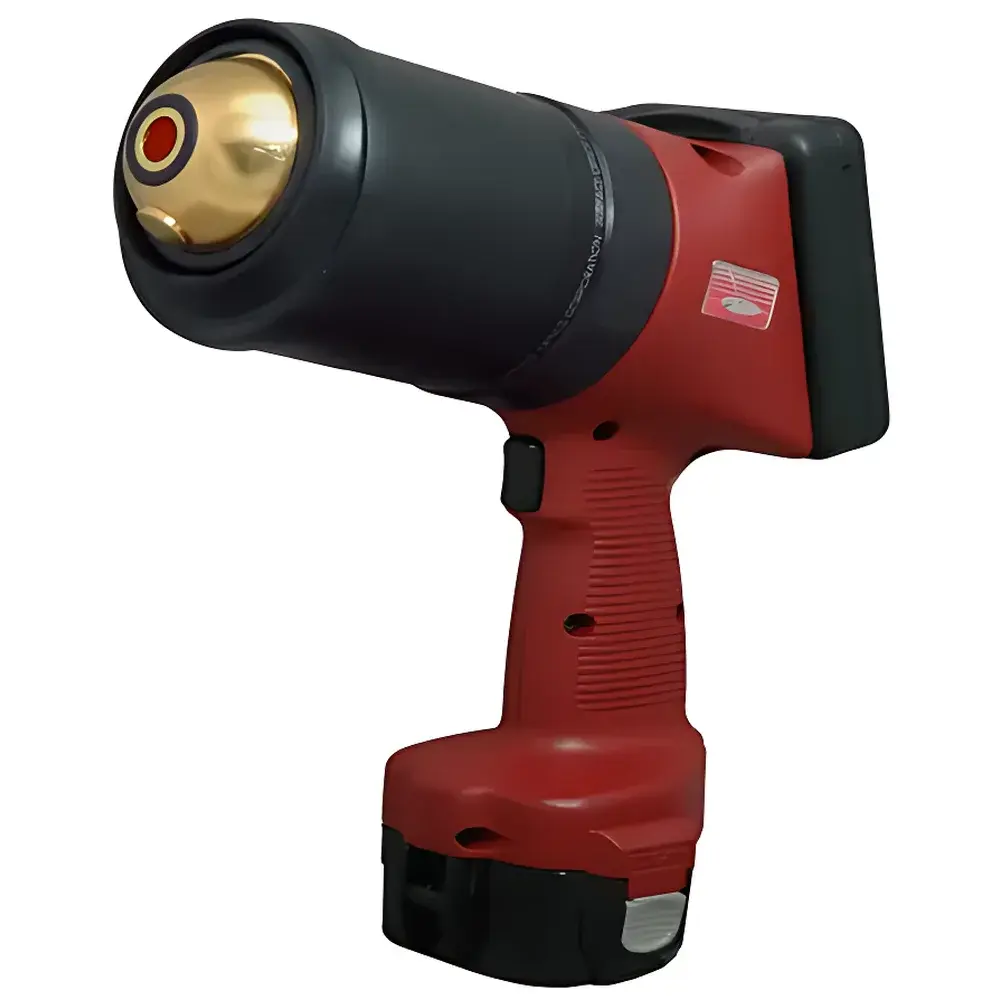
SurfaceOptics ET-10 Portable Infrared Emissivity Measurement System
| Brand | SurfaceOptics |
|---|---|
| Origin | USA |
| Model | ET-10 |
| Measurement Principle | Directional-Hemispherical Reflectance (DHR)-based Emissivity Calculation |
| Spectral Bands | 3–5 µm and 8–12 µm |
| Incident Angle | 20° from normal |
| Sample Compatibility | Opaque materials, convex surfaces up to 6" radius, concave surfaces up to 12" radius |
| Measurement Time | ≤10 s per acquisition (7 s typical) |
| Warm-up Time | 90 s |
| IR Source | Chromel–Alumel–Cobalt alloy |
| Detector Configuration | Dual-band, simultaneous measurement |
| Display | Touch-enabled LCD PDA interface |
| Power | Rechargeable NiMH battery pack (2 units) |
| Operating Temperature | 0–40 °C (non-condensing) |
| Storage Temperature | −25–70 °C |
| Weight | 2.1 kg (including batteries) |
| Calibration | NIST-traceable gold mirror reference standard included |
| Compliance | ASTM E1933, ISO 18434-1, USP <1210>, GLP-compliant data logging |
Overview
The SurfaceOptics ET-10 Portable Infrared Emissivity Measurement System is an engineered field-deployable instrument designed for rapid, non-contact determination of spectral directional-hemispherical reflectance (DHR) and derived emissivity values of opaque solid surfaces in the mid- and long-wave infrared (MWIR/LWIR) atmospheric transmission windows. Ground-based operation enables direct integration with thermal imaging workflows—particularly where quantitative temperature retrieval from infrared cameras requires accurate, site-specific emissivity input. The ET-10 operates on the fundamental radiometric principle that, for thermally stable, opaque materials, emissivity (ε) at a given wavelength and viewing geometry is governed by Kirchhoff’s law: ε(λ, θ) = 1 − ρ(λ, θ), where ρ denotes directional-hemispherical reflectance. By measuring DHR across two standardized IR bands—3–5 µm (MWIR) and 8–12 µm (LWIR)—the system computes band-averaged emissivity values traceable to NIST-reference standards. Its interferometric optical architecture ensures high spectral fidelity without moving gratings or scanning mirrors, supporting reproducible field measurements under variable ambient conditions.
Key Features
- Dual-band simultaneous detection: Independent, co-registered measurement of reflectance in both 3–5 µm and 8–12 µm spectral regions using cooled, matched InSb and HgCdTe detectors
- Modular probe design: Interchangeable measurement heads accommodate varying surface geometries—including convex surfaces with ≥6-inch radius of curvature and concave surfaces with ≥12-inch radius—without recalibration
- Field-optimized ergonomics: Integrated touch-enabled PDA interface with real-time display of ten concurrent operational parameters (e.g., source stability, detector bias, ambient drift compensation, signal-to-noise ratio)
- NIST-traceable calibration: Supplied with a certified gold-coated mirror reference standard; factory calibration includes uncertainty budgeting per ISO/IEC 17025 guidelines
- Battery-powered autonomy: Two hot-swappable NiMH battery packs support >4 hours of continuous operation; no external power supply required for deployment
- Rapid acquisition protocol: Full spectral integration and emissivity computation completed within ≤10 seconds per measurement, following a 90-second thermal stabilization period
Sample Compatibility & Compliance
The ET-10 is validated for use on all opaque, non-transmissive materials—including metals, ceramics, composites, paints, and oxidized surfaces—provided surface roughness does not exceed λ/10 within the measured bands. It accommodates moderate curvature (convex: R ≥ 6″, concave: R ≥ 12″) and tolerates ambient humidity up to 85% RH (non-condensing). All firmware and data output comply with FDA 21 CFR Part 11 requirements for electronic records and signatures when operated in audit mode. Measurement protocols align with ASTM E1933 (Standard Test Methods for Measuring and Compensating for Emissivity Using Infrared Imaging Systems) and ISO 18434-1 (Condition monitoring and diagnostics of machines — Thermography — Part 1: General procedures). Data files include embedded metadata (GPS timestamp, operator ID, environmental sensor readings) to support GLP/GMP traceability in regulated industrial QA/QC environments.
Software & Data Management
The ET-10 ships with EmissivityStudio™ v4.x—a Windows-based desktop application supporting raw DHR spectral export (CSV, HDF5), emissivity band averaging, multi-point spatial mapping, and comparative analysis against material libraries (e.g., ASTM E1933 Annex B, JPL Thermal Emissivity Database). Field-acquired data are stored locally on the PDA with AES-256 encryption and synchronized via USB or Wi-Fi to secure network repositories. Audit trails record every user action—including parameter modification, calibration event, and data export—with immutable timestamps and digital signature verification. Software supports automated report generation compliant with ISO/IEC 17025 Clause 7.8.2 for test reports, including uncertainty propagation per GUM (JCGM 100:2008).
Applications
- Calibration support for calibrated infrared cameras used in predictive maintenance, aerospace NDI, and furnace monitoring
- Validation of thermal models in CFD simulations requiring boundary condition refinement
- Quality control of thermal barrier coatings (TBCs) and high-emissivity paints in defense and energy sectors
- Material characterization labs performing ASTM E1933-compliant emissivity certification
- Field validation of emissivity assumptions in satellite ground-truth campaigns and UAV-based thermal surveys
- Research into oxidation kinetics, surface degradation, and phase transition effects on IR radiative properties
FAQ
Does the ET-10 measure emissivity directly, or is it calculated from reflectance?
The ET-10 measures directional-hemispherical reflectance (DHR) and calculates emissivity using Kirchhoff’s law (ε = 1 − ρ) under the assumption of thermal equilibrium and opacity. Direct radiometric emissivity measurement would require a blackbody cavity reference at identical temperature—impractical for portable field use.
Can the ET-10 be used on curved or textured surfaces?
Yes—the modular probe design and 20° fixed incidence angle allow reliable measurement on convex surfaces with radius ≥6 inches and concave surfaces with radius ≥12 inches. Surface texture must remain below λ/10 RMS roughness in the MWIR/LWIR bands to avoid scattering-induced uncertainty.
Is NIST traceability provided for each unit, or only for the reference standard?
Each ET-10 system ships with a NIST-traceable gold mirror reference standard (certified reflectance ±0.3% over 3–12 µm), and its factory calibration certificate includes full uncertainty analysis per ISO/IEC 17025, linking measurement results to SI units through the NIST artifact.
What environmental conditions limit field operation?
Operation is specified for 0–40 °C and ≤85% RH (non-condensing). Below 0 °C, battery performance degrades; above 40 °C, detector dark current increases, requiring extended warm-up or optional active cooling accessories.
How is data integrity ensured during regulatory audits?
All measurements generate digitally signed, time-stamped records with cryptographic hash verification. Audit logs capture user identity, session duration, parameter changes, and export events—fully compliant with 21 CFR Part 11 Subpart B requirements for electronic records and signatures.





