
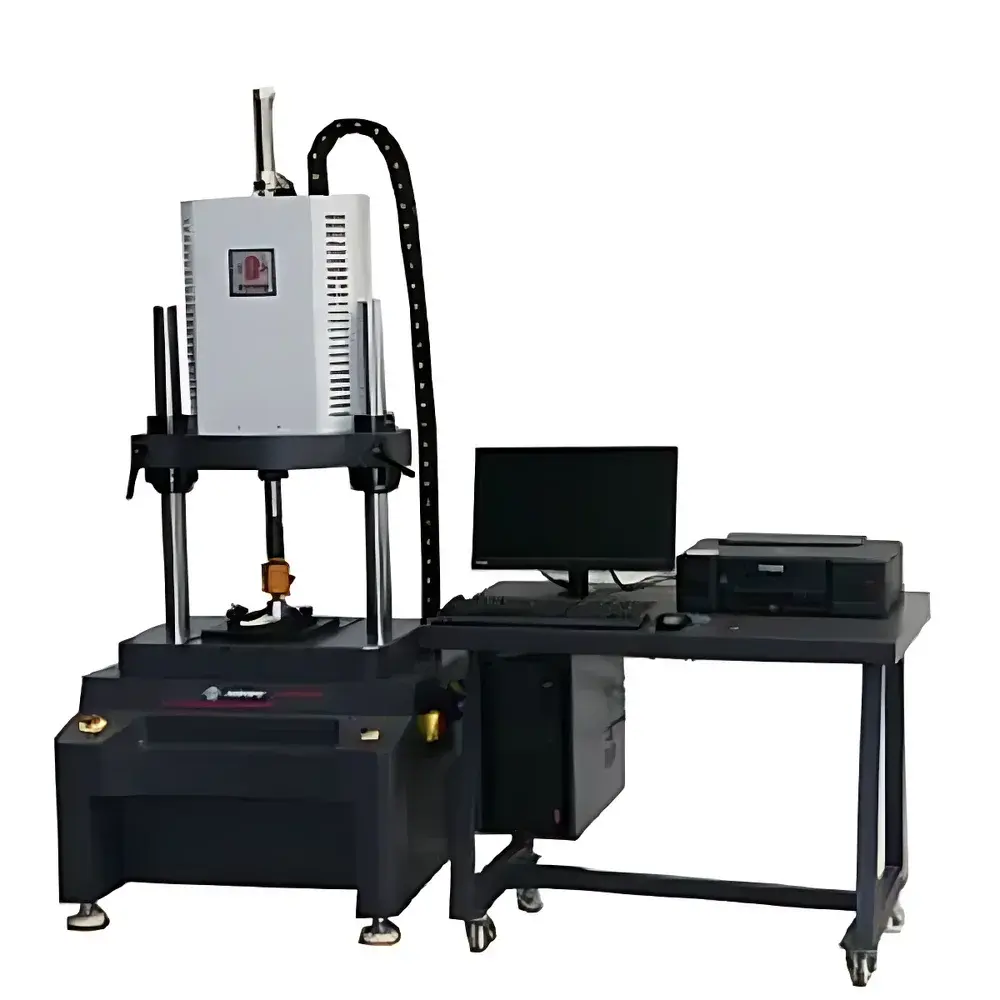
NYX HY-835YS Dynamic Sole Fatigue Testing Machine Compliant with GB/T 38018–2019 and GB/T 38012–2019
| Brand | NYX |
|---|---|
| Origin | Tianjin, China |
| Manufacturer Type | Direct Manufacturer |
| Regional Classification | Domestic (PRC) |
| Model | HY-835YS |
| Instrument Category | High-Frequency Fatigue Testing Machine |
| Maximum Test Load | 5000 N |
| Frequency Range | 0–5 Hz (adjustable) |
| Test Stroke | 0–60 mm (resolution: 0.01 mm) |
| Load Cell Capacity | 0–500 kg (force resolution: 0.01 N) |
| Impact Head Dimensions | Forefoot pad: (85 ± 1) mm × (50 ± 1) mm × 5 mm crown height |
| Heel pad | Ø(50 ± 1) mm × 5 mm crown height |
| Dynamic Fatigue Max Load | 1500 N |
| 30th Impact Force (Shock Absorption Mode) | 2300 N ± 200 N |
| Column Spacing | 420 mm |
| Control Modes | Load-controlled and Displacement-controlled |
| Host Dimensions (W×D×H) | 600 × 1300 × 1800 mm |
| Net Weight | Approx. 320 kg |
Overview
The NYX HY-835YS Dynamic Sole Fatigue Testing Machine is a purpose-built electromechanical testing system engineered to evaluate the mechanical durability and energy absorption characteristics of footwear outsoles under cyclic loading conditions. It operates on the principle of controlled sinusoidal or stepwise dynamic compression, replicating biomechanically relevant foot-ground interaction patterns observed during walking and jogging. The system conforms strictly to two key Chinese national standards: GB/T 38018–2019 (“Test Method for Dynamic Fatigue Resistance of Footwear Soles”) and GB/T 38012–2019 (“Test Method for Shock Absorption Performance of Footwear Soles”). These standards define standardized test protocols—including prescribed impact head geometries, displacement amplitudes, frequency ranges, and pass/fail criteria—for quantifying thickness retention, surface integrity, force attenuation, and hysteresis behavior after repeated loading. Unlike generic universal testers, the HY-835YS integrates dedicated sole-specific fixtures, real-time load-displacement synchronization, and programmable control logic optimized for footwear material viscoelasticity and structural compliance.
Key Features
- Biomechanically calibrated impact heads: Separate forefoot pad (85 ± 1 mm × 50 ± 1 mm, 5 mm crown) and heel pad (Ø50 ± 1 mm, 5 mm crown) replicate anatomical contact areas defined in GB/T 38012–2019.
- Dual-mode actuation: Supports both constant-force fatigue cycling (for endurance evaluation) and constant-displacement shock absorption testing (for instantaneous energy dissipation analysis).
- Precision electromechanical drive: Servo-motor-driven linear actuator enables stable frequency operation from 0.1 to 5 Hz, with closed-loop position and load feedback ensuring repeatability within ±0.5% of setpoint.
- High-resolution transduction: Integrated 0–500 kg load cell (0.01 N resolution) and linear variable differential transformer (LVDT) displacement sensor (0.01 mm resolution) provide synchronized force–displacement data acquisition.
- Modular test chamber design: 420 mm column spacing accommodates full-size footwear specimens without fixture interference; adjustable stroke range (0–60 mm) supports midsole compression profiling across varying stack heights.
- Robust structural architecture: Heavy-duty welded steel frame (320 kg net weight) minimizes resonance and ensures long-term dimensional stability during high-cycle testing.
Sample Compatibility & Compliance
The HY-835YS accepts whole-footwear units—athletic shoes, casual footwear, and occupational safety boots—with sole thicknesses up to 45 mm and widths ≤ 120 mm. Specimens are secured using standardized clamping plates aligned to ASTM F1677 (heel strike reference plane) and ISO 20344 (protective footwear mounting guidelines). All test procedures align with mandatory clauses in GB/T 38018–2019 (including minimum 100,000-cycle fatigue protocol and post-test thickness measurement at three defined zones) and GB/T 38012–2019 (30-impact shock absorption sequence with force decay curve analysis). While developed for PRC regulatory frameworks, the machine’s traceable calibration paths, documented uncertainty budgets (<1.2% k=2), and raw data export capability support cross-referencing with ISO 14837-1 (footwear mechanical testing) and EN ISO 20344:2022 Annex D (energy absorption verification).
Software & Data Management
The embedded Windows-based control software provides intuitive test method configuration, real-time waveform visualization (force vs. time, displacement vs. time), and automated report generation per standard requirements. Each test session logs timestamped metadata—including operator ID, environmental temperature/humidity (via optional external sensor integration), calibration certificate IDs, and version-controlled test parameters. Raw ASCII data files (.csv) contain millisecond-synchronized force, displacement, and cycle count columns, enabling third-party statistical analysis (e.g., Weibull fatigue life modeling or hysteresis loop integration). Audit trails comply with GLP principles: all parameter changes are logged with user ID and timestamp; data files are write-protected post-test; electronic signatures support 21 CFR Part 11–aligned validation packages when deployed in regulated QC environments.
Applications
- Evaluation of thermoplastic polyurethane (TPU), ethylene-vinyl acetate (EVA), and rubber compound fatigue resistance under repetitive compressive loading.
- Comparative assessment of midsole geometry (e.g., lattice structures, air pockets, dual-density layers) on shock attenuation efficiency and degradation kinetics.
- Pre-certification validation for GB/T 38018–2019 compliance prior to third-party laboratory submission.
- Material development R&D: Correlating polymer formulation changes (e.g., crosslink density, filler dispersion) with measurable reductions in permanent set or surface cracking onset.
- Quality assurance in high-volume footwear manufacturing: Batch-level screening for consistency in compression modulus, recovery rate, and energy loss ratio (tan δ).
- Failure mode analysis: Identifying early-stage delamination, foam collapse, or adhesive bond failure via in-situ acoustic emission monitoring (optional add-on module).
FAQ
What standards does the HY-835YS directly support?
It is fully configured for GB/T 38018–2019 (dynamic fatigue) and GB/T 38012–2019 (shock absorption); test methods, fixtures, and reporting templates are pre-loaded.
Can the system perform static compression tests?
Yes—displacement-controlled hold modes enable static creep and stress-relaxation measurements up to 5000 N, though these fall outside the scope of the referenced footwear standards.
Is calibration traceable to national metrology institutes?
Load cell and displacement sensor calibrations are performed annually using NIM-traceable deadweight and laser interferometry standards; calibration certificates include expanded uncertainty statements.
What sample preparation is required before testing?
Specimens must be conditioned at 23 °C ± 2 °C and 50% ± 5% RH for ≥48 h per GB/T 38018–2019 Section 6.1; no cutting or sectioning is needed—whole shoes are tested in anatomical orientation.
Does the system support multi-axis loading?
No—the HY-835YS implements uniaxial vertical compression only, consistent with the single-plane impact mechanics specified in both standards.



