
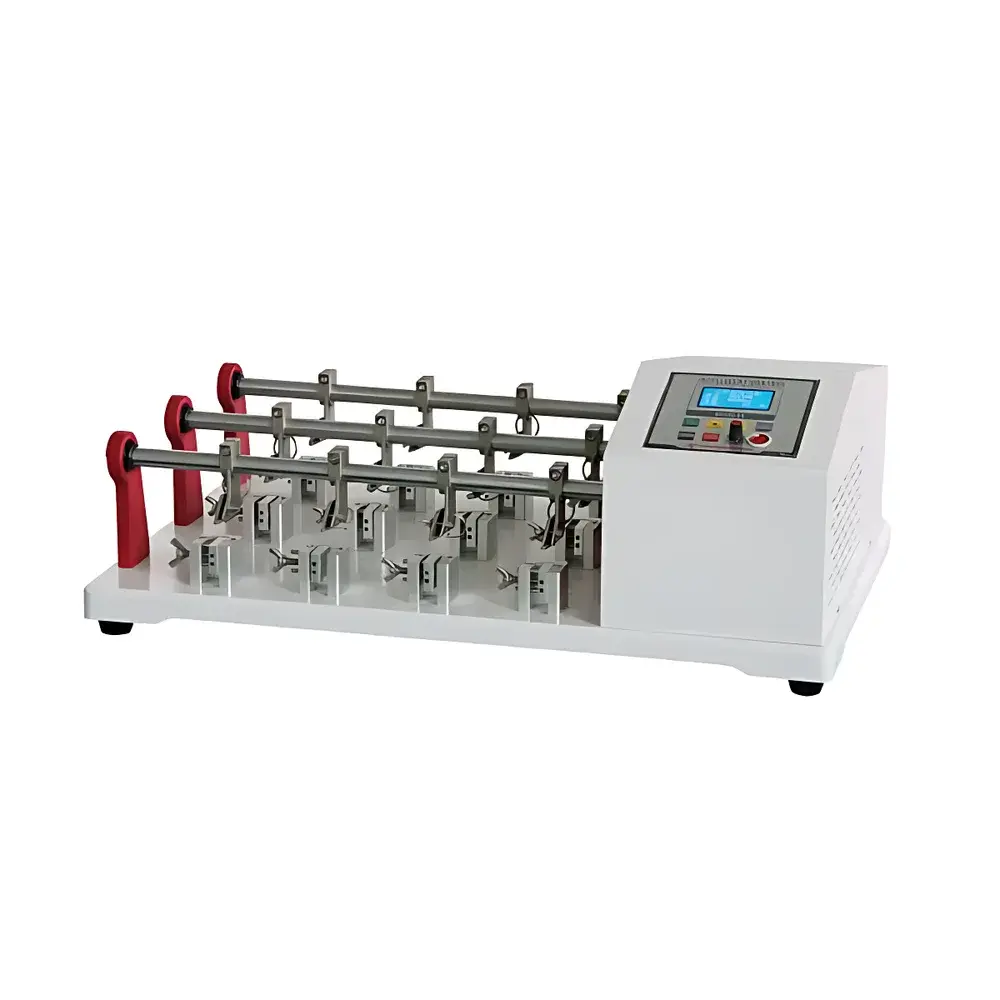
Hengyu QB/T 2714 Leather Flexing Tester
| Brand | Hengyu |
|---|---|
| Model | QB/T 2714 |
| Standard Compliance | QB/T 2714–2005, ISO 5402, ISO 20344, ASTM D6182, BS 3144, JIS K 6546, GB/T 20991–2007, FZ/T 73028, SATRA TM55, SLP 14, IUP 20, Adidas GE-24 |
| Test Stations | 12 |
| Drive Motor | Imported low-noise AC motor |
| Base Construction | Monolithic machined aluminum base (no welding) |
| Dimensions (L×W×H) | 63 × 45 × 40 cm |
| Weight | 60 kg |
| Power Supply | AC 220 V, 50 Hz, 300 W |
| Operating Environment | 23 °C ± 2 °C, 50 % RH ± 5 % RH |
| Footprint | Benchtop installation |
Overview
The Hengyu QB/T 2714 Leather Flexing Tester is an electromechanical benchtop instrument engineered for standardized fatigue evaluation of flexible sheet materials under repeated bending stress. It operates on the principle of controlled angular oscillation—applying a defined flexing angle (typically ±90° or as specified by test method) at a fixed frequency (e.g., 60–120 cycles per minute) to simulate real-world mechanical deformation experienced by leather, synthetic leather, coated textiles, and technical fabrics in footwear uppers, apparel, handbags, and luggage. Unlike dynamic tensile or abrasion testers, this device subjects specimens to cyclic torsional strain about a fixed mandrel, enabling quantification of crack initiation, surface delamination, grain separation, and structural integrity loss after prescribed cycle counts. Its design strictly adheres to the kinematic requirements outlined in QB/T 2714–2005—the Chinese national light industry standard—and maintains full functional equivalence with internationally harmonized protocols including ISO 5402 (leather flex resistance), ISO 20344 (personal protective footwear), and ASTM D6182 (flex resistance of coated fabrics).
Key Features
- Twelve independent test stations enable parallel evaluation of replicate specimens or multi-material comparison within a single test run—reducing inter-test variability and improving statistical robustness.
- Monolithic machined aluminum base eliminates welded joints, ensuring long-term dimensional stability and consistent flex angle accuracy across thousands of cycles; thermal expansion and creep effects are minimized by homogeneous material structure.
- Imported precision AC motor delivers stable rotational torque and ultra-low acoustic emission (<55 dB(A)), supporting uninterrupted operation in shared laboratory environments without vibration coupling or electromagnetic interference.
- Automated origin return function ensures repeatable zero-position alignment prior to each test sequence—critical for compliance with GLP documentation requirements and audit-ready test logs.
- Benchtop footprint (63 × 45 × 40 cm) and modest power demand (300 W, 220 V/50 Hz) allow deployment in standard QC laboratories, R&D facilities, or contract testing centers without dedicated utility infrastructure.
Sample Compatibility & Compliance
The tester accommodates rectangular specimens (typically 50 mm × 20 mm or as defined by referenced standards) cut from finished leather, PU/PVC-coated textiles, laminated composites, and microfiber synthetics. Specimen thickness range spans 0.5–4.0 mm, with clamping force calibrated to prevent slippage while avoiding edge compression artifacts. All mechanical parameters—including mandrel diameter (e.g., 8 mm per QB/T 2714), flex amplitude, and stroke frequency—are adjustable within limits defined by each cited standard. Full traceability is maintained through documented adherence to ISO/IEC 17025 calibration practices for motion control subsystems. The instrument supports regulatory workflows aligned with ISO 9001 quality management systems and facilitates audit trails required under FDA-regulated textile component validation (e.g., for medical footwear or occupational PPE).
Software & Data Management
While the base configuration operates via front-panel digital controls with LED cycle counter and manual start/stop interface, optional RS-232 or USB data output enables integration with LIMS or custom SCADA platforms. Cycle count, elapsed time, and operator ID can be logged externally for 21 CFR Part 11–compliant electronic records when paired with validated timestamping software. No proprietary cloud service or vendor-hosted platform is required—data remains fully under user control and exportable in CSV or XML formats for statistical process control (SPC) analysis using JMP, Minitab, or Python-based libraries.
Applications
- Quality assurance of upper leather batches prior to shoe assembly, verifying compliance with brand-specific durability thresholds (e.g., Adidas GE-24 ≥ 100,000 cycles).
- Comparative benchmarking of bio-based leathers versus chrome-tanned alternatives under ISO 5402 conditions.
- Development-stage validation of novel coating adhesion on stretch knits used in athletic apparel.
- Third-party certification testing for SATRA TM55 and SLP 14 compliance in EU footwear supply chains.
- Root cause analysis of premature cracking in luxury handbag linings exposed to repeated folding during retail handling.
FAQ
Does the QB/T 2714 tester meet ISO/IEC 17025 calibration requirements?
Yes—mechanical components (angle encoder, motor controller, cycle counter) are calibrated against NIST-traceable reference standards; calibration certificates include uncertainty budgets per ILAC-G8 guidelines.
Can test parameters be modified to match non-standard flex angles or frequencies?
Within hardware limits (±90° max angular displacement, 30–150 cpm range), yes—but deviations from published standards must be explicitly declared in test reports and may invalidate conformance claims.
Is environmental conditioning integrated into the unit?
No—the instrument requires external climate-controlled chamber operation at 23 °C ± 2 °C and 50 % RH ± 5 % RH per ISO 2419 and QB/T 2714–2005; ambient lab monitoring is recommended.
What maintenance intervals are recommended for long-term reliability?
Motor lubrication and mandrel surface inspection every 12 months; periodic verification of station synchronization using optical encoder readouts every 200 operating hours.
Are spare parts and technical documentation available in English?
Yes—full English-language operation manual, calibration procedure, and OEM-sourced spare parts list (including mandrels, clamps, and motor assemblies) are provided with shipment.



