
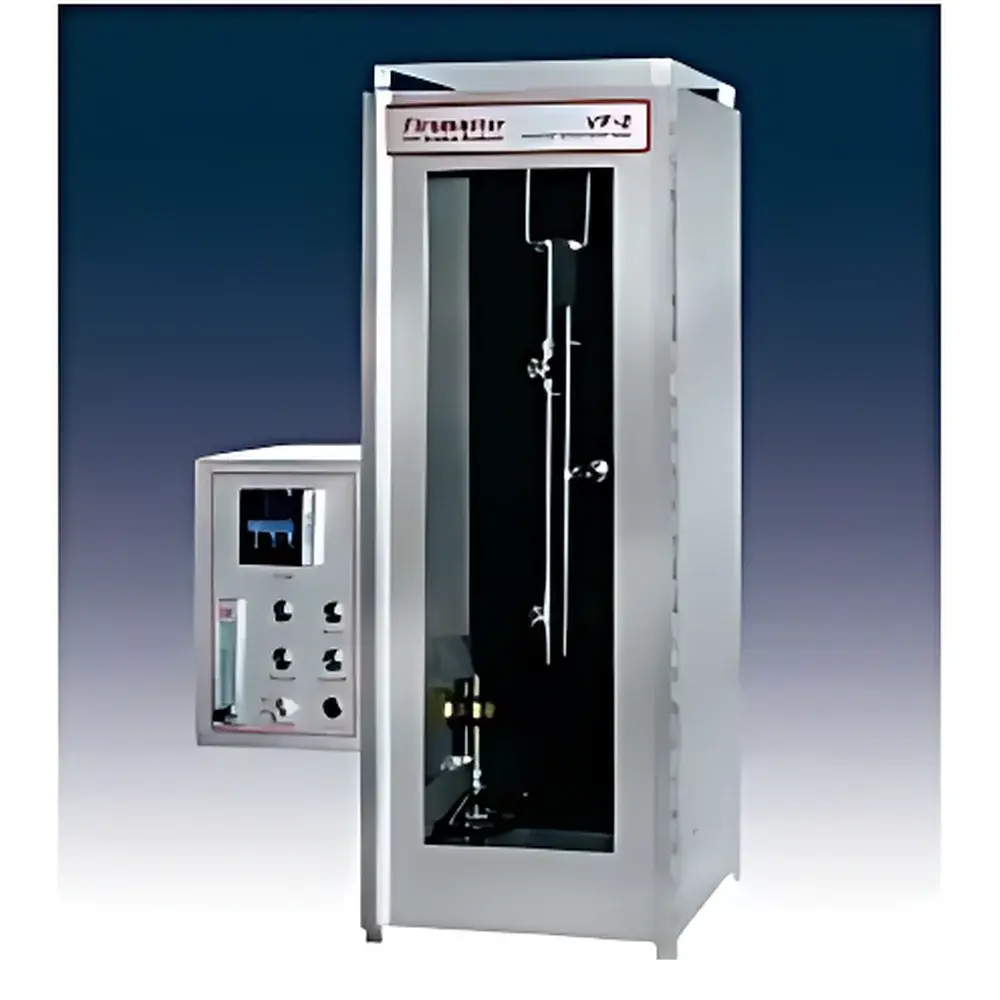
Vertical Flammability Tester VFT
| Origin | Tianjin, China |
|---|---|
| Manufacturer Type | Distributor |
| Origin Category | Domestic |
| Model | VFT |
| Pricing | Upon Request |
Overview
The Vertical Flammability Tester VFT is a precision-engineered instrument designed to evaluate the flame propagation behavior of textile, upholstery, and polymer materials under controlled vertical orientation conditions. It operates in strict accordance with internationally recognized flammability test standards—including California Technical Bulletin 117 (CA TB 117), ASTM D6413/D6413M (Standard Test Method for Flame Resistance of Textiles—Vertical Test), and ISO 6941 (Textiles—Determination of Burning Behaviour of Vertical Specimens). The tester utilizes a calibrated Bunsen-type burner delivering a defined propane or methane flame (20 mm ± 1 mm height) applied for precisely 12 seconds to the bottom edge of a vertically suspended specimen. Critical performance metrics—including afterflame time, afterglow time, char length, and whether ignition propagates to the specimen clamp—are recorded manually or via optional digital timing and measurement modules. Its robust steel enclosure with tempered glass viewing window ensures operator safety while enabling real-time visual observation of combustion dynamics.
Key Features
- Compliance-ready design aligned with CA TB 117–2013, ASTM D6413, ISO 6941, and GB/T 5455 (Chinese national standard for vertical flame resistance testing)
- Adjustable burner assembly with precision gas flow control (propane or natural gas compatible) and certified flame height verification gauge
- Stainless-steel specimen holder with standardized clamping geometry (specimen dimensions: 50 mm × 300 mm per ASTM requirements)
- Integrated flame timing system with dual independent stopwatches (afterflame and afterglow) meeting GLP traceability requirements
- Fire-resistant enclosure with 300 mm × 400 mm tempered borosilicate observation window and rear exhaust port for fume management
- Modular mounting interface for optional accessories: digital char-length ruler, high-speed thermal imaging bracket, and automated ignition trigger
Sample Compatibility & Compliance
The VFT accommodates rigid and flexible flat specimens up to 3 mm thickness and 300 mm length, including woven/nonwoven textiles, foam-backed upholstery composites, coated fabrics, and laminated polymer sheets. Specimen preparation follows strict conditioning protocols per ASTM D1776 (standard atmospheric conditioning at 23 °C ± 2 °C and 50 % ± 5 % RH for minimum 4 h). Testing methodology supports both single-layer and multi-layer assemblies as specified in CA TB 117–2013 Section 2 (smoldering ignition resistance) and Section 3 (open-flame resistance). All operational procedures are documented in accordance with ISO/IEC 17025–2017 general requirements for competence of testing and calibration laboratories. The system is routinely validated using NIST-traceable reference materials such as cotton duck fabric (Class 1 baseline) and flame-retardant polyester (Class 2 benchmark).
Software & Data Management
While the base VFT model operates as a manual benchtop instrument, optional firmware-enabled modules support digital data capture via USB-connected timing controllers and calibrated linear encoders. The companion software suite (VFT-Log v2.1) enables structured test logging compliant with FDA 21 CFR Part 11 requirements—including electronic signatures, audit trails, user access levels, and immutable test record archiving. Export formats include CSV and PDF reports with embedded metadata (operator ID, ambient conditions, calibration dates, and instrument serial number). All software configurations undergo annual validation per GMP Annex 11 guidelines when deployed in regulated QC environments.
Applications
- Quality assurance of residential and commercial upholstery fabrics for compliance with U.S. state fire safety regulations
- R&D screening of flame-retardant additives in polyurethane foams and thermoplastic elastomers
- Third-party certification testing for UL 1040, NFPA 260, and CAL 133 compliance
- Comparative evaluation of char-forming mechanisms across halogen-free vs. brominated FR systems
- Academic research on pyrolysis kinetics and flame inhibition pathways in cellulosic and synthetic fiber blends
FAQ
What flame gases are compatible with the VFT burner system?
Propane and natural gas (methane) are supported; gas supply must meet ASTM D6413 purity specifications (≥95 % pure hydrocarbon, ≤0.1 % moisture content).
Is the VFT suitable for testing composite materials with backing layers?
Yes—provided total specimen thickness does not exceed 3 mm and backing layers remain intact during clamping; layered assemblies must be tested as a single unit per CA TB 117 Section 3.
Does the instrument include calibration documentation?
Each unit ships with a factory calibration certificate covering burner flame height verification, timer accuracy (±0.1 s), and dimensional tolerances of the specimen holder per ASTM E74.
Can test results be exported directly into LIMS platforms?
Via VFT-Log v2.1, CSV exports are LIMS-compatible; API integration requires on-site configuration by certified application engineers.
What maintenance intervals are recommended for long-term repeatability?
Burner nozzle inspection every 50 tests; full gas train leak check and optical window cleaning biweekly; annual third-party metrological verification advised.



