
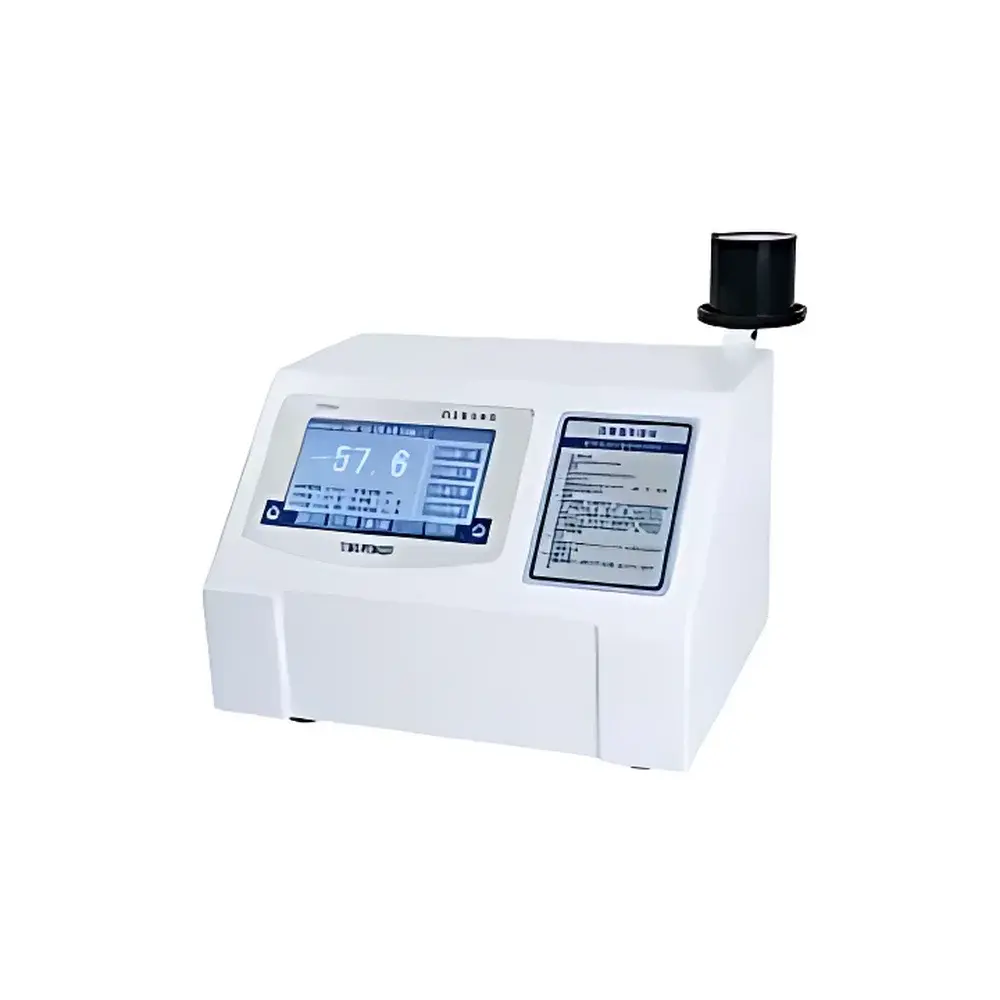
Timepower TP304 Iron Content Analyzer
| Brand | Timepower |
|---|---|
| Origin | Beijing, China |
| Manufacturer Type | Manufacturer |
| Origin Category | Domestic |
| Model | TP304 |
| Price | Upon Request |
Overview
The Timepower TP304 Iron Content Analyzer is a benchtop photometric analyzer engineered for precise, trace-level quantification of dissolved iron (Fe²⁺/Fe³⁺) in ultra-pure and low-conductivity water matrices. It operates on the principle of visible-light spectrophotometry, specifically applying the Lambert–Beer Law: absorbance (A) of a chromophoric complex formed between iron ions and a selective colorimetric reagent (e.g., 1,10-phenanthroline or sulfosalicylic acid) is linearly proportional to iron concentration under fixed optical path length and wavelength conditions. Designed for continuous monitoring and discrete batch analysis in thermal power plants and nuclear facilities, the instrument delivers reliable sub-ppb sensitivity with minimal operator intervention—critical for maintaining steam-cycle integrity, preventing flow-accelerated corrosion (FAC), and complying with ASME PTC 19.11, IAPWS TR-10, and DL/T 912–2018 guidelines for boiler feedwater and turbine condensate quality control.
Key Features
- Integrated optoelectronic architecture featuring imported monochromatic cold-light LED source (peak emission at 510 nm or 560 nm, depending on reagent chemistry), ensuring long-term photometric stability, low thermal drift, and >50,000-hour service life.
- High-density surface-mount PCB design with embedded microcontroller unit (MCU), optimized for low-power operation (<30 W), electromagnetic compatibility (EMC), and resistance to ambient temperature fluctuations (5–45 °C).
- 5.0-inch capacitive touch TFT-LCD display with native Chinese UI support and intuitive icon-driven navigation—no external PC required for routine calibration or measurement.
- Automated timing protocol with audible and visual alerts for reaction incubation, reagent addition, and endpoint reading—reducing procedural variability and human error.
- Dual-point calibration capability: zero-point blank compensation eliminates electronic and optical baseline drift; full-scale calibration maintains linearity across the 0.0–200 μg/L range.
- Circular data buffer storing up to 256 measurement records with timestamp, sample ID, and operator tag; overflow management ensures data continuity without manual deletion.
Sample Compatibility & Compliance
The TP304 is validated for use with boiler feedwater, condensate, steam sampling lines, generator stator cooling water, drum boiler water, and natural surface waters where iron concentrations fall within the specified dynamic range. Sample introduction is manual via calibrated sampling cup; no integrated peristaltic pump or autosampler is included. To ensure metrological validity, users must employ Type I or II high-purity water (per ISO 3696 or ASTM D1193) for reagent preparation and system rinsing. All reagents—including iron standards, complexing agents, and reducing agents—must be analytical grade (≥99.9%) and stored in certified polyethylene containers to prevent leaching or adsorption. The analyzer supports GLP-aligned documentation practices: each measurement log includes date/time stamp, calibration status flag, and user identification field—facilitating internal audit readiness per ISO/IEC 17025 and power industry QA/QC protocols.
Software & Data Management
While the TP304 operates as a standalone instrument, its embedded firmware supports USB mass-storage mode for exporting CSV-formatted datasets (including absorbance values, calculated concentrations, and calibration coefficients) to external PCs. No proprietary software installation is required; exported files are compatible with Excel, LabChart, or LIMS platforms. Audit trail functionality is implemented at the firmware level: all calibration events, parameter modifications, and system resets are time-stamped and non-erasable within the device’s internal memory. Though not FDA 21 CFR Part 11 compliant out-of-the-box (lacking digital signature and role-based access control), the unit meets foundational data integrity requirements for non-regulated industrial environments and can be integrated into broader Part 11–compliant workflows via external validation protocols.
Applications
- Monitoring iron carryover in high-pressure boiler feedwater systems to prevent deposition in superheater tubes and turbine blades.
- Tracking iron release from carbon steel piping during start-up/shutdown cycles in combined-cycle and fossil-fuel power plants.
- Verifying effectiveness of condensate polisher resin regeneration and assessing resin degradation through soluble iron leakage trends.
- Supporting chemistry control programs in nuclear secondary loops per EPRI NP-6501 and NEI 99-05 recommendations.
- Environmental surveillance of iron mobilization in reservoirs and intake water sources feeding thermal generation units.
FAQ
What is the recommended frequency for blank and calibration curve verification?
Daily blank calibration is mandatory; full multi-point calibration (minimum 3 points) is required every 14 days or after reagent lot change, sensor cleaning, or environmental relocation.
Can the TP304 measure both ferrous (Fe²⁺) and total iron?
Yes—when used with appropriate pretreatment (e.g., ascorbic acid reduction for Fe³⁺ conversion), the analyzer quantifies total dissolved iron; direct measurement without reduction yields primarily Fe²⁺ concentration.
Is the instrument suitable for online continuous monitoring?
No—the TP304 is a laboratory-grade grab-sample analyzer. For real-time deployment, consider Timepower’s TP304-Online variant with integrated flow cell and 4–20 mA output.
What maintenance procedures are required to sustain accuracy?
Monthly optical path cleaning using lint-free wipes and isopropanol; quarterly verification of LED intensity and detector linearity using NIST-traceable neutral density filters.
Does the device comply with international water quality standards such as ISO 11929 or ASTM D1068?
It implements methodologies aligned with ASTM D1068–22 (Standard Test Method for Iron in Water) and supports uncertainty estimation per ISO/IEC 11929:2021, though formal certification requires site-specific validation per ISO/IEC 17025.
Related Products






