
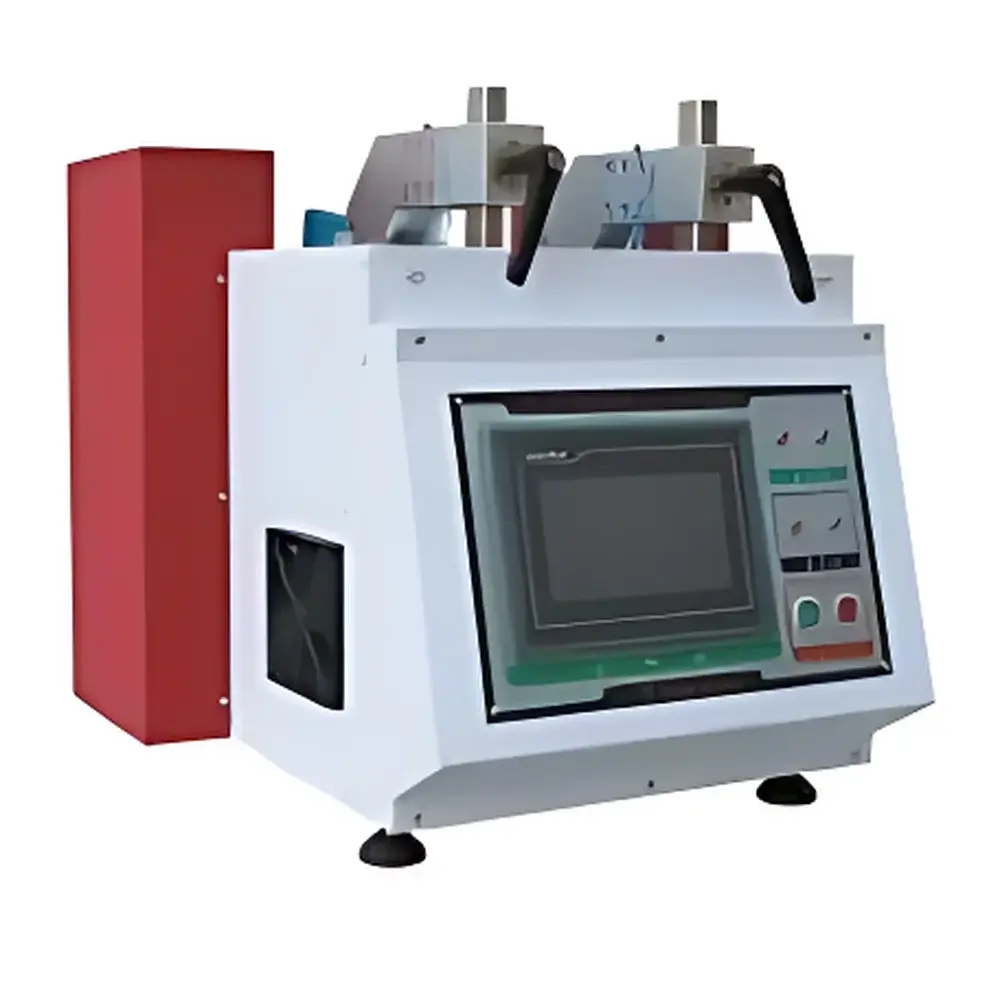
GB/T 16641 Compliant Walking Simulator for Dynamic Shoe Waterproofness Testing – HY-762DQ
| Origin | Tianjin, China |
|---|---|
| Manufacturer Type | Authorized Distributor |
| Origin Category | Domestic (PRC) |
| Model | HY-762DQ |
| Price Range | USD 14,000–42,000 |
| Instrument Type | Specialized Fatigue Tester for Footwear |
| Frequency Range | 60 cycles/min |
| Test Angle | 45° ± 1° |
| Sample Capacity | 2 shoes simultaneously |
| Actuation Mechanism | Dual Humanoid Metal Foot Formers |
| Control System | PLC-based with Touchscreen HMI |
| Power Supply | AC 220 V, 50 Hz |
| Net Weight | 110 kg |
| Memory Function | Power-Failure Resume Capability |
Overview
The HY-762DQ Walking Simulator for Dynamic Shoe Waterproofness Testing is a purpose-built fatigue testing system engineered to evaluate the dynamic water resistance performance of finished footwear under standardized mechanical stress conditions. It operates on the principle of controlled cyclic flexion—mimicking the biomechanical motion of human gait—to assess how footwear materials and construction resist water ingress during repeated bending at the forefoot region. Designed in strict accordance with GB/T 16641–2018 (“Test Method for Dynamic Water Resistance of Footwear”), this instrument replicates real-world wear scenarios by subjecting mounted shoes to repetitive dorsiflexion while fully immersed in water. The test endpoint is objectively defined: the moment water penetrates the interior lining and triggers an electrical conductivity-based detection circuit, initiating automatic alarm and test termination. This deterministic endpoint ensures high inter-laboratory reproducibility and eliminates subjective visual judgment, making the HY-762DQ suitable for QC labs operating under ISO/IEC 17025-accredited quality management systems.
Key Features
- Dual independent test stations—enables parallel evaluation of two footwear samples under identical environmental and mechanical conditions, improving throughput without compromising comparability.
- Precision-engineered humanoid metal foot formers replicate anatomical forefoot geometry and bending axis, ensuring consistent flexion kinematics across test cycles per GB/T 16641 requirements.
- Programmable flexion angle control (45° ± 1°) maintained via calibrated servo-actuated linkage, minimizing angular drift over extended test durations (>10,000 cycles).
- PLC-based control architecture with industrial-grade touchscreen HMI provides intuitive parameter setup, real-time cycle counting, and event logging—including start time, stop time, and final bend count at water breakthrough.
- Intelligent power-failure recovery function retains all operational parameters and accumulated cycle data in non-volatile memory, allowing seamless resumption after unexpected shutdowns—critical for long-duration durability assessments.
- Corrosion-resistant stainless steel water bath tank with integrated level sensor and overflow protection ensures stable immersion depth and operator safety during continuous operation.
Sample Compatibility & Compliance
The HY-762DQ accommodates standard adult and youth footwear sizes when mounted on its dedicated metal shoe trees, supporting both lace-up and slip-on configurations. It is validated for use with leather, synthetic uppers, laminated membranes (e.g., Gore-Tex®, eVent®), and stitched or bonded sole constructions. While primarily aligned with GB/T 16641, the test methodology exhibits functional equivalence to aspects of ISO 20344:2022 (Personal protective footwear — Test methods) Clause 6.4 (Water penetration resistance under flexing), enabling cross-referenced reporting in multinational supply chain documentation. The system supports GLP-compliant data integrity through timestamped digital logs exportable via USB; however, native 21 CFR Part 11 compliance requires optional audit-trail firmware upgrade and user access control configuration.
Software & Data Management
The embedded PLC controller records each test session as a discrete dataset containing: initiation timestamp, total elapsed time, cumulative flexion cycles, termination trigger status (water breakthrough detected), and final water ingress location (left/right foot). All data are stored in CSV format on internal flash memory and exportable to external USB drives for integration into LIMS or statistical process control platforms. No proprietary software installation is required on host PCs—raw files are human-readable and compatible with Excel, Minitab, or Python-based analysis pipelines. Optional RS-485 or Ethernet module enables remote monitoring and centralized fleet management in multi-unit lab environments.
Applications
- Quality assurance of waterproof hiking boots, work safety footwear, and outdoor athletic shoes prior to mass production release.
- Comparative validation of membrane lamination adhesion strength and seam sealing efficacy under dynamic wet flex conditions.
- R&D benchmarking of novel hydrophobic coatings, breathable laminates, and last construction techniques affecting forefoot water barrier integrity.
- Supplier qualification testing where contractual specifications mandate minimum flex-cycle thresholds before water breakthrough (e.g., ≥5,000 cycles).
- Root-cause analysis of field-reported water ingress failures—correlating laboratory flexion data with real-world usage patterns and failure locations.
FAQ
What standards does the HY-762DQ directly support?
It is designed and verified for full compliance with GB/T 16641–2018. Its mechanical configuration also permits adaptation to ISO 20344:2022 Annex D and ASTM F2413–23 Section 7.3.2 protocols with minor procedural adjustments.
Is calibration traceable to national metrology institutes?
Yes—angular positioning accuracy (±0.5°) and cycle timing (±0.1 s) are verified using NIST-traceable angle encoders and high-resolution chronometers during factory certification. A calibration certificate is supplied with each unit.
Can the system test children’s footwear?
Yes, provided appropriate size-matched metal shoe trees are installed. The fixture design accommodates EU sizes 20–48, covering infant through adult ranges.
Does it require compressed air or external hydraulic supply?
No—the actuation system is fully electromechanical, driven by precision stepper motors and harmonic drive gearboxes; only standard AC 220 V / 50 Hz power is required.
How is water breakthrough detected?
Via low-voltage (<12 V DC) conductive sensing electrodes embedded in the interior sock liner surface. Detection occurs upon formation of a closed circuit between electrodes through intruding water—ensuring rapid, repeatable, and non-destructive endpoint identification.



