
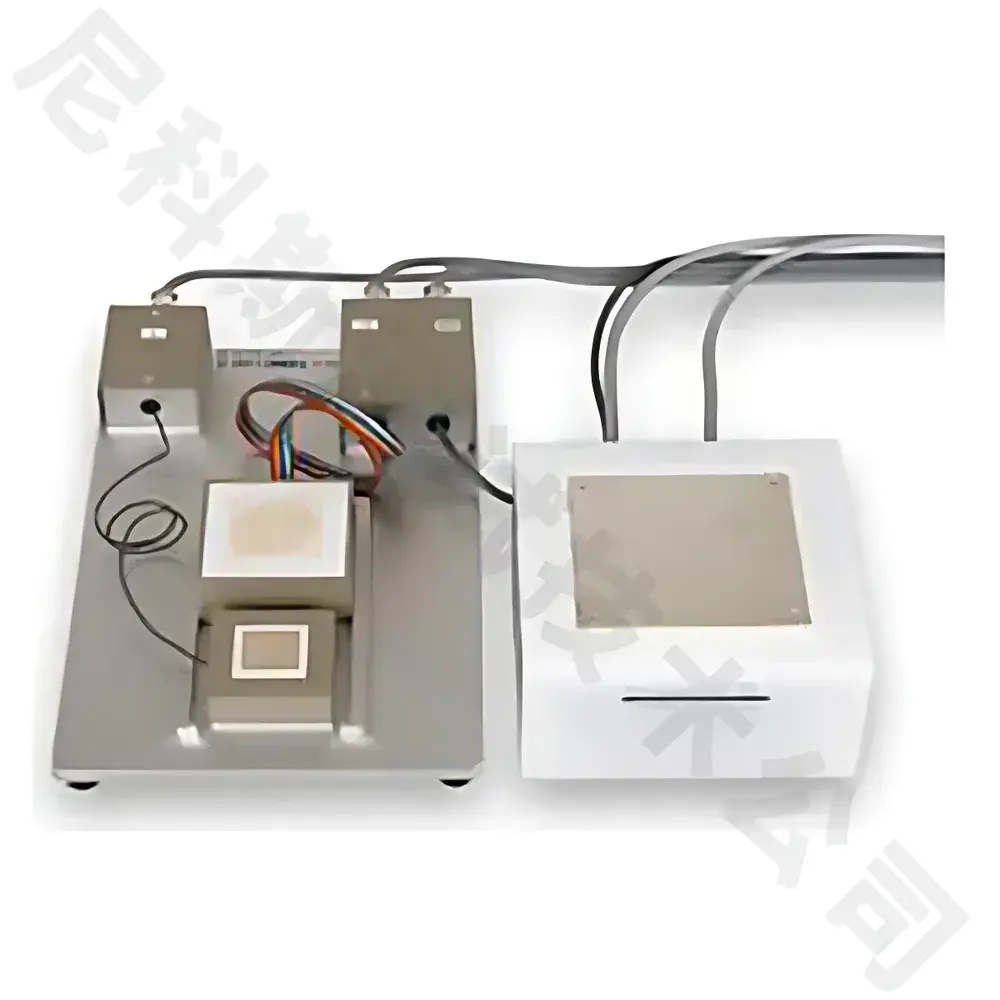
NYX CWT-A1-1 Contact Coolness/Warmth Sensation Tester per GB/T 35263-2017
| Brand | NYX |
|---|---|
| Origin | Tianjin, China |
| Manufacturer Type | Manufacturer |
| Region of Origin | Domestic (China) |
| Model | CWT-A1-1 |
| Pricing | Upon Request |
| Measurement Principle | Transient heat flux quantification under controlled contact pressure and temperature differential |
| Test Parameter | Q-max (J/(cm²·s)) |
| Heat Plate Material | Copper |
| Heat Plate Area | 9 cm² |
| Contact Pressure | 0.1 ± 0.01 N/cm² |
| Heat Plate Temperature Range | 20–40 °C |
| Temperature Sensor Response Time | ≤ 0.2 s |
| Temperature Resolution | 0.1 °C |
| Sample Platform Temperature Control | Yes |
| Required ΔT Between Plate and Platform | 15 °C |
| Calibration Compliance | GB/T 35263-2017, FTTS-FA-019 |
| System Components | Thermally regulated copper heat plate, insulated sample stage, high-speed data acquisition card, PC-based analysis software |
Overview
The NYX CWT-A1-1 Contact Coolness/Warmth Sensation Tester is a precision-engineered instrument designed to quantify the instantaneous thermal perception—specifically the contact coolness coefficient (Q-max)—of textile materials upon initial skin contact. It operates on the principle of transient heat flux measurement: a thermally regulated copper heat plate, maintained at a defined temperature above the sample’s surface, is brought into controlled mechanical contact with the specimen under standardized pressure. During the first 1–2 seconds of contact, the system captures the peak heat flow density (in J/(cm²·s)) transferred from the plate to the material. This Q-max value serves as an objective, reproducible metric for evaluating the subjective sensation of “cool-to-touch” or “warm-to-touch” behavior—a critical performance indicator in functional apparel, sportswear, medical textiles, and smart fabric development. The instrument strictly implements the test methodology defined in GB/T 35263-2017, China’s national standard for textile contact thermal sensation, and is also compatible with FTTS-FA-019, a widely referenced Japanese textile testing protocol.
Key Features
- Copper heat plate with active temperature control (20–40 °C), enabling precise thermal gradient setup relative to the sample stage.
- Fixed contact area of 9 cm² and calibrated mechanical loading mechanism delivering consistent contact pressure of 0.1 ± 0.01 N/cm²—ensuring compliance with GB/T 35263-2017 mechanical boundary conditions.
- Integrated high-resolution temperature sensor (0.1 °C resolution) with rapid response time (≤ 0.2 s), synchronized with a high-speed data acquisition card for sub-second thermal transient capture.
- Thermally stabilized sample platform with independent temperature regulation; maintains a fixed 15 °C differential against the heat plate to satisfy standard-defined thermal boundary conditions.
- Rigorous system validation: when operated at the nominal 15 °C ΔT, the instrument demonstrates baseline Q-max repeatability ≤ 0.08 J/(cm²·s) on reference non-conductive substrates—verifying minimal parasitic heat loss and measurement integrity.
- Modular architecture comprising heat plate assembly, insulated load frame, acquisition hardware, and dedicated Windows-based software—designed for long-term stability and serviceability in QC laboratories.
Sample Compatibility & Compliance
The CWT-A1-1 accommodates flat, flexible textile specimens up to 30 cm × 30 cm in dimension and ≤ 10 mm in thickness—including woven, knitted, nonwoven, laminated, and coated fabrics. Samples are mounted tautly on the thermostatically controlled platform without adhesive or clamping-induced compression artifacts. The system meets full technical alignment with GB/T 35263-2017 requirements for apparatus geometry, thermal dynamics, pressure application, and data sampling rate. It also supports comparative evaluation per FTTS-FA-019, facilitating international benchmarking. While not certified to ISO/IEC 17025, the instrument’s design enables traceable calibration using NIST-traceable temperature references and force standards. Routine verification protocols—documented in the included user manual—support GLP-aligned operation in regulated textile R&D and quality assurance environments.
Software & Data Management
The bundled PC software provides real-time visualization of heat flux transients, automatic Q-max detection (peak value within first 2 s), and export of raw time-series data (CSV) and summary reports (PDF). Each test record includes metadata: operator ID, sample ID, ambient temperature/humidity (if external sensors connected), heat plate setpoint, platform temperature, contact pressure confirmation, and timestamped acquisition logs. Audit trail functionality supports basic electronic record integrity, and the software architecture allows integration into LIMS via standardized COM/ActiveX interfaces. All data files are stored with immutable timestamps and version-stamped configuration parameters, satisfying foundational requirements for data integrity under ISO 9001 and internal QA documentation systems.
Applications
- Objective ranking of cooling performance in phase-change material (PCM)-infused fabrics and moisture-wicking textiles.
- Formulation screening for polymer-coated or nano-treated fibers intended for thermoregulatory function.
- Quality conformance testing of commercial sportswear and bedding products against GB/T 35263-2017 specifications.
- Correlation studies between Q-max values and human panel sensory assessments (ASTM E2299-22 guidance applicable).
- Process optimization in calendering, coating, or lamination lines where surface thermal conductivity is affected by finish chemistry or density.
- Academic research on interfacial heat transfer physics at solid–fabric–skin interfaces.
FAQ
What standards does the CWT-A1-1 directly support?
GB/T 35263-2017 (Chinese national standard) and FTTS-FA-019 (Fiber Technology Textile Society, Japan).
Is the instrument suitable for non-textile materials such as leather or thin plastics?
Yes—provided the specimen is flat, thermally stable below 40 °C, and conforms to the 9 cm² contact area and pressure requirements.
Does the system include calibration certificates or traceable standards?
No factory-issued calibration certificate is included; however, the hardware design permits third-party calibration using ISO/IEC 17025-accredited providers for temperature, force, and timing parameters.
Can Q-max data be exported for statistical process control (SPC)?
Yes—CSV exports contain full time-series heat flux data and derived Q-max values, compatible with JMP, Minitab, and Python-based SPC toolchains.
What environmental conditions are recommended during operation?
Ambient temperature: 20–25 °C; relative humidity: 40–60% RH; stable benchtop with vibration isolation; no direct airflow on the heat plate or sample stage.



