
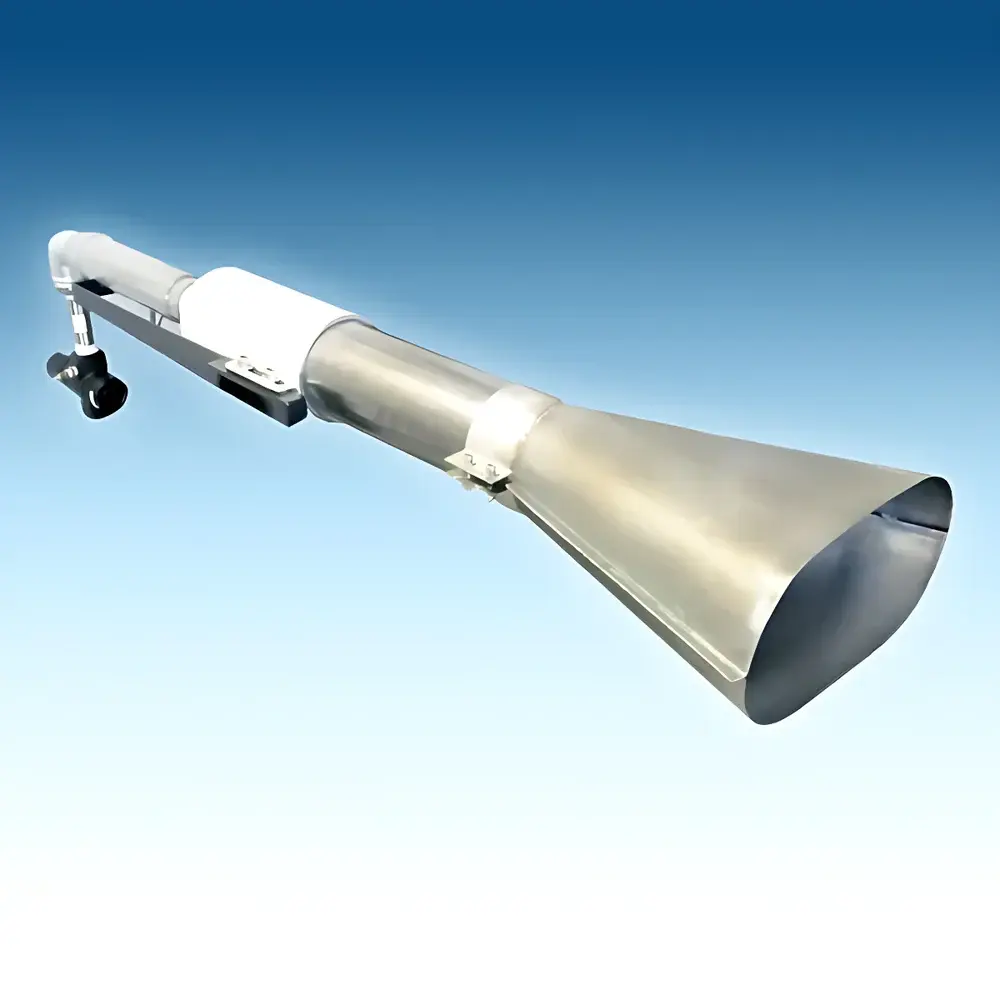
NexGen Aviation Fuel Burner ME1500-3
| Origin | USA |
|---|---|
| Manufacturer Type | Authorized Distributor |
| Origin Category | Imported |
| Model | ME1500-3 |
| Pricing | Available Upon Request |
Overview
The NexGen Aviation Fuel Burner ME1500-3 is a FAA-qualified, precision-engineered combustion source designed specifically for regulatory fire safety testing of aircraft interior materials and components. Developed under FAA guidance to replace discontinued legacy burners—including the Park DPL 3400, Lennox OB-32, and Carlin 200 CRD—the NexGen system maintains full operational fidelity to prior-generation burner physics while incorporating modern instrumentation architecture for traceable fuel and oxidizer delivery control. It operates on the principle of controlled turbulent diffusion flame generation using aviation turbine fuel (Jet A or Jet A-1) under precisely regulated mass flow, pressure, and preheat conditions. This ensures repeatable flame geometry, thermal flux distribution, and residence time—critical parameters governing heat transfer and ignition response in standardized flammability assessments. The burner is not a standalone analyzer but a certified, calibrated combustion stimulus integrated into full-scale test rigs compliant with airworthiness certification requirements.
Key Features
- FAA-recognized design per Advisory Circular AC 25.853-1 and AC 25.855-1, validated against original DPL 3400 performance benchmarks
- Integrated digital mass flow controllers for aviation fuel (±0.5% FS accuracy) and compressed air (±0.8% FS), enabling real-time logging of stoichiometric ratios and thermal input rate (kW)
- Modular burner head assembly compatible with multiple test fixtures: horizontal seat cushion assemblies, vertical insulation panels, cargo liner specimens, flexible/hard ducting, and electrical harness configurations
- Preheated air supply system (up to 150 °C) with PID-controlled temperature stability (±2 °C), replicating in-flight ambient thermal boundary conditions
- Structural frame engineered for ISO 17025-accredited laboratory environments, including seismic anchoring points and ESD-safe grounding provisions
- Firmware-upgradable controller platform supporting future FAA-mandated protocol revisions without hardware replacement
Sample Compatibility & Compliance
The ME1500-3 supports specimen geometries ranging from 305 mm × 305 mm flat panels to 3D structural assemblies up to 1.2 m in height. It interfaces seamlessly with ASTM E162 (Radiant Panel), ASTM D5132 (Vertical Burn), and FAA-specific test fixtures per AC 25.853 Appendix 1. Regulatory compliance includes FAR 25.853(a)–(d), FAR 25.855, FAR 25.863 (Cargo Compartment Liners), FAR 25.867 (Electrical Wiring Interconnection Systems), and harmonized standards MH/T 6086–2019, HB 7263–2014, MH/T 6041–2006, GB/T 25352–2010, and HB 7044–2001. All calibration procedures follow NIST-traceable protocols; burner output verification is performed quarterly using thermocouple arrays and infrared thermography per FAA Order 8110.4B.
Software & Data Management
The embedded control interface runs on a deterministic real-time OS with dual-channel data acquisition (100 Hz sampling). Logged parameters include fuel mass flow (g/min), air mass flow (SLPM), preheat temperature (°C), chamber backpressure (kPa), and flame impingement distance (mm). Export formats include CSV and XML compliant with ASTM E2911-22 for audit-ready reporting. Full audit trail functionality meets FDA 21 CFR Part 11 requirements for electronic records, including user authentication, session locking, and immutable timestamped event logs. Software updates are delivered via secure SFTP and require dual-signature authorization for installation.
Applications
- Flame spread and burn-through resistance evaluation of polymeric seat cushions, armrests, and headrest foams
- Thermal barrier integrity testing of fiberglass/aluminum honeycomb insulation systems under sustained radiant + convective heating
- Fire propagation assessment of cargo compartment liners, including edge ignition and lateral flame travel metrics
- Fire containment validation of flexible ducting, wire bundles, and electro-mechanical actuators subjected to direct flame impingement
- Developmental screening of intumescent coatings and nanocomposite flame retardants under representative flight-condition thermal loads
FAQ
Is the ME1500-3 approved for use in FAA Designated Engineering Representative (DER) evaluations?
Yes—the burner is listed in FAA Order 8110.4B Appendix B as an acceptable means of compliance for FAR 25.853 through 25.867 testing when operated within its certified configuration and calibration window.
Does the system support automated test sequence execution per ASTM E162-21?
It provides synchronized trigger outputs for external radiant panel controllers and high-speed imaging systems, but does not embed ASTM E162 logic; sequence orchestration requires integration with third-party test management software.
What maintenance intervals are required to maintain FAA recognition?
Fuel nozzle inspection every 50 operational hours; full calibration verification every 90 days or after any component replacement affecting flow dynamics or thermal profile.
Can the burner be configured for alternative fuels such as HEFA-SPK or FT-SPK?
Only Jet A and Jet A-1 are qualified per current FAA acceptance; alternate fuel qualification requires separate engineering review and thermal output validation per AC 25.1309-1.
Is remote diagnostics supported for global laboratory networks?
Yes—via TLS 1.3-encrypted VNC access with role-based permissions; diagnostic logs include spectral analysis of flame luminosity and dynamic pressure harmonics for predictive maintenance alerts.
Related Products



