
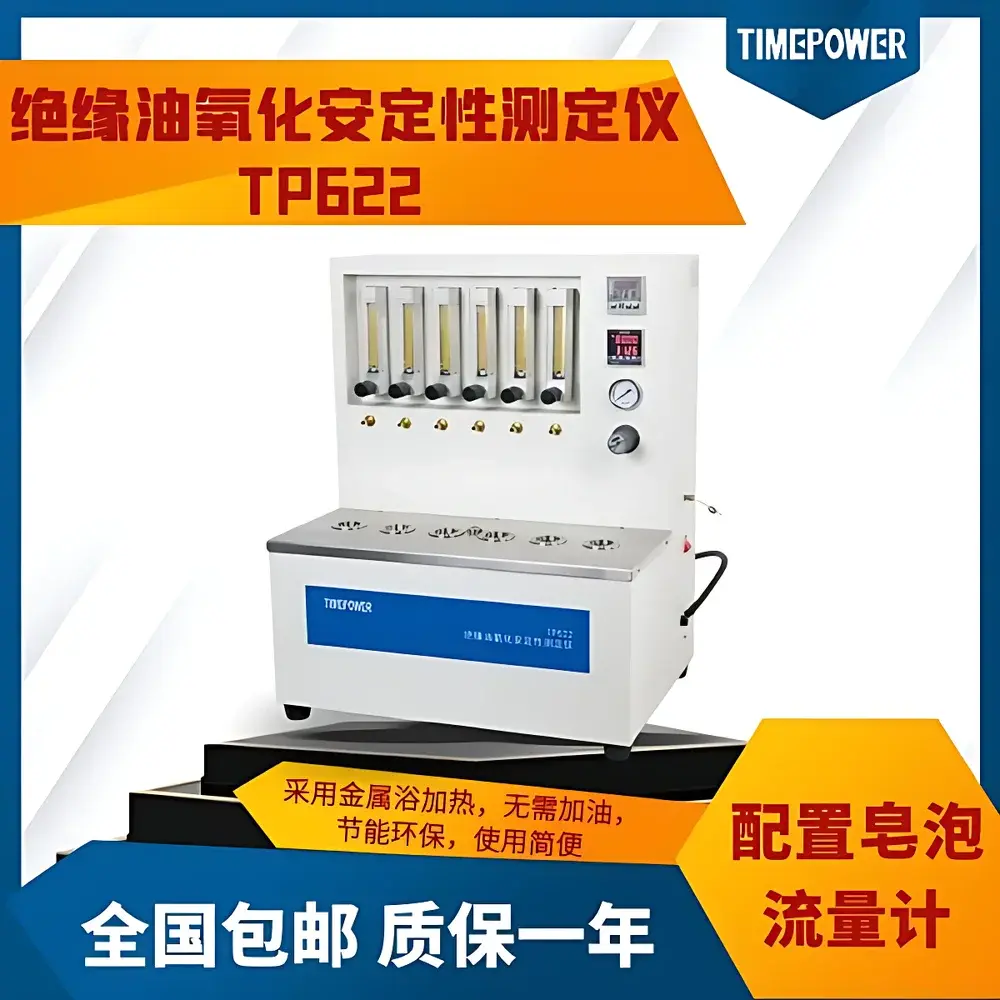
TimePower TP622 Insulating Oil Oxidation Stability Tester
| Brand | TimePower |
|---|---|
| Origin | Beijing, China |
| Manufacturer | TimePower (Beijing Shidai Xinwei Measurement & Control Equipment Co., Ltd.) |
| Type | TP622 |
| Compliance Standards | SH/T 0811, SH/T 0206 |
| Heating Method | Precision Metal Bath (Oil-Free) |
| Temperature Control | PID-Based with ±0.1 °C Stability |
| Safety Features | Dual-Stage Over-Temperature Protection |
| Gas Flow Monitoring | Calibrated Soap-Bubble Flowmeter (±2% accuracy) |
| Timing Function | Programmable Digital Timer with Auto-Start/Stop |
| Certification Support | NIST-Traceable Calibration Certificate Available |
Overview
The TimePower TP622 Insulating Oil Oxidation Stability Tester is an automated benchtop instrument engineered for quantitative evaluation of oxidative degradation resistance in electrical insulating oils—primarily mineral-based transformer oils. It operates on the principle of accelerated oxidation under controlled elevated temperature, oxygen flow, and catalytic copper wire exposure, per the standardized gravimetric and acid number tracking methodology defined in SH/T 0811 (equivalent to ASTM D2440 for oxidized sludge quantification) and SH/T 0206 (aligned with IEC 61125 and ASTM D94). The system subjects a precisely weighed oil sample to continuous oxygen sparging at 100 °C (or user-defined setpoint within 90–120 °C range) for up to 168 hours, while monitoring mass change of copper catalyst and/or measuring acid number increase at prescribed intervals. This enables direct assessment of oil’s ability to resist sludge formation, acid generation, and viscosity drift—key failure indicators in power transformer service life prediction.
Key Features
- Metal-bath heating architecture eliminates thermal oil maintenance, reduces fire hazard, and ensures uniform temperature distribution across all reaction vessels (±0.1 °C stability after PID convergence)
- Integrated soap-bubble flowmeter calibrated to ISO 2533 for real-time oxygen flow verification (range: 0.1–1.0 L/min, accuracy ±2% FS), critical for reproducible oxidation kinetics
- Dual independent over-temperature cutoff circuits (mechanical and electronic) compliant with IEC 61010-1 safety requirements for laboratory equipment
- Programmable digital timer with event-triggered logging—supports multi-step test protocols including pre-heating, oxidation phase, and post-test cooldown sequencing
- Modular reaction vessel assembly accommodating standard 300-mL glass oxidation cells with copper coil immersion fixtures per SH/T 0206 geometry specifications
- Front-panel interface with LED status indicators for temperature, gas flow, and timer; designed for unattended operation in QC labs operating under ISO/IEC 17025 workflows
Sample Compatibility & Compliance
The TP622 is validated for use with naphthenic and paraffinic mineral insulating oils meeting IEC 60296 or ASTM D3487 specifications. It supports testing of inhibited and uninhibited formulations, including those containing DBPC (di-tert-butyl-p-cresol) or 2,6-di-tert-butylphenol antioxidants. All operational parameters—including temperature ramp rate, dwell time, oxygen purity (≥99.5%), and copper catalyst mass—are traceable to SH/T 0811 Annex A and SH/T 0206 Section 5 procedural requirements. The instrument’s design facilitates full audit readiness for GLP-compliant laboratories: calibration records, operator ID logging (via optional external USB keyboard), and raw data export support alignment with FDA 21 CFR Part 11 principles when paired with TimePower’s optional LIMS-integrated software module.
Software & Data Management
While the base TP622 operates via embedded firmware without mandatory PC connectivity, optional TimePower LabLink™ software (v3.2+) enables comprehensive test method configuration, real-time parameter visualization, and automated report generation in PDF/CSV formats. Data fields include timestamped temperature logs, cumulative oxygen consumption, observed mass loss/gain of copper catalyst, and calculated oxidation induction period (OIP). All exported files embed digital signatures and revision-controlled metadata to satisfy ISO 17025 clause 7.8.2 documentation integrity requirements. Audit trails record user login, method modification history, and calibration event timestamps—fully compatible with enterprise quality management systems (QMS) deployed in utility and OEM transformer manufacturing environments.
Applications
- Quality release testing of new transformer oil batches prior to filling (per IEEE C57.106)
- Condition monitoring of in-service oils during routine maintenance sampling
- Evaluation of antioxidant depletion kinetics in aged oil reclamation studies
- Comparative screening of alternative base oils or additive packages during R&D
- Supporting root-cause analysis of sludge-related transformer failures in forensic diagnostics
- Academic research on oxidation pathway inhibition mechanisms using model compounds
FAQ
Does the TP622 comply with international standards beyond Chinese national standards?
Yes—the test methodology aligns with ASTM D2440 (sludge measurement), ASTM D94 (acid number), IEC 61125 (oxidation stability of insulating liquids), and ISO 4263-2 (lubricants oxidation testing), enabling cross-border data acceptance.
Is copper catalyst preparation specified in the manual?
Yes—SH/T 0206 mandates 1.0 g of standardized 0.8 mm diameter copper wire, cleaned per ASTM D664 procedure, coiled into a defined geometry; the TP622 fixture ensures consistent immersion depth and surface area exposure.
Can the instrument be used for turbine oils or other lubricants?
While optimized for insulating oils, the TP622 may be adapted for turbine oils per ASTM D94 or D2272 with protocol adjustments; validation per ASTM D4310 is required prior to reporting.
What documentation accompanies shipment for regulatory audits?
Each unit ships with Factory Calibration Certificate (traceable to CNAS-accredited lab), SH/T 0811/0206 Conformance Statement, Electrical Safety Test Report (IEC 61010-1), and User Manual with preventive maintenance schedule.
Is remote firmware update supported?
Firmware updates require local USB connection and are performed using TimePower’s certified Configuration Utility v2.4+, with version rollback capability and SHA-256 integrity verification.





