
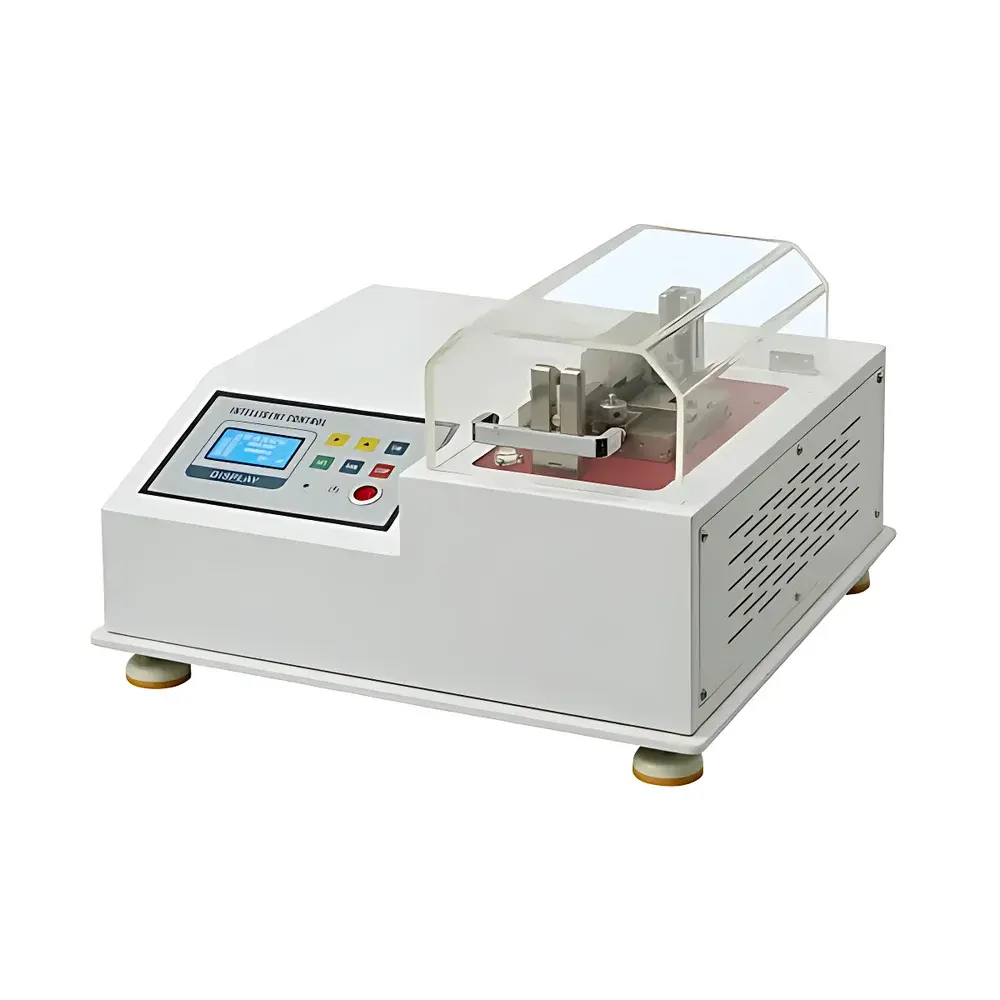
ISO 5981 Crease Resistance Tester (HY-727)
| Brand | HENGYU |
|---|---|
| Origin | Tianjin, China |
| Model | HY-727 |
| Load Plates | 5 N ±0.1 N / 10 N ±0.2 N |
| Cycle Frequency | 144–180 cycles/min (2.4–3.0 Hz) |
| Dimensions (L×W×H) | 50×50×32 cm |
| Weight | 60 kg |
| Power Supply | AC 220 V, 50 Hz, 500 W |
| Operating Environment | 20 ±2 °C, 65 ±4 % RH |
| Compliance | ISO 5981, PSA D 42 1007, EASC 9904 0180-A08 §3.25, NF G 37-110 |
Overview
The ISO 5981 Crease Resistance Tester (HY-727) is a precision mechanical fatigue testing instrument engineered to quantify the resistance of coated textile substrates—particularly leather, synthetic leather, and rubber- or polyurethane-coated fabrics—to repeated flexing and creasing under controlled compressive load. It operates on the principle of reciprocating plate motion, where a standardized test specimen is clamped between two parallel plates; one plate oscillates vertically at a fixed frequency while applying either 5 N or 10 N nominal static load, simulating real-world mechanical stress encountered during vehicle interior use (e.g., seat upholstery, airbag covers, door panels). Unlike tensile or abrasion testers, this device specifically replicates the multi-cycle folding deformation that initiates microcracking, whitening, delamination, or surface hazing—failure modes directly correlated with end-user perception of material durability. Its design conforms strictly to the kinematic and metrological requirements defined in ISO 5981:2004, which specifies test parameters including stroke amplitude, dwell time, load tolerance, and environmental conditioning protocols.
Key Features
- Two selectable static load configurations: 5 N ±0.1 N and 10 N ±0.2 N, each traceable to national force calibration standards;
- Adjustable oscillation frequency range: 144–180 cycles per minute (2.4–3.0 Hz), maintained within ±1% stability over continuous operation;
- Robust cast-aluminum frame with vibration-dampened base, minimizing external interference and ensuring cycle-to-cycle repeatability;
- Digital counter with auto-stop function, programmable up to 999,999 cycles, supporting both preset endpoint testing and time-based validation;
- Integrated thermal and humidity monitoring interface (optional RS-232/USB output) for synchronized environmental logging per ISO 291 and ASTM D4332 compliance;
- Modular sample holder accommodates specimens up to 100 mm × 100 mm, compatible with standard cutting dies per ISO 3758 and ISO 13934-1.
Sample Compatibility & Compliance
The HY-727 is validated for testing flexible, anisotropic planar materials including but not limited to: thermoplastic polyurethane (TPU)-coated polyester, PVC-laminated nylon, silicone-impregnated leather, and elastomeric nonwovens used in automotive safety systems. Specimen thickness must fall within 0.3–3.0 mm to ensure uniform load distribution across the contact area. The instrument satisfies mandatory test method alignment with ISO 5981:2004 (Textiles — Coated fabrics — Determination of resistance to creasing), PSA D 42 1007 (Peugeot Citroën specification for interior trim durability), EASC 9904 0180-A08 §3.25 (Renault-Nissan Alliance material qualification), and NF G 37-110 (French standard for coated textile folding endurance). All test reports generated using this system are structured to support GLP-compliant documentation workflows and may be referenced in IATF 16949 internal audit evidence packages.
Software & Data Management
While the base HY-727 operates via front-panel controls, optional PC connectivity enables integration with HENGYU’s TestLink™ v3.2 software suite. This Windows-based application supports automated test sequencing, real-time cycle counting with timestamped event logging, and export of raw data in CSV and XML formats compliant with ASTM E2500-17 Annex A2. Audit trails record operator ID, calibration date, environmental readings, and parameter lock status—meeting FDA 21 CFR Part 11 requirements when configured with electronic signatures and role-based access control. Data files include embedded metadata referencing ISO/IEC 17025:2017 clause 7.8.2 for result traceability.
Applications
- Qualification of automotive interior trim materials against OEM-specific durability gates;
- Comparative benchmarking of coating adhesion integrity before and after aging (e.g., UV, heat, humidity exposure);
- Root cause analysis of field returns related to surface cracking or grain distortion;
- Supporting R&D development of low-VOC, high-flexibility PU formulations;
- Pre-certification testing for UN Regulation No. 118 (flammability + mechanical durability of interior materials).
FAQ
What environmental conditions must be maintained during testing?
Testing shall be conducted in a conditioned laboratory environment at 20 ±2 °C and 65 ±4 % relative humidity, as specified in ISO 291 and required by ISO 5981 Clause 6.2. Specimens must equilibrate for ≥24 h prior to mounting.
Is calibration certification included with delivery?
Each unit ships with a factory-issued calibration report covering load cell verification (per ISO 376 Class 0.5) and frequency accuracy (traceable to NIM, China). Annual recalibration is recommended per ISO/IEC 17025:2017 Section 6.5.
Can the tester accommodate non-standard specimen geometries?
Yes—custom fixture inserts are available upon request for specimens exceeding 100 mm × 100 mm or requiring edge restraint; dimensional constraints must be reviewed with HENGYU Application Engineering prior to modification.
Does the system meet electromagnetic compatibility (EMC) requirements for lab integration?
The HY-727 complies with EN 61326-1:2013 for laboratory equipment, including radiated emissions (Class B) and electrostatic discharge immunity (IEC 61000-4-2 Level 3).
How is test failure defined per ISO 5981?
Failure is objectively determined upon first observation of visible surface defects—including fissures, coating separation, or permanent set exceeding 1.5 mm depth measured with calibrated depth gauge—under 10× magnification, following Clause 8.3 of the standard.



