
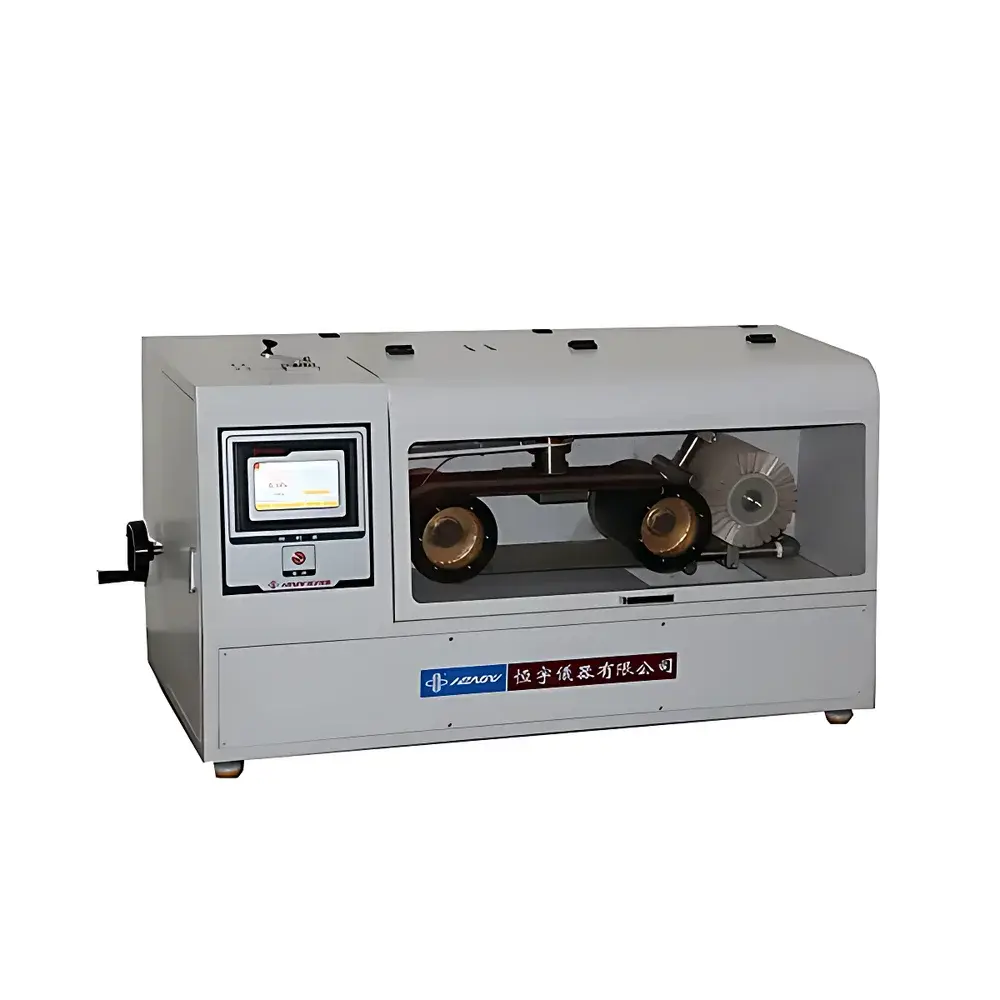
Hengyu HY-7520-1 EN 13595-2 Knee Protector Abrasion Tester
| Brand | Hengyu |
|---|---|
| Origin | Tianjin, China |
| Manufacturer Type | Authorized Distributor |
| Regional Classification | Domestic (China) |
| Model | HY-7520-1 |
| Pricing | Upon Request |
| Standards Compliance | EN 13595-2, EN 14120, GB/T 24278–2019 |
| Abrasive Belt Speed | 2–8 m/s |
| Abrasion Head Diameter | 40 mm |
| Effective Abraded Area | 1963 mm² |
| Drop Height | 50 ± 5 mm |
| Applied Load | 49 N (via calibrated weights, excluding pneumatic lift mechanism mass) |
| Standard Reference Fabric | Provided cotton duck cloth (EN-compliant) |
| Abrasive Belts | P60 and P120 grit aluminum oxide belts |
Overview
The Hengyu HY-7520-1 EN 13595-2 Knee Protector Abrasion Tester is a precision-engineered mechanical test system designed to evaluate the abrasion resistance of protective textile layers used in occupational and motorcycling knee protectors, as specified in EN 13595-2:2002 + A1:2010 and complementary standards including EN 14120 and GB/T 24278–2019. The instrument operates on a controlled oscillatory abrasion principle: a motor-driven abrasive belt moves at a regulated linear velocity beneath a vertically loaded, rotating abrasion head. This configuration replicates real-world dynamic contact conditions—such as sliding impact against rough surfaces during falls—where knee protection materials are subjected to localized shear and wear. Unlike rotary drum or Martindale-type testers, the HY-7520-1 employs a fixed-axis, gravity-loaded friction head with defined kinematic constraints, ensuring high reproducibility across laboratories and alignment with the standardized test geometry mandated by EN 13595-2. Its architecture prioritizes mechanical stability, load fidelity, and dimensional repeatability—critical for pass/fail assessment under regulatory certification workflows.
Key Features
- Motor-driven abrasive belt system with adjustable linear speed (2–8 m/s), digitally regulated via closed-loop tachometric feedback to maintain ±0.1 m/s tolerance over extended test durations.
- Standardized abrasion head with 40 mm effective wear diameter and precisely engineered contact geometry, conforming to EN 13595-2 Annex B specifications for force distribution and surface engagement.
- Gravity-based loading mechanism utilizing calibrated stainless-steel weights; nominal applied force of 49 N (equivalent to 5.0 kgf), traceable to national mass standards and independent of pneumatic or hydraulic actuation variables.
- Controlled drop-height assembly (50 ± 5 mm) ensures consistent kinetic energy transfer upon initial contact between specimen and abrasive surface—essential for simulating impact-initiated wear scenarios.
- Interchangeable P60 and P120 aluminum oxide abrasive belts, supplied with batch-certified grit uniformity and substrate adhesion performance, enabling comparative evaluation across material classes and finish types.
- Included EN-compliant reference cotton duck fabric for inter-laboratory calibration and method verification, supporting measurement uncertainty estimation per ISO/IEC 17025 requirements.
Sample Compatibility & Compliance
The HY-7520-1 accommodates flat, flexible textile specimens up to 150 mm × 150 mm, mounted on rigid backing plates to prevent buckling or lateral displacement during abrasion. It supports layered composites typical of CE-marked motorcycle PPE (e.g., aramid-reinforced outer shells with thermoplastic or viscoelastic impact absorbers). All mechanical dimensions—including effective abraded area (1963 mm²), head profile radius, and belt tracking alignment—are verified against EN 13595-2 Figures 1 and 2. The system is validated for use in accredited testing laboratories operating under ISO/IEC 17025:2017, and its test reports are admissible for EU Type Examination (Module B) submissions under Regulation (EU) 2016/425. Documentation includes traceable calibration certificates for load cells, belt speed sensors, and height gauges.
Software & Data Management
While the HY-7520-1 operates as a standalone electromechanical platform without embedded microprocessor control, it integrates seamlessly with external data acquisition systems via analog voltage outputs (0–10 V) for belt speed and cycle counter TTL pulses. Users may log cycle counts, elapsed time, and optional external force/temperature readings using third-party software compliant with 21 CFR Part 11 (e.g., LabVIEW with audit trail modules or validated LIMS platforms). Raw test records—including start/stop timestamps, weight verification logs, and reference fabric wear metrics—are retained per GLP documentation protocols. No proprietary firmware or cloud connectivity is implemented, preserving data sovereignty and simplifying IQ/OQ validation for regulated environments.
Applications
- Pre-certification abrasion screening of knee protectors for EN 13595-2 Class 1 and Class 2 compliance.
- Comparative durability analysis of novel high-performance fibers (e.g., Dyneema®, Vectran®, bio-based polyesters) versus conventional nylon or polyester substrates.
- Quality control testing in manufacturing facilities producing CE-marked motorcycle PPE, aligned with internal AQL sampling plans per ISO 2859-1.
- Research into textile–abrasive interface mechanics, including coefficient-of-friction evolution and mass loss kinetics under variable load/speed regimes.
- Supporting technical documentation for Notified Body audits, including uncertainty budgets for abrasion cycles-to-failure and inter-operator reproducibility studies.
FAQ
Does the HY-7520-1 comply with the latest revision of EN 13595-2?
Yes—the mechanical configuration, load application method, and geometric tolerances fully satisfy EN 13595-2:2002+A1:2010, the current harmonized standard referenced in the EU OJ for motorcycle PPE.
Can the tester be used for standards beyond EN 13595-2?
It is directly applicable to EN 14120 (protective gloves) and GB/T 24278–2019 (Chinese national standard for protective clothing abrasion), provided specimen mounting fixtures are adapted per clause-specific requirements.
Is calibration certification included with delivery?
Each unit ships with a factory calibration report covering load verification (49 N), drop-height measurement (50 ± 5 mm), and belt speed linearity (2–8 m/s), traceable to CNAS-accredited metrology institutes.
What maintenance is required to ensure long-term accuracy?
Routine inspection of belt tension, head bearing play, and weight set integrity is recommended quarterly; full recalibration is advised every 12 months or after 500 test cycles, whichever occurs first.
Are replacement abrasive belts and reference fabrics available through Hengyu?
Yes—original-specification P60/P120 belts and certified cotton duck reference fabric are stocked and supplied with batch-specific conformity statements.



