
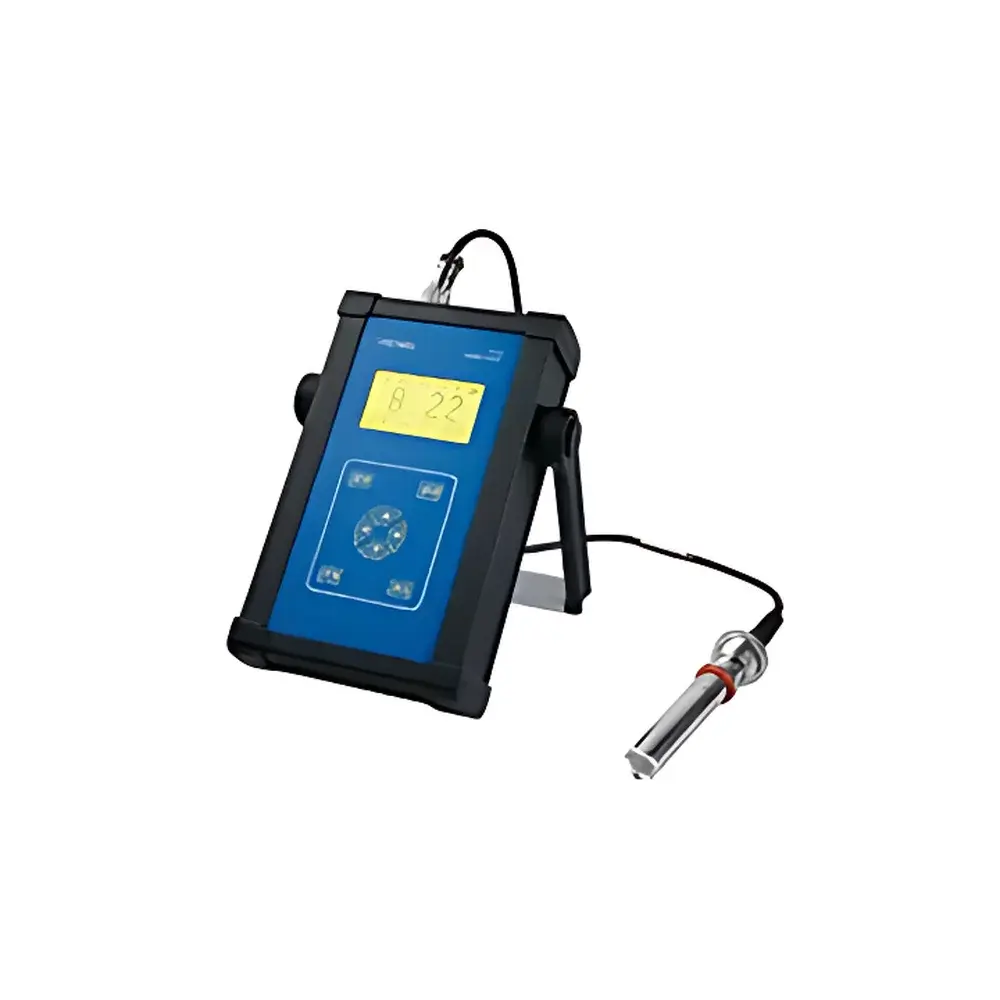
Timepower TP350 Portable Microgram-Level Dissolved Oxygen Meter
| Brand | Timepower |
|---|---|
| Origin | Beijing, China |
| Manufacturer Type | Direct Manufacturer |
| Instrument Type | Portable |
| Measurement Principle | Electrochemical Clark-type Polarographic Sensor |
| Measurement Range | 0.0–100 µg/L (microgram per liter), auto-ranging up to 20.00 mg/L |
| Accuracy | ±1.0% FS |
| Repeatability | ≤1% |
| Detection Limit | ±2 ppb |
| Response Time (T90) | <5 min at 25 °C |
| Temperature Compensation Range | 0–60.0 °C |
| Sample Temperature Range | 5–45 °C |
| Environmental Operating Range | 5–45 °C, ≤90% RH (non-condensing) |
| Display | 128×64 LCD, Chinese interface |
| Power Supply | AC 85–265 V, 45–65 Hz |
| Power Consumption | ≤1 W |
| IP Rating | IP65 |
| Dimensions | 285 × 60 × 255 mm |
| Weight | 2.28 kg |
| Data Storage | Cyclic non-volatile memory, >10 years retention after power loss |
| Battery Life | Up to 8 hours continuous operation (internal rechargeable battery) |
Overview
The Timepower TP350 Portable Microgram-Level Dissolved Oxygen Meter is an electrochemical analytical instrument engineered for high-precision, field-deployable measurement of dissolved oxygen (DO) in aqueous solutions across ultra-trace to low-milligram concentration ranges. It operates on the Clark-type polarographic principle: molecular oxygen diffuses through a gas-permeable membrane—constructed from fluorinated polymer (e.g., PTFE) and polyethylene—into an internal electrolyte chamber containing a platinum working electrode and a silver/silver chloride or lead reference electrode. Under a fixed polarizing voltage, oxygen reduction generates a diffusion-limited current proportional to the partial pressure of dissolved O₂. This current is digitized via a 24-bit analog-to-digital converter and temperature-compensated using an integrated Pt1000 sensor, enabling accurate quantification down to sub-ppb detection levels. Designed specifically for applications requiring microgram-per-liter sensitivity—such as ultrapure water monitoring in pharmaceutical manufacturing, boiler feedwater control in power generation, and low-oxygen process validation—the TP350 delivers laboratory-grade reproducibility in a rugged, handheld form factor compliant with IP65 environmental protection standards.
Key Features
- Microgram-level resolution: 0.1 µg/L in the 0.0–100 µg/L range, supporting compliance with ASTM D888, ISO 5814, and USP for ultrapure water testing.
- Polarographic sensor architecture with imported membrane assembly: short response time (T90 <5 min at 25 °C), thermal stability up to 45 °C sample temperature, and resistance to fouling in low-conductivity matrices.
- Integrated Pt1000 temperature sensor enabling automatic, linear compensation across 0–60.0 °C—critical for maintaining accuracy in variable ambient conditions.
- High-integrity electronics: surface-mount technology (SMT), single-chip microcontroller architecture, and low-power design (<1 W nominal consumption) ensuring stable operation during extended field deployments.
- Non-volatile data storage with 10+ year retention: cyclic buffer automatically overwrites oldest records; supports traceability under GLP/GMP environments where audit trails are required.
- Intuitive Chinese-language menu system on 128×64 monochrome LCD—designed for rapid operator training and error-minimized field use without reliance on external PCs.
- Robust mechanical construction: compact footprint (285 × 60 × 255 mm), lightweight chassis (2.28 kg), and IP65-rated enclosure suitable for outdoor, plant-floor, and mobile laboratory applications.
Sample Compatibility & Compliance
The TP350 is validated for use with deionized water, condensate, boiler feedwater, semiconductor rinse water, and other low-conductivity (<5 µS/cm), low-organic-content aqueous streams. Its polarographic sensor avoids zero-current drift associated with galvanic cells and maintains calibration stability over extended periods when operated within specified temperature and flow regimes. The instrument meets general requirements for portable field instrumentation per IEC 61000-6-2 (EMC immunity) and IEC 61000-6-3 (EMC emission). While not pre-certified to FDA 21 CFR Part 11, its data logging architecture—including timestamped records, user-accessible storage history, and no remote write capability—supports implementation of electronic signature and audit trail protocols required for regulated environments. Calibration verification may be performed using Winkler titration (ISO 5813) or saturated air-saturated water standards (ASTM D888 Method B).
Software & Data Management
Data acquisition and configuration are managed entirely via the onboard interface—no proprietary PC software is required. All measurements are timestamped and stored in chronological sequence. Users may scroll, review, and export historical readings directly from the display. Memory management follows a first-in-first-out (FIFO) policy; overflow entries are overwritten automatically, eliminating manual file maintenance. For integration into centralized SCADA or LIMS platforms, optional RS232/USB output modules (sold separately) provide ASCII-formatted serial output compatible with Modbus RTU or custom parsing scripts. Raw current output (4–20 mA) is available via analog port for connection to PLCs or chart recorders—enabling continuous DO trending without host dependency.
Applications
- Pharmaceutical water systems: monitoring TOC-free purified water (PW) and water for injection (WFI) per USP and EU GMP Annex 1.
- Power plant chemistry control: real-time tracking of dissolved oxygen in condensate and feedwater to prevent corrosion in steam cycles.
- Semiconductor fab ultrapure water loops: verifying sub-5 µg/L DO thresholds prior to point-of-use filtration.
- Research laboratories: kinetic studies of oxygen consumption in enzymatic or microbial assays requiring stable, low-drift baseline measurement.
- Environmental field surveys: profiling hypolimnetic oxygen depletion in stratified lakes or assessing reaeration rates in constructed wetlands.
FAQ
How often must the DO membrane and electrolyte be replaced?
Membrane replacement is recommended every 2–3 months under continuous use or immediately following mechanical damage, exposure to solvents, or performance degradation (e.g., prolonged T90, unstable zero). Electrolyte should be refreshed concurrently; full polarization and two-point calibration are mandatory after each service.
Can the TP350 measure in flowing versus static samples?
Yes—but optimal accuracy requires controlled flow: 10–30 cm/s linear velocity across the membrane surface. Use rigid tubing (e.g., stainless steel or PFA) instead of silicone or PVC to prevent atmospheric oxygen permeation, especially below 10 µg/L.
Is temperature compensation automatic or manual?
Fully automatic, using the built-in Pt1000 sensor. No user input is required; compensation algorithm applies Nernst-derived correction across the full 0–60.0 °C range.
What calibration standards are recommended?
Zero-point calibration uses sodium sulfite (Na₂SO₃) solution saturated with nitrogen; span calibration employs air-saturated water at known barometric pressure and temperature, calculated per ISO 5814 or APHA Standard Methods 4500-O G.
Does the instrument support regulatory audit trails?
While native firmware does not include electronic signatures, all stored data includes date/time stamps and cannot be edited or deleted remotely—providing foundational traceability. Integration with external LIMS via serial output enables full 21 CFR Part 11-compliant workflows when paired with validated middleware.







