Petroleum Demulsibility Tester TP651 by TimePower
| Brand | TimePower |
|---|---|
| Origin | Beijing, China |
| Manufacturer Type | Manufacturer |
| Country of Origin | Domestic (China) |
| Model | TP651 |
| Price | Upon Request |
| Temperature Range | Ambient to 100 °C |
| Temperature Accuracy | ±2 °C |
| Temperature Repeatability | ≤4 °C |
| Temperature Resolution | 0.1 °C |
| Stirring Duration | 5 min (fixed) |
| Stirring Depth | 6 mm above cylinder bottom |
| Cylinder Capacity | 100 mL |
| Power Supply | AC 220 V ±10%, 50 Hz ±10% |
| Power Consumption | ≤1600 W |
| Dimensions (W×D×H) | 510 mm × 360 mm × 580 mm |
| Net Weight | 23.5 kg |
| Operating Environment | 5–40 °C, RH ≤85% |
Overview
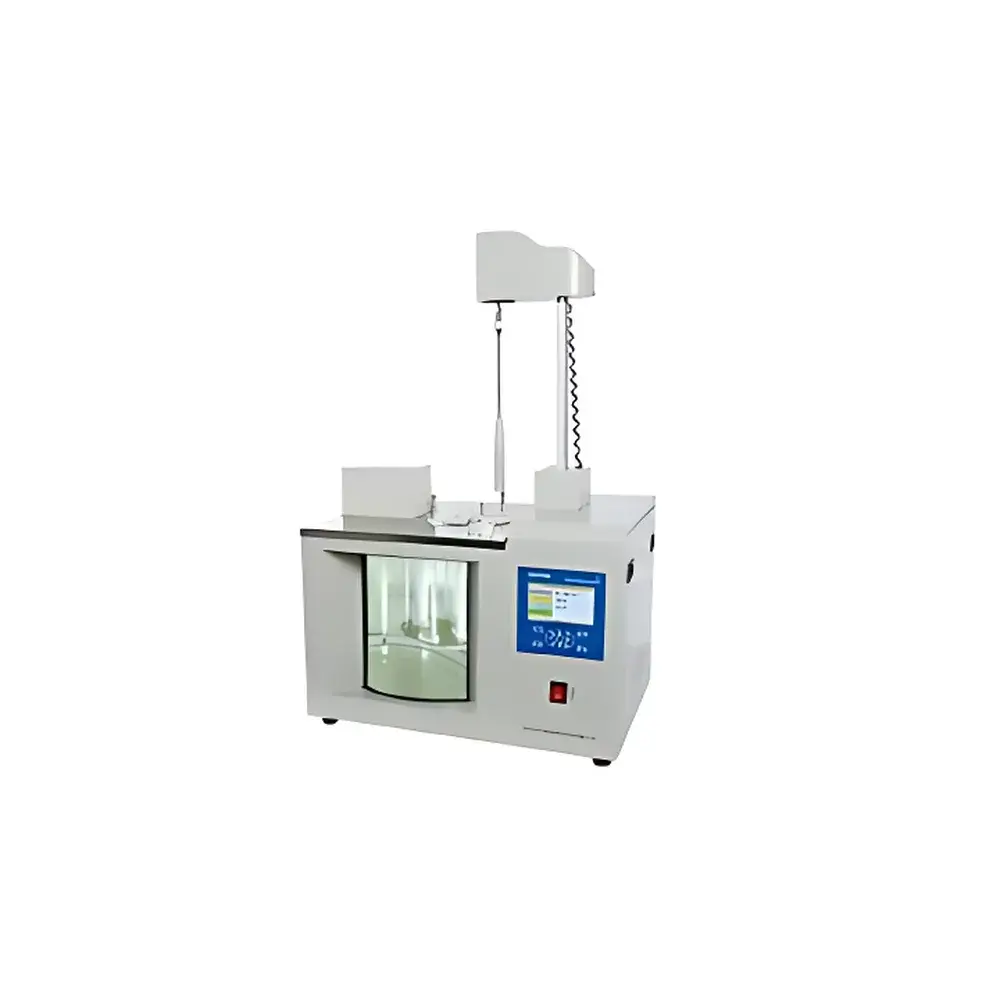
The TimePower TP651 Petroleum Demulsibility Tester is an automated benchtop instrument engineered for precise determination of the demulsification characteristics of petroleum products and synthetic lubricants under standardized test conditions. It operates in strict accordance with ASTM D1401 and GB/T 7305—both internationally recognized methods that quantify the time required for an oil–water emulsion to separate into distinct, measurable layers. The instrument employs a controlled water-bath heating system, programmable mechanical stirring, and synchronized timing logic to replicate industrial and regulatory test protocols. Its core measurement principle relies on visual phase separation kinetics: after a defined 5-minute agitation cycle at a precisely maintained temperature (54 °C ±1 °C for typical oils; 82 °C ±1 °C for high-viscosity fluids), the system initiates automatic elapsed-time recording until complete stratification occurs—defined as three distinct, stable layers (oil, emulsion, water) or two clear phases (oil and water) with no visible interfacial haze. This kinetic endpoint detection supports objective, operator-independent evaluation of demulsibility performance—a critical parameter for turbine oils, hydraulic fluids, and transformer insulating oils where water contamination compromises dielectric strength, oxidation stability, and bearing protection.
Key Features
- Automated dual-phase operation: Integrated microcontroller coordinates water-bath temperature regulation, electric actuator–driven stirrer arm positioning, timed agitation (5 min ±0.1 s), and post-agitation countdown with start/stop confirmation via tactile interface.
- Precision thermal control: PID-regulated water bath maintains setpoint stability within ±2 °C across the full operating range (ambient to 100 °C), with 0.1 °C resolution and real-time display on a 480×272-pixel color LCD.
- Repeatable mechanical actuation: Linear electric push rod ensures consistent stirrer immersion depth (6 mm above cylinder base) and smooth vertical travel—eliminating manual alignment errors and enhancing inter-laboratory reproducibility.
- Human-centered interface: Full Chinese-language menu navigation with contextual prompts, guided input fields, and status feedback minimizes operator training requirements while reducing procedural deviation.
- Robust mechanical architecture: Stainless-steel water bath tank, reinforced aluminum frame, and vibration-damped base support long-term use in QC laboratories and field service environments.
Sample Compatibility & Compliance
The TP651 is validated for use with petroleum-based and synthetic hydrocarbon fluids—including turbine oils (ISO VG 32–68), hydraulic oils (HL, HM, HV), and electrical insulating oils—as specified in GB/T 7305 and aligned with ASTM D1401 methodology. It accommodates standard 100 mL calibrated glass graduated cylinders conforming to ISO 4787 and ASTM E542 dimensional tolerances. All operational sequences—including temperature ramping, agitation duration, and separation timing—are programmatically locked to prevent deviation from normative test parameters. The system supports GLP-compliant documentation practices through timestamped manual endpoint confirmation, enabling traceable audit trails when integrated with laboratory notebook systems. While not inherently 21 CFR Part 11–compliant, its deterministic behavior and fixed protocol execution facilitate validation for regulated environments under internal SOPs.
Software & Data Management
The TP651 operates via embedded firmware with no external PC dependency. All control logic—including temperature setpoint management, stirrer actuation sequencing, and timer activation—is executed by an industrial-grade microcontroller unit (MCU). Data output is limited to real-time display and user-recorded endpoint times; no onboard data logging, USB export, or network connectivity is provided. For laboratories requiring electronic records, manual transcription into LIMS or Excel is standard practice. The interface design prioritizes functional reliability over digital integration—ensuring uninterrupted operation in electromagnetically noisy industrial settings and minimizing firmware-related downtime.
Applications
- Quality control of new and in-service turbine oils in power generation facilities, where rapid water separation prevents corrosion, sludge formation, and reduced film strength.
- Evaluation of additive package efficacy in anti-emulsifying agents during lubricant formulation development.
- Acceptance testing of transformer oils per IEC 60296 and GB/T 7595, where demulsibility correlates directly with moisture removal efficiency in on-line filtration systems.
- Comparative assessment of used oil samples to detect degradation-induced surfactant accumulation or oxidation byproduct formation.
- Regulatory conformance testing for commercial lubricants supplied to petrochemical refineries, marine engine manufacturers, and rail infrastructure operators.
FAQ
What standards does the TP651 comply with?
It is designed and verified for execution of GB/T 7305 and is functionally equivalent to ASTM D1401 test procedures.
Can the instrument be used for non-petroleum synthetic fluids?
Yes—provided the fluid’s viscosity and density fall within the operational envelope of the 100 mL cylinder and stirrer geometry, and test temperature remains within the 54–82 °C range specified in applicable standards.
Is calibration certification included with purchase?
The unit ships with factory temperature verification at 54 °C and 82 °C using NIST-traceable reference thermometers; formal calibration certificates are available upon request at additional cost.
How is the separation endpoint determined?
Endpoint is manually confirmed by the operator observing complete phase separation—typically defined as ≥90% volume clarity in both oil and aqueous layers, with no persistent emulsion band at the interface.
What maintenance is required for long-term accuracy?
Routine cleaning of the water bath, stirrer shaft, and cylinder holder; annual verification of temperature sensor drift using a calibrated reference probe; and periodic inspection of the electric actuator’s mechanical limit switches.